
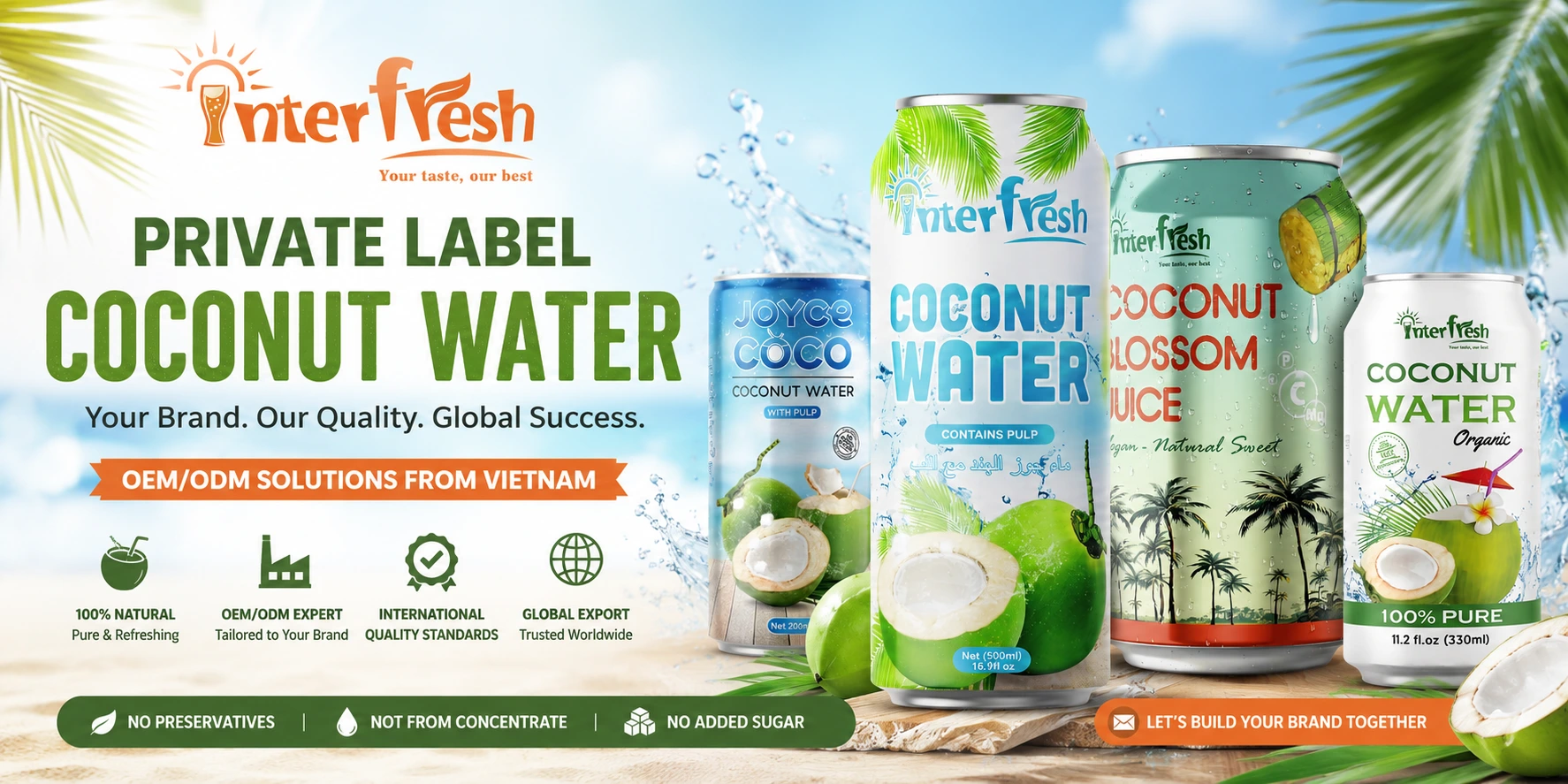
The global coconut water market
is no longer a niche health trend
It is a mainstream beverage category generating billions in annual retail value, and the private label opportunity within it is growing faster than most importers realize. Supermarket chains across Europe, health-channel distributors in North America, and specialty beverage brands throughout the Middle East and Asia-Pacific are all reaching the same conclusion: sourcing a credible, export-compliant private label coconut water product is one of the most commercially viable plays available to beverage businesses today.
This page gives serious importers, private label brand founders, and sourcing managers everything needed to evaluate our program with confidence:
- Raw material origin & formula flexibility
- Packaging options across all major formats
- Certifications & regulatory compliance
- Minimum order quantities
- From first contact to first container — step by step
Why Vietnam is the right origin for your private label coconut water
When sourcing coconut water at a manufacturing level, origin matters far more than most buyers initially appreciate. It affects raw material quality, supply chain resilience, input cost stability, and the logistical economics of export. Vietnam’s position in the global coconut water supply chain is not incidental — it is structural.
Vietnam’s coconut belt: a stable raw material foundation
Ben Tre Province, Mekong Delta — Southeast Asia’s most productive cultivation zone
Vietnam’s primary coconut-growing region, centered around Ben Tre Province in the Mekong Delta, accounts for one of Southeast Asia’s most productive and geographically concentrated coconut cultivation zones. With a harvest cycle that runs year-round without the pronounced seasonal gaps that affect other origin countries, Ben Tre provides the kind of raw material consistency that professional beverage manufacturers depend on.
For importers, this matters in a specific and practical way. A factory positioned close to its primary raw material source maintains stable input pricing, tighter incoming quality control, and faster response to demand shifts. When your production partner is sourcing from contracted farms within its own operating region, the supply chain risk profile changes significantly.
Competitive cost structure without quality compromise
Favorable vs Thailand and the Philippines — the two most commonly cited competing origins
Vietnam’s cost of manufacturing positions it favorably against both Thailand and the Philippines without the quality trade-offs that buyers sometimes fear when comparing lower-cost origins. Labor costs, energy costs, and overhead structures allow a well-organized manufacturer to offer competitive FOB pricing while maintaining the process controls and certification standards that international buyers require.
Free trade agreements providing preferential tariff access:
| Origin | Labor cost | FTA coverage (EU) | Raw material proximity | FOB pricing |
|---|---|---|---|---|
| 🇻🇳 Vietnam | Competitive | EVFTA | Farm-gate | Favorable |
| 🇹🇭 Thailand | Higher | Limited | Regional | Premium |
| 🇵🇭 Philippines | Competitive | Limited | Local | Moderate |
An established export track record
Mature infrastructure — Cat Lai Terminal, Ho Chi Minh City
Preferential tariff via EVFTA. Major entry ports: Rotterdam, Hamburg, Antwerp.
Well-established FMCG export corridor. Entry via Los Angeles, Long Beach, and East Coast ports.
Growing demand for ambient coconut beverages. Entry via Jebel Ali (Dubai) and Dammam.
Short transit window supports competitive landed cost. Entry via Sydney and Melbourne.
Cat Lai Terminal, Ho Chi Minh City
Vietnam’s beverage export infrastructure has matured considerably. Port facilities at Ho Chi Minh City handle high volumes of temperature-sensitive and ambient FMCG exports efficiently. Logistics corridors to major import markets are well-established, with reliable transit time benchmarks that allow importers to plan inventory cycles with confidence.
Product capabilities: what we manufacture and how we do it
Understanding the full scope of what a manufacturing partner can produce is essential before entering a sourcing relationship. Buyers who discover mid-process that a factory cannot support a particular format, certification, or processing method face costly delays and failed product launches.
Coconut water variants
The full range of commercially relevant product types
100% Pure coconut water
Pressed directly from fresh coconuts without reconstitution. Preserves the natural electrolyte profile and clean flavor. Ideal for premium retail channels, health food distributors, and clean-label brand positioning.
From concentrate
Tighter Brix control, extended shelf life, and more competitive unit pricing. Appropriate for mass-market private label programs, foodservice, and price-sensitive markets.
Blended & functional variants
Blended with mango, pineapple, lychee, or pink guava. Enhanced with electrolytes, collagen peptides, B vitamins, or probiotics. Available as OEM specifications or customized from our ODM base.
With pulp or jelly
Suspended coconut pulp or nata de coco inclusions. For markets where textured coconut beverages are culturally familiar or commercially differentiated.
Packaging formats
Full range relevant to international retail and distribution
Tetra Pak / Aseptic carton
Dominant in European and health channel retail. Shelf-stable without refrigeration — strong consumer familiarity in established markets.
PET bottle
Most flexible and cost-accessible format for private label entrants. Widely accepted across retail, foodservice, and e-commerce.
Aluminum can
360° print real estate for premium branding. Strong shelf presence and excellent product protection. Growing across functional beverage segments.
Pouch / Spouted pack
Popular across Asia, Middle East, and emerging markets. Lower tooling cost than cans for custom graphics.
Processing & shelf-life specifications
Every format backed by validated shelf-life data
Standard UHT aseptic processing supports ambient shelf life across all major formats. Specific parameters depend on product composition and packaging material. Brix ranges are adjustable per buyer specification.
Nutritional labeling: For buyers entering markets with strict requirements, our QA team generates format-specific nutrition panels — calculated per 100ml and per serving — formatted to the regulatory standards of your target market.
Certifications, compliance, and regulatory readiness
Certification and compliance documentation are not administrative formalities. For importers, they are the foundation of commercial risk management. A shipment that arrives at a port of entry without the correct documentation — or from a factory whose certification status is unverified — can be held, rejected, or destroyed at the importer’s cost. Getting this right begins at the factory selection stage.
What our factory holds
A comprehensive certification framework covering both facility and output
Global retail requirement
Process safety baseline
Production environment
UK & EU retail chains
Product-level certifications available
Market- and brand-appropriate certifications beyond the factory baseline
Required for any product entering the United States market. Our facility is FDA-registered and we produce FSMA-compliant supply chain documentation that US Customs requires.
Standard — included
Export certificate issued by Vietnam’s Ministry of Agriculture and Rural Development for every consignment destined for EU member states.
Standard — per consignment
Essential for market entry across the GCC, Southeast Asia, and Muslim-majority consumer segments globally. All products can be produced under our Halal-certified program.
Standard — all SKUs
Available on request, subject to certified raw material availability and appropriate lead time for sourcing and documentation.
Available on request
Kosher certification is available on request for buyers targeting Jewish consumer segments in North America, Europe, and Israel.
Available on request
Market-specific compliance support
Routinely prepared for 6 destination market groups
Standard shipment documentation package
Our export documentation team routinely prepares compliant shipment packages for the United States, European Union, GCC (with SFDA/ESMA registration support), Australia & New Zealand (FSANZ/AQIS), Japan, and South Korea.
Phytosanitary Certificate
Free Sale Certificate
Market nutrition panel
SGS / Intertek lab results
Destination market groups with routine compliance coverage
Minimum order quantities, pricing, and lead times
Transparency on MOQ, pricing structure, and production lead times is something many manufacturers are deliberately vague about — often because they are not set up to support smaller or first-time buyers. Interfresh takes a different approach.
Minimum order quantities by format
Designed to be accessible to serious private label entrants without operationally unviable run sizes
What drives unit pricing
No two private label programs are identical — pricing is built to your specification
NFC vs. concentrate raw material input
Packaging format and material specifications
Certification add-ons (organic & Kosher carry a premium)
Formula complexity for functional blends
Volume commitment across annual program
We do not publish fixed price lists, because no two private label programs are identical. Several variables move unit pricing meaningfully — from raw material choice to certification requirements and formula complexity.
We encourage buyers to share their volume projections honestly during the proposal stage — it allows us to structure pricing that reflects a genuine partnership, not just a transaction.
Volume unlocks better economics
Buyers who approach volume commitments at the 3-container-per-year level and above unlock meaningfully better FOB unit economics than single-container trial orders.
Production lead times: a realistic framework
From order confirmation to container departure
ODM
OEM / Hybrid
Custom packaging design and brand identity
A competitive private label product requires more than a liquid in a container. It requires a finished, shelf-ready product that communicates brand positioning at the point of purchase, complies with destination-market labeling regulations, and holds up through the rigors of international shipping and retail handling.
Label design and regulatory compliance review
From brand assets to press-ready artwork — without a separate design agency
Buyer supplies brand assets
Logo, color palette, and brand guidelines handed off to our design team.
Dieline & initial layout
Structural dieline templates for all supported formats. Initial label layouts produced for review.
Compliance review
Export documentation team reviews every label before print approval.
Press-ready artwork
Final approved files delivered to print — compliant, scannable, and retail-ready.
Our in-house design team provides structural dieline templates for all supported packaging formats. Buyers supply their brand assets and we produce initial label layouts for review.
Buyers who have launched private label products before will recognize how much time and cost the compliance review step can absorb when left to chance. We build it into the process as a standard deliverable.
Correctly formatted for the destination market
Meeting local regulatory requirements
Scannable at retail across target markets
Correctly allocated per format and market
Printing and structural options
Format-appropriate print methods across all supported packaging types
Shrink sleeve, pressure-sensitive label, or direct print. Each option carries different minimum run economics and brand impact considerations.
Shrink sleeve · PSL · Direct print
Full wraparound lithographic printing in up to eight colors. Maximum brand real estate and premium shelf presence for standout retail positioning.
Up to 8 colors
Standard four-color print program within Tetra Pak’s established production workflow. Clean, retail-standard output with strong consumer recognition.
4-color standard
Two high-quality print processes depending on run size and design complexity. Rotogravure offers superior color consistency for longer runs.
Flexo · Rotogravure
Structural differentiation at scale
Custom mold development and stocked can sizes for brand distinction
Custom PET bottle molds
For brands that want true structural differentiation, custom PET bottle mold development is available subject to minimum volume commitments. A proprietary bottle shape is one of the most durable brand assets in the beverage category.
Stocked can diameters
Standard can sizes are stocked as ready formats — no tooling lead time required for these options:
Standard 250ml
330ml
500ml
The sampling and approval process
The path from initial inquiry to confirmed production order follows a structured process that is designed to be low-friction for the buyer while giving both parties the information they need to proceed with confidence.
Response within 1 business day
Packaging format
Estimated volume
Certification requirements
Formula requirements
Prepared for your program
Packaging configurations
Indicative FOB pricing
Regulatory checklist
Timeline projection
7–10 business days
Label proof
Lab analysis (Brix, pH, microbio)
Formal specification sheet
DHL / FedEx express
1 revision — no charge
Regulatory advisor sign-off
Consumer panel option
One revision included
PO triggers slot booking
3 in-line QC stages
SGS / Intertek / Bureau Veritas
Buyer-nominated agency
Full docs with bill of lading
What consistency actually looks like
Buyers who have sourced from Asian manufacturers before often carry a specific anxiety: the first sample is excellent, the first container is acceptable, and by the third shipment, something has changed. Addressing this concern requires more than a general commitment to quality — it requires a documented, auditable system.
Before entering production
Continuous during production
Full microbio panel required
Certificate of Analysis — every lot
Issued for every production lot and included in the shipment documentation package as standard. No exceptions.
Retain samples
Stored for the full shelf-life duration of every batch, providing traceability in the event of a market complaint or regulatory inquiry.
Factory visits welcomed
For buyers whose internal supplier approval process includes an on-site audit, factory visits are welcomed. Our QA team is available to walk through the full production and testing process in person.
Container optimization and export documentation
Manufacturing competence and logistics competence are separate capabilities. Interfresh’s export operations team manages the full journey from production completion to container departure, and provides buyers with the information they need to manage the import leg on their side.
Ambient cargo — no reefer required
All UHT aseptic products ship as ambient cargo. No refrigerated container required — meaningfully reducing freight cost relative to chilled or frozen product categories.
Pallet optimization report
For each order we produce a report showing units per pallet, pallets per container, and container utilization rate — ensuring buyers are not paying for empty space.
Standard documentation package
Payment terms
Where private label coconut water is heading
The buyers who move early in a growing category create the advantages that are difficult for followers to overcome. Private label coconut water sits at the intersection of three powerful retail trends.
Private label share growing
High velocity, recurring
Active NPD category
Interfresh R&D supports all of these variant categories
If you have a market positioning hypothesis and need a formulation partner to bring it to shelf, that is a conversation worth having.
Why Interfresh — what makes a manufacturing partnership last
The decision to partner with a specific OEM manufacturer is, in practice, a decision about who you are going to trust with your brand’s product quality, your customers’ experience, and your business’s commercial reputation in a market. It deserves the same rigor you would apply to any significant supplier relationship.
Dedicated account manager
Every private label client is assigned a dedicated account manager from the sample stage — someone who knows your program, your target market, and your specifications, and who is accountable for continuity across orders.
Proprietary IP protection
Your custom OEM formulas are treated as proprietary IP and are never shared with or produced for any other buyer. Your formula is yours exclusively.
Full audit transparency
We welcome third-party audits, encourage factory visits, and proactively share QC data rather than waiting for problems to surface downstream.
container
annual program
& formats
Production capacity designed to grow with you
From a single 20ft container trial order to multi-container annual programs across multiple SKUs and formats.
Frequently asked questions
Direct answers to the questions serious buyers ask most often during the evaluation stage.
Still have questions?
Our export team responds to every inquiry within one business day. Share your requirements and we’ll prepare a customized proposal for your specific program.
8–10 wks
10–14 wks
7–10 days
1 business day
Ready to discuss your private label program?
The sourcing decision you make for your private label coconut water program will shape your product quality, your regulatory standing, your production cost structure, and ultimately your ability to scale. It is worth getting right from the beginning.
Retail chains
Beverage brands
First-time private label
Established programs