
Australian grocery is being reshaped by one structural force. Clean label is no longer a premium niche. It is the baseline requirement for placement in Woolworths, Coles, and the independent grocery channel.
For Australian distributors, category buyers, and FMCG importers, sourcing from a clean label beverage manufacturer Vietnam delivers a specific commercial result. It combines tropical ingredient authenticity with FSANZ-compliant production, AANZFTA zero-tariff access, and the margin structure that makes private label commercially viable at the retail shelf.
Interfresh is a certified clean label beverage manufacturer Vietnam. We produce for Australian buyers under private label, OEM, and white label models. Every product we manufacture for the Australian market is formulated without artificial additives, built to FSANZ Food Standards Code requirements, and documented to HACCP and ISO 22000 standards.
Why the Australian Market Requires a Different Manufacturing Brief
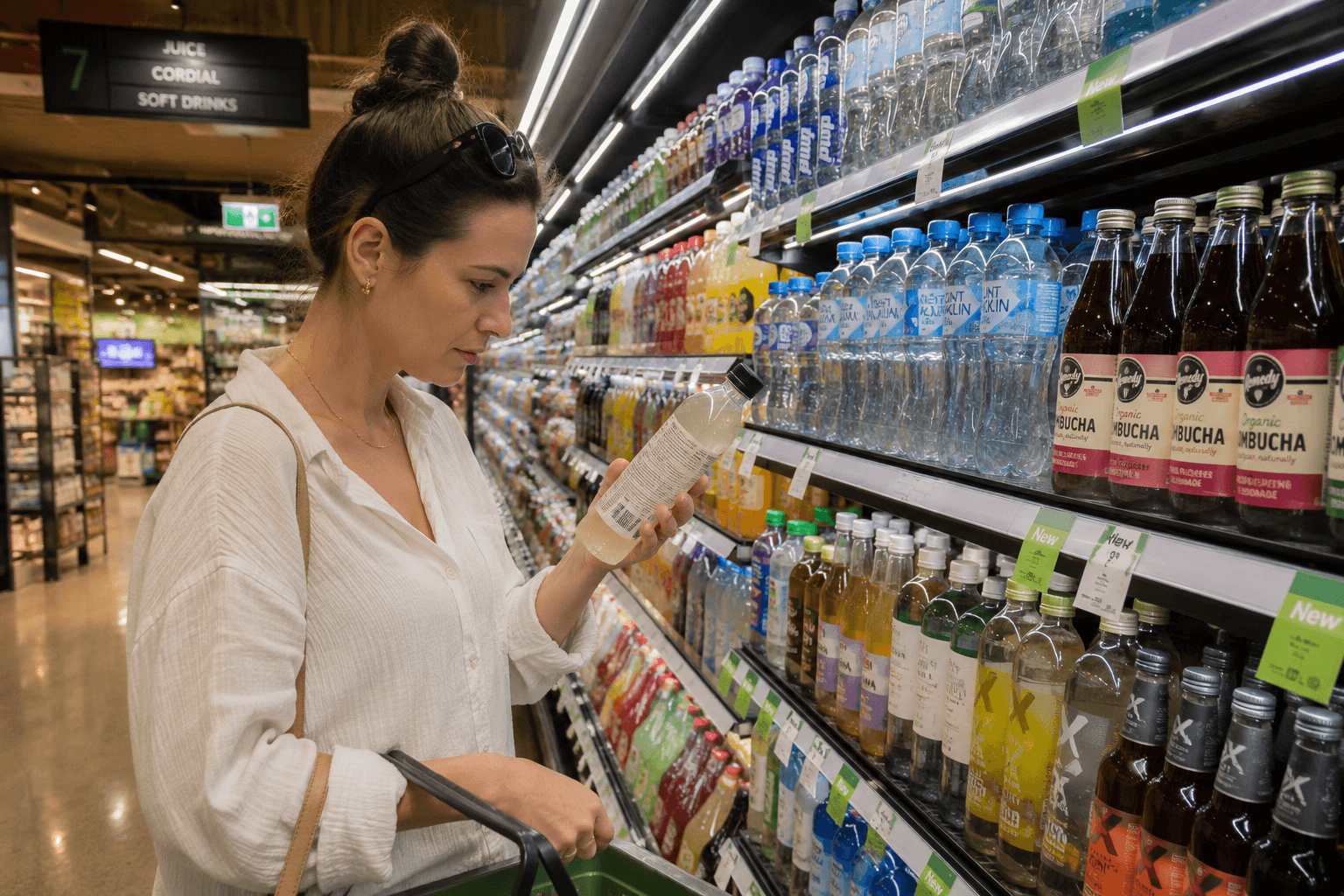
Australian retail operates under the most demanding clean label environment in the Asia-Pacific region.
The two dominant supermarket chains, Coles and Woolworths, exert significant influence on ingredient specifications through their private label programs, which now account for 18 to 22% of beverage production volume. Their focus on clean label, low sugar, and sustainable ingredients is driving formulation changes across the entire supply chain.
That influence translates into specific requirements for any supplier manufacturing beverages for Australian distribution.
- No artificial colours. Woolworths and Coles own-brand specifications explicitly exclude synthetic food dyes. All colour must come from fruit, vegetable, or plant extract. This rules out most standard Asian beverage formulations that use permitted-but-synthetic colourings.
- No artificial preservatives. Sodium benzoate, potassium sorbate, and similar synthetic preservatives are outside the clean label brief. Shelf stability must be achieved through validated thermal processing, pH control, or water activity management.
- Minimal and recognisable ingredients. The AU consumer reads ingredient lists. Over 40% of new organic beverage launches in 2024 to 2025 carried a “no added sugar” or “low GI” claim. The AU brief demands short ingredient lists. Every ingredient must be explainable in plain language.
- FSANZ Food Standards Code compliance. All food sold in Australia must comply with the Australia New Zealand Food Standards Code. A clean label beverage manufacturer Vietnam must be thoroughly familiar with these standards.
- Country of origin labelling. Under the Country of Origin Food Labelling Information Standard 2016, imported beverages must carry a bar chart and statement clearly indicating the country of origin. “Product of Vietnam” must appear on-label in a compliant format.
The AANZFTA Advantage: Zero Tariff from Vietnam to Australia
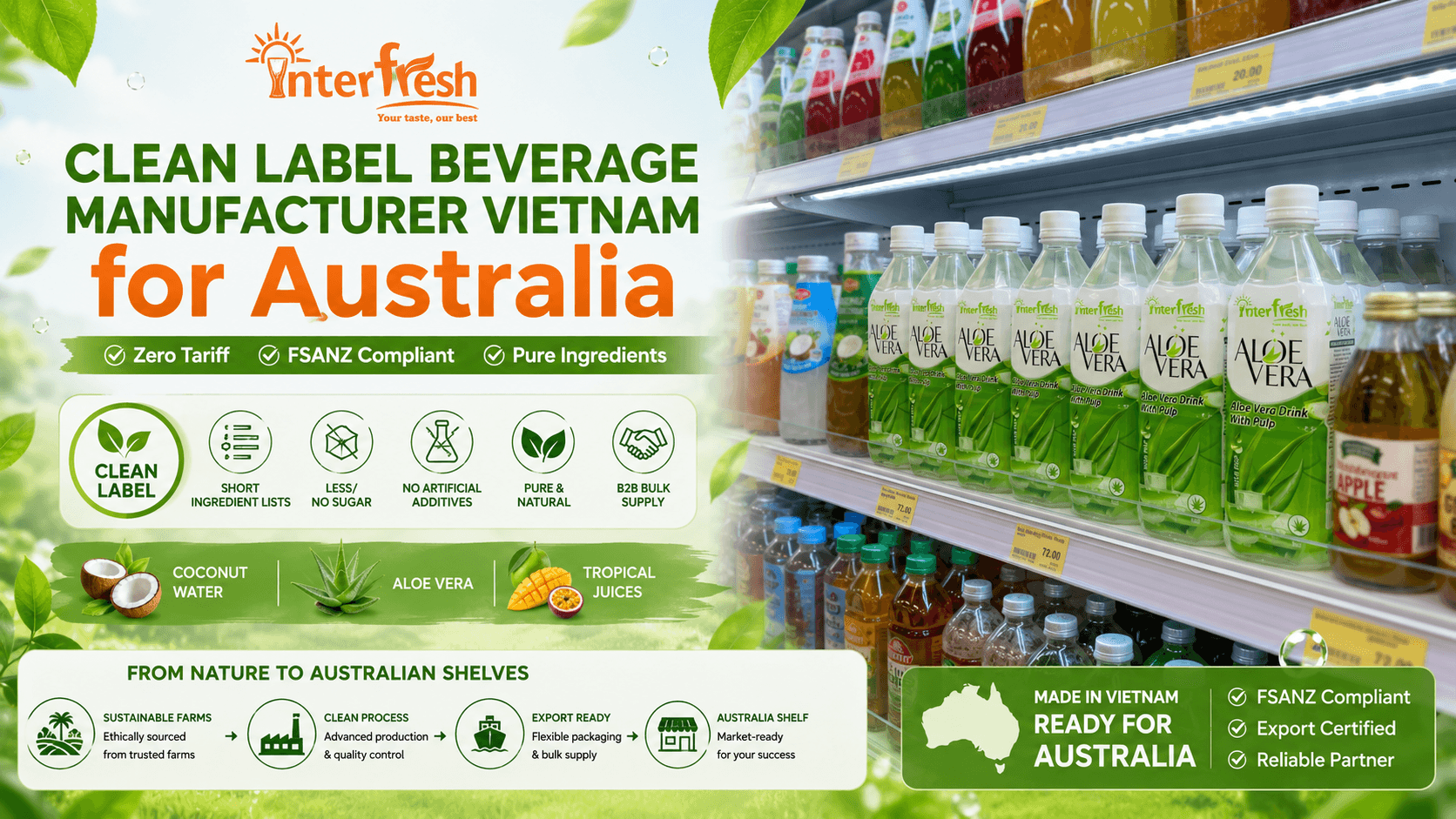
One structural commercial reason Australian importers source from a clean label beverage manufacturer Vietnam is the tariff position under the ASEAN-Australia-New Zealand Free Trade Agreement (AANZFTA).
Import dependence remains structurally significant in Australia, supplying an estimated 35 to 45% of packaged organic beverages by volume. This is particularly true for tropical fruit juices, coconut water, and specialty RTD teas that cannot be sourced year-round from domestic organic farms.
Under AANZFTA, qualifying Vietnamese-origin beverages enter Australia at 0% import duty. This applies to coconut water, aloe vera drinks, fruit juice, RTD tea, basil seed drinks, and other non-alcoholic packaged beverages that meet the agreement’s rules of origin.
For a category buyer at a major Australian grocery chain, partnering with a clean label beverage manufacturer Vietnam creates a strong landed cost advantage.
Clean Label Beverage Categories Available for Australian Distribution
Interfresh manufactures the following categories under full clean label specification as a leading clean label beverage manufacturer Vietnam:
Coconut water. Pure, unflavoured and lightly flavoured variants. Sourced from Vietnamese coconuts and processed within hours of harvest. No concentrate reconstitution. No added preservatives. Available in 250ml and 330ml cans, 250ml and 1L Tetra Pak, and 500ml PET. Strong alignment with the clean hydration positioning demanded by Woolworths and Coles health and wellness ranges.
Aloe vera drinks. Aloe vera with real pulp, fruit juice, or botanical additions. Available in multiple flavour profiles. No artificial colour. Sweetened with cane sugar or available in reduced sugar and no-added-sugar formulations using natural sweeteners. PET and can formats. One of Interfresh’s highest-volume export categories to AU-bound buyers.
Tropical fruit juice. Passion fruit, guava, mango, lychee, and blends. Single-strength and lightly diluted variants. No artificial flavour. All fruit content sourced domestically from Vietnamese agricultural supply chains. Compliant with FSANZ Standard 2.6.1 (fruit juice and fruit drink standards).
Basil seed drinks. High-texture functional beverage. Real basil seeds visible in product. Natural fruit flavour. Resonates with the AU natural and health food channel and with multicultural grocery buyers. No artificial additives.
RTD herbal and botanical teas. Lemongrass, chrysanthemum, pandan, and ginger-based formats. Low and no-added-sugar variants. Clean ingredient declarations. Growing placement in AU health food retail and IGA independents.
Sparkling fruit beverages. Carbonated variants with natural fruit flavour. No artificial colour. Low sugar formulations available. Compatible with Coles and Woolworths sparkling soft drink fixture for private label placement.
All categories are available under private label (your brand), OEM (your formula), or ODM (our formula, your brand). Minimum order quantities, lead times, and AU-specific label artwork support are detailed in the quotation process.
→ Learn more about our OEM and Private Label capabilities
FSANZ Compliance and HACCP Documentation
Every beverage Interfresh manufactures for Australian distribution is produced under a documented food safety management system and supported by the following credentials as a trusted clean label beverage manufacturer Vietnam.
- ISO 22000 certification. Interfresh holds active ISO 22000:2018 certification covering our full beverage production scope. ISO 22000 is the international food safety management standard accepted by Woolworths and Coles as a supplier qualification credential.
- HACCP certification. Our HACCP plan is validated and implemented across all production lines. Certificate of Analysis per production batch is available from an accredited third-party laboratory.
- FSANZ additive compliance. All Interfresh formulas for AU-bound products are reviewed against Standard 1.3.1 of the Australia New Zealand Food Standards Code. No additive is used that is not listed as permitted in the Code at the applicable maximum permitted concentration.
- Allergen declaration. Labels produced for the Australian market include allergen declarations in plain English, compliant with FSANZ Standard 1.2.3 (updated allergen requirements, full transition as of February 2024).
- Country of origin bar chart. All AU-market label artwork includes a compliant country of origin label with bar chart indicating “Product of Vietnam. Made in Vietnam from imported and local ingredients” or the appropriate variant based on ingredient origin.
We provide the full documentation package to Australian importers as standard. This includes ISO 22000 certificate, HACCP plan summary, Certificate of Analysis, ingredient declarations, and allergen review sign-off.
Seasonality and Order Timing for Australian Buyers
The Australian B2B beverage sourcing calendar has a clear structure. Understanding it prevents the most common mistake Australian importers make with Vietnamese suppliers: enquiring too late.
September is the critical window. Australian supermarket category reviews for the following calendar year typically conclude in Q4. Supplier contracts, new product approvals, and private label briefs are locked during the September to November period. For a new private label SKU to be available for January planogram resets, purchase orders must be placed no later than October.
Lead time planning from this point:
-
Product brief and sample approval: 2 to 3 weeks from brief submission
-
Production of approved formula with AU-compliant label: 5 to 7 weeks from PO
-
Ocean freight, Ho Chi Minh City to Melbourne or Sydney: 10 to 14 days
-
Australian customs clearance: 3 to 5 business days
Total timeline from brief to AU warehouse: approximately 10 to 12 weeks. For a September order season, that means submitting your brief to Interfresh no later than the first week of July.
If you are planning for the next order season, now is the right time to engage with a reliable clean label beverage manufacturer Vietnam.
Start Your Australian Clean Label Beverage Project
For distributors and importers sourcing hydration drinks wholesale, Interfresh is a certified OEM and private label beverage manufacturer based in Vietnam. We supply distributors, importers, and bulk buyers in the USA, Australia, EU, and the Middle East. Certifications: FSSC 22000, HACCP, FDA registered, Halal. For wholesale inquiries, contact us at interfresh.com.vn/contact-us.
FAQs
Q: Can I import clean label beverages from Vietnam into Australia duty-free? Yes. Under AANZFTA, qualifying products from a clean label beverage manufacturer Vietnam enter Australia at 0% import duty.
Q: What does FSANZ compliance mean for an imported beverage? It means the product and label must fully comply with the Australia New Zealand Food Standards Code.
Q: What is the minimum order quantity for private label beverages from Vietnam for the Australian market? For private label orders with custom AU-compliant label, MOQ typically starts at 3,000–5,000 units per SKU.
References
IndexBox (2026) Organic Beverages Market in Australia — Analysis, Forecast, Size, Trends and Insights. Available at: https://www.indexbox.io/store/australia-organic-beverages-market-analysis-forecast-size-trends-and-insights/ (Accessed: 23 June 2026).
IndexBox (2026) Beverages Market in Australia — Analysis, Forecast, Size, Trends and Insights. Available at: https://www.indexbox.io/store/australia-beverages-market-analysis-forecast-size-trends-and-insights/ (Accessed: 23 June 2026).
Matthews Australasia (2025) Private Label Trends to Watch in 2025. Available at: https://www.matthews.com.au/blog/private-label-trends-to-watch-in-2025 (Accessed: 23 June 2026).
USDA Foreign Agricultural Service (2025) Retail Foods Annual: Australia. Report AS2025-0019. Canberra. Available at: https://apps.fas.usda.gov/newgainapi/api/Report/DownloadReportByFileName?fileName=Retail+Foods+Annual_Canberra_Australia_AS2025-0019.pdf (Accessed: 23 June 2026).
Food Standards Australia New Zealand (FSANZ) (2025) Australia New Zealand Food Standards Code — Compilation No. 16. Available at: https://www.foodstandards.gov.au/food-standards-code (Accessed: 23 June 2026).
International Organization for Standardization (ISO) (2018) ISO 22000:2018 Food Safety Management Systems. Available at: https://www.iso.org/standard/65464.html (Accessed: 23 June 2026).