
Russia Is Vietnam’s Largest Single Market for Tropical Juice
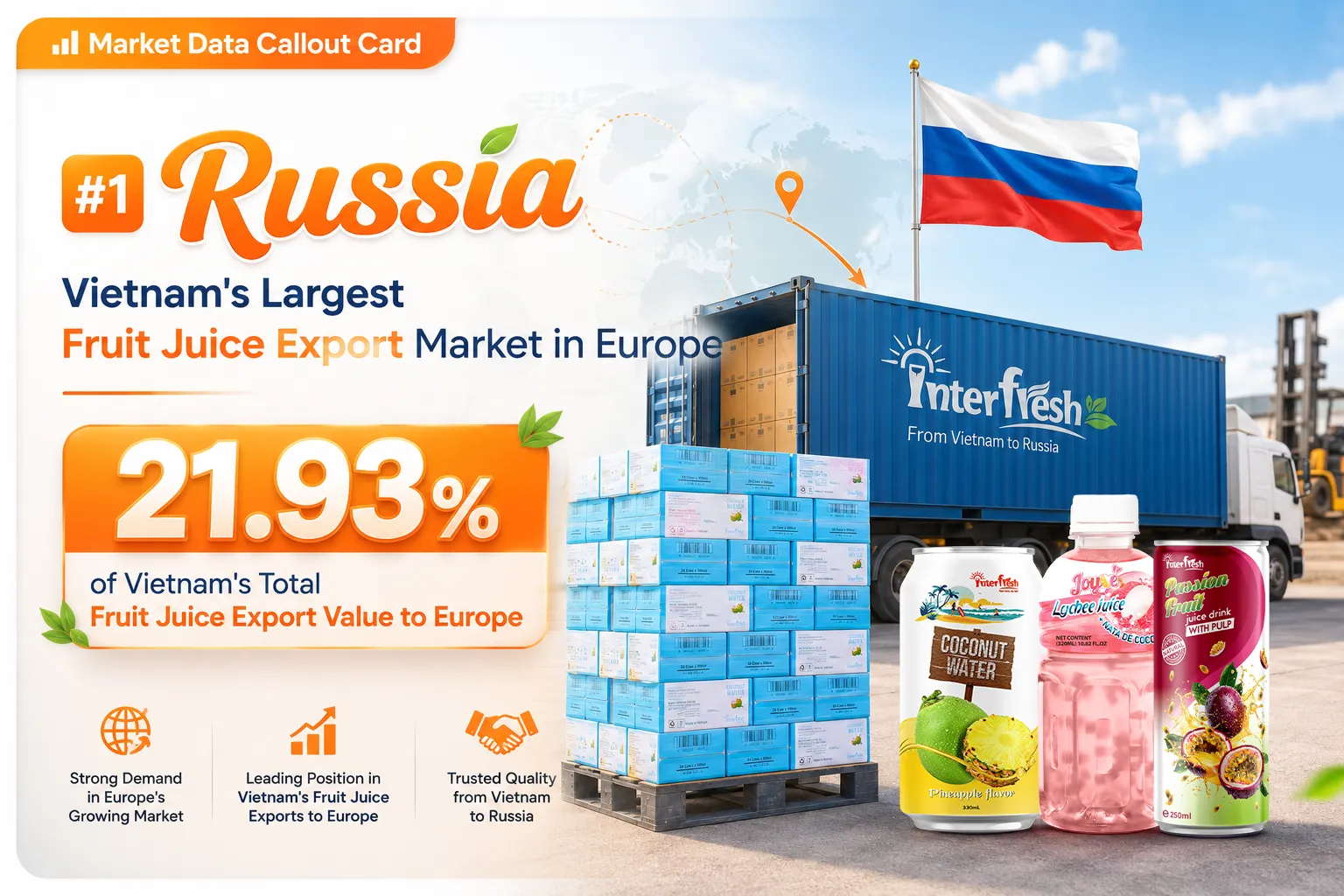
Russia does not produce mango, lychee, or passion fruit. It imports them. And among all countries in the European and CIS region, Russia ranks first for Vietnamese fruit juice imports. From November 2024 to September 2025, Russia accounted for 21.93% of Vietnam’s total fruit juice export value to Europe, making it the single largest destination.
That number reflects a structural reality. Russian consumers have developed strong demand for tropical flavors. Summer months from June to August push this demand to peak. Mango leads. Lychee holds a loyal following. Passion fruit is growing fast in the premium segment.
For any fruit juice supplier in Russia network, Vietnam is the natural source. Interfresh Food and Beverage Company supplies bulk tropical juice from Ho Chi Minh City to distributors, wholesalers, and private label buyers across the Russian Federation and CIS.
Why Russian Distributors Choose Vietnam Over Alternative Sources
When Russian importers search for a reliable fruit juice supplier Russia can depend on, three countries come up most often: Vietnam, Thailand, and China. Vietnam consistently wins the shortlist for these reasons.
Raw material depth. Vietnam’s Mekong Delta and Central Highlands produce mango, passion fruit, and lychee at industrial scale. Year-round harvest cycles mean no seasonal supply gaps for finished juice buyers.
Cost structure. Vietnam’s export price for tropical juice under HS 200989 averaged USD 3.36 per kg in 2025, well below comparable Malaysian or European-processed alternatives. For a Russian importer managing RUB-denominated margins, this matters.
Established trade lane. Vietnam has shipped over 8.5 million kilograms of fruit juice to European markets in the 12 months to September 2025, generating USD 72.47 million in export value. The logistics infrastructure, freight forwarder networks, and customs documentation between HCMC and Russian ports are mature and reliable.
As a fruit juice manufacturer in Vietnam with export operations across 100 markets, Interfresh is part of this established trade lane, not a new entrant into it.
The Three SKUs That Drive Russia’s Summer Season
Mango Juice — Volume Leader, June to August
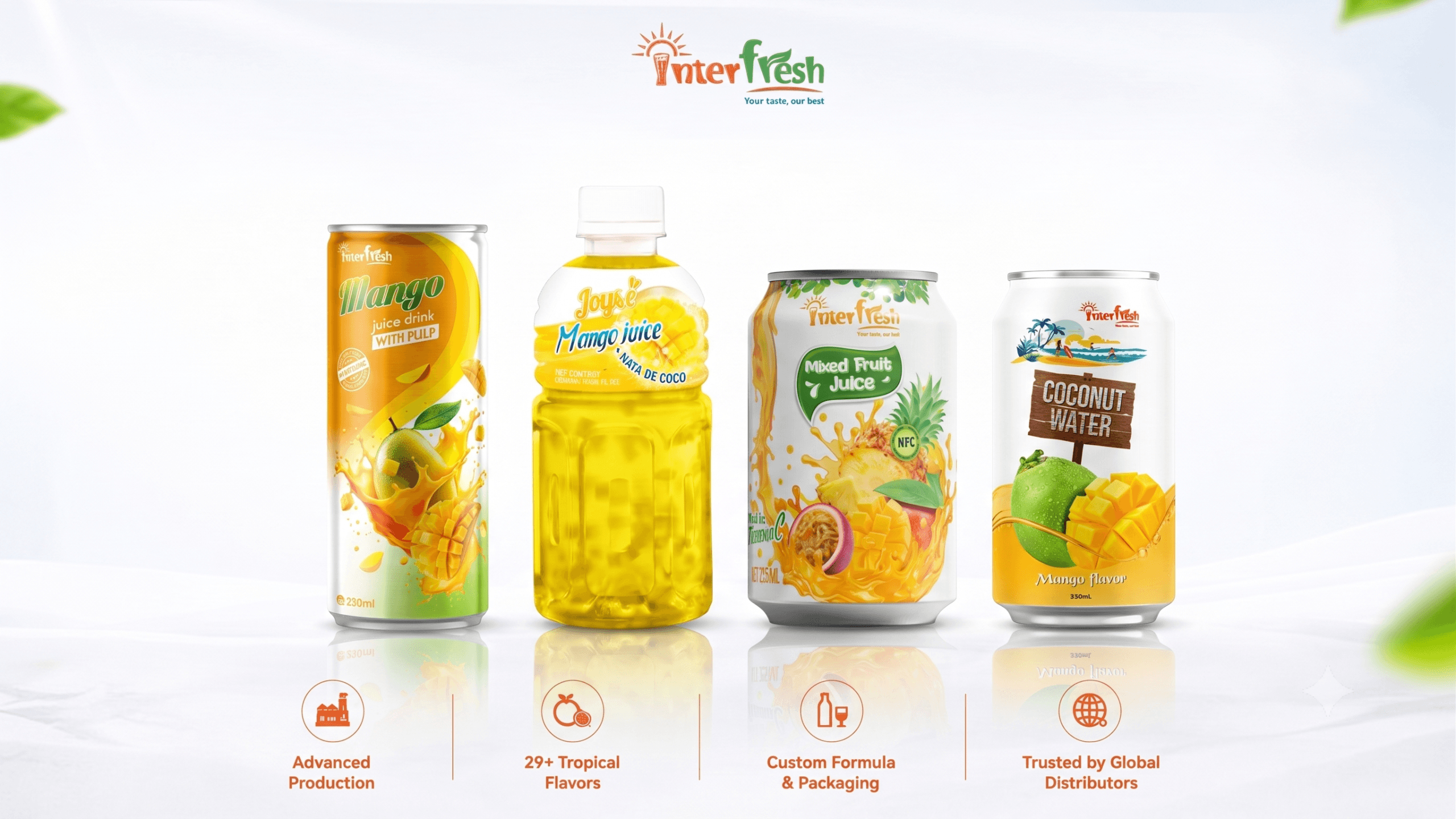
Mango juice is the highest-volume tropical SKU in Russia’s ambient beverage category. Russian summer temperatures in Moscow and Krasnodar routinely reach 30 to 35 degrees Celsius from late June onward. Demand for chilled ambient juice surges. Mango’s flavor profile is widely recognized and accepted across all Russian demographics.
Interfresh produces mango juice drink in 250 ml PET, 330 ml can, 500 ml PET, and 1,000 ml Tetra Pak formats. Brix is adjustable between 10 and 14 degrees. Pulp content is configurable per your market’s flavor preference. For Russian distributors building a summer campaign, the mango juice OEM manufacturer Vietnam page covers full formulation options and MOQ structure.
Lychee Juice — Premium Segment, Strong Repeat Purchase
Lychee juice is positioned as a premium SKU in Russian retail. Its distinctive floral aroma creates strong brand recall. Repeat purchase rates among lychee juice consumers are above average in the RTD fruit juice category.
Interfresh sources lychee from Bac Giang province in northern Vietnam, one of Asia’s highest-quality lychee-growing regions. The resulting juice is produced without synthetic flavor masking. It carries a clean, authentic lychee profile that holds through shelf life. Review formulation options at the lychee juice OEM supplier Vietnam page and request a sample before committing to volume.
Passion Fruit Juice — Fastest Growing, Premium Margin
Passion fruit juice is the category’s fastest-growing tropical SKU globally. Russia is part of this trend. The flavor’s tartness creates strong differentiation from mainstream juice SKUs. It commands a higher price per unit at Russian retail.
Interfresh exports passion fruit juice to EU and Asian markets. The product specs relevant to a Russian distributor, including EAEU-compatible documentation formats, are covered in detail at the passion fruit juice OEM Vietnam page. Calamansi juice is also available for distributors seeking citrus diversification, detailed at the calamansi juice OEM Vietnam page.
Check our fruit juice lineup!




Fruit Juice Drink
Jucy Jucy 250ml Lychee Juice Stubby Can – B2B Export & Custom Packaging

Fruit Juice Drink
Jucy Jucy 250ml Mango Juice Stubby Can – B2B Private Label & Bulk Orders
How Interfresh Makes Fruit Juice — The Production Process
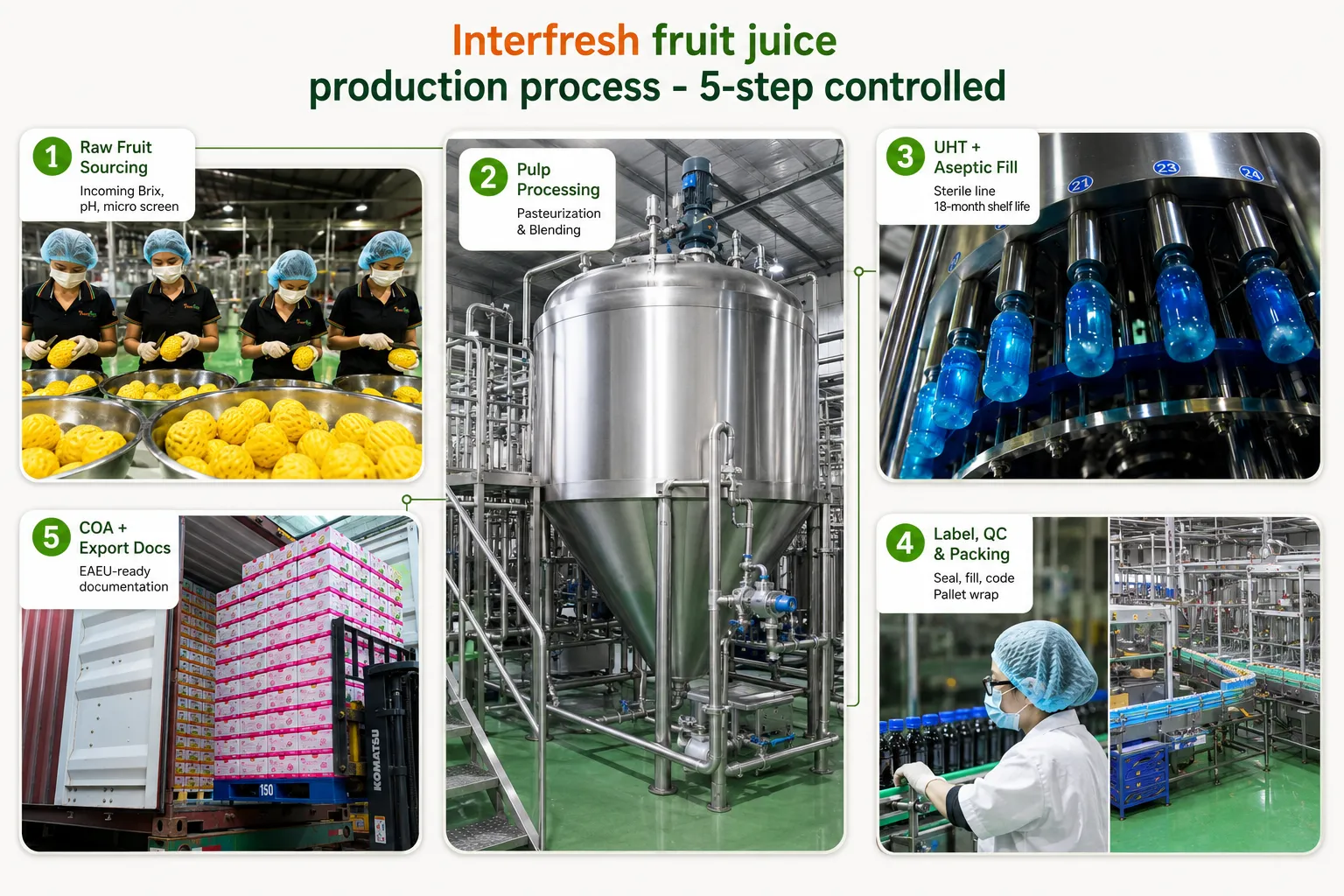
Russian importers at the decision stage need confidence in production consistency. Here is exactly how Interfresh produces every batch of tropical fruit juice.
Step 1. Raw Fruit Sourcing and Incoming Inspection. Interfresh sources fresh fruit pulp and juice concentrate directly from contracted farms and processing cooperatives in Vietnam’s growing regions. Every batch undergoes incoming Brix, pH, color, and microbiological screening before entering production.
Step 2. Pulp Processing and Blending. Fruit pulp is processed through pasteurization at controlled temperatures. Blending is calibrated to specification. Sugar balance, pulp percentage, and acidity are adjusted per the buyer’s formulation brief. Interfresh maintains batch records for full traceability.
Step 3. UHT Treatment and Aseptic Filling. Juice passes through UHT (Ultra High Temperature) processing to eliminate pathogenic microorganisms. Aseptic filling lines then package the product into PET bottles, aluminum cans, or Tetra Pak cartons under sterile conditions. This is the step that delivers 12-month ambient shelf life.
Step 4. Labeling, Quality Control, and Packing. Each unit is labeled per the client’s artwork specification. The finished goods quality control team runs final checks on seal integrity, fill volume, label placement, and coding (production date, best before, lot number). Pallets are wrapped and packed for FCL container loading.
Step 5. Pre-Shipment Inspection and Export Documentation. Before container sealing, Interfresh issues a Certificate of Analysis covering Brix, pH, color, total plate count, yeast and mold, heavy metals, and ingredient declaration. All documents are prepared in formats accepted by Russian customs and EAEU certification bodies.
For distributors interested in the full OEM journey, from concept brief to goods at port, the fruit juice manufacturer Vietnam hub page outlines Interfresh’s end-to-end production and export capability.
Certifications Every Fruit Juice Supplier in Russia Exporters Need for Customs Clearance
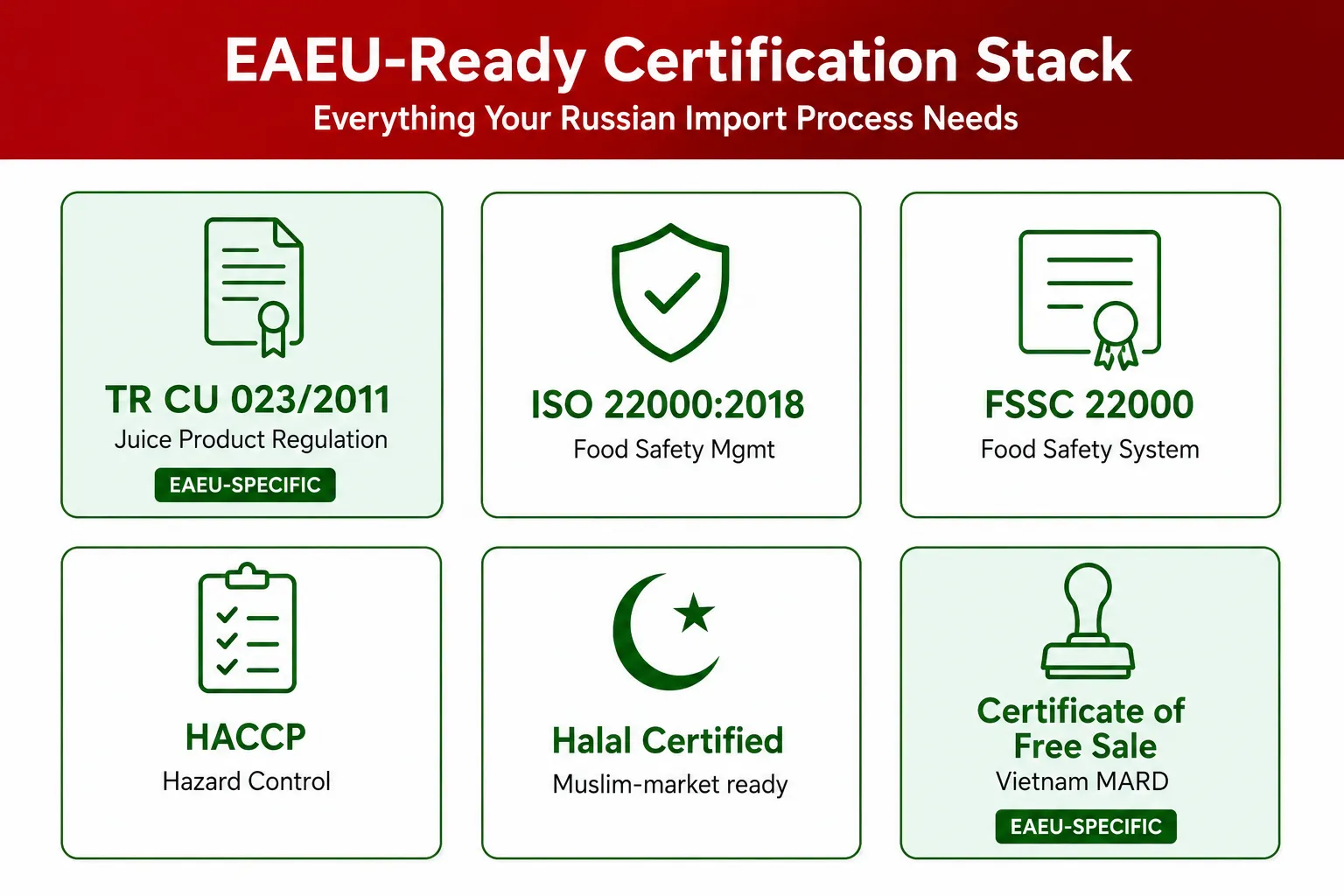
This is where most Vietnam-Russia juice deals stall. Russian import compliance operates under the Eurasian Economic Union (EAEU) regulatory framework, which is more specific than general ISO certification. Here is what matters.
EAEU TR CU 023/2011. This technical regulation governs juice products from fruits and vegetables sold within EAEU member states (Russia, Belarus, Kazakhstan, Armenia, Kyrgyzstan). It defines composition requirements, category claims, and labeling standards for juice, nectar, and juice drinks. Interfresh produces and documents product specifications in alignment with TR CU 023/2011 requirements.
EAEU TR CU 021/2011. This regulation governs food safety. It requires that imported food products comply with HACCP principles and microbiological standards applicable to food sold in the EAEU market. Interfresh holds HACCP certification and provides the required documentation.
EAEU TR CU 022/2011. This covers food labeling. All export products destined for Russia require Russian-language labeling with specific mandatory declarations: product name, composition, net quantity, nutritional information, manufacturer’s name and address, country of origin, and best before date. Interfresh manages label localization for Russian-market export and provides pre-validated label artwork files.
ISO 22000:2018. Interfresh’s food safety management system is certified to ISO 22000:2018. This certification is recognized by EAEU conformity bodies as evidence of systematic food safety controls and is required documentation for EAC Declaration of Conformity procedures.
FSSC 22000. Interfresh holds FSSC 22000 certification, the globally recognized food safety system certification that underpins EAC market access applications for packaged food and beverage imports.
Halal Certification. For distributors serving Russia’s Muslim-majority regions (Tatarstan, Bashkortostan, North Caucasus), Halal certification is a commercial requirement, not optional. Interfresh’s Halal certificate from a recognized certification body is included in the standard export documentation package.
Certificate of Free Sale (Vietnam MARD). Issued by Vietnam’s Ministry of Agriculture and Rural Development, this certificate confirms the product is legally manufactured and sold in Vietnam. It is a standard requirement for EAC Declaration of Conformity registration.
MOQ, Lead Time, and the Russia Logistics Route
Minimum Order Quantity. 1 x 20-foot container per SKU. This is approximately 20,000 units in 250 ml PET or 14,400 units in 330 ml cans. Mixed-SKU containers are available at 1,000-unit minimums per variant.
Production Lead Time. 21 to 28 days from confirmed purchase order and deposit receipt. New clients with custom label requirements add 5 to 7 working days for label approval.
Shipping Route to Russia. Primary route: FCL container from Cat Lai Port, Ho Chi Minh City via sea to Vladivostok, Novorossiysk, or St. Petersburg. Transit time is 18 to 25 days depending on the destination port and routing through the Suez or Malacca Strait. Multi-modal routing via rail through Central Asia (HCMC to Russia via China) is available as an alternative, with transit times of 22 to 30 days.
Incoterms. FOB HCMC is standard. CIF Novorossiysk and CIF Vladivostok can be arranged with Interfresh’s established freight partners.
Payment Terms. 30% T/T deposit, 70% against Bill of Lading copy. LC at sight is accepted for orders above USD 50,000.
Ordering Window for Summer Peak. For goods to arrive in Russia before June 1, the purchase order must be confirmed by late March. The 28-day production lead time plus up to 25 days transit means a March 25 PO reaches Russian ports by late May. Distributors planning summer stock for June to August should initiate sourcing conversations in February.
Supplier Comparison: What to Verify Before Issuing Your RFQ
Russian distributors evaluating multiple Vietnam suppliers should verify these criteria before committing:
| Criteria | Key Question | Interfresh Answer |
| EAEU compliance | Can they produce TR CU 023/2011-aligned docs? | Yes. Full EAEU document package available |
| Russian label readiness | Do they support Russian-language label production? | Yes. Label localization service included |
| Flavor catalog | Mango, lychee, passion fruit all available? | Yes. 20+ tropical flavors in catalog |
| Production certifications | ISO 22000, HACCP, FSSC 22000? | All three certified |
| Halal | Certificate from recognized body? | Yes. Included in export package |
| Mixed container | Can I trial two SKUs in one shipment? | Yes. 1,000-unit minimum per SKU variant |
| Sample policy | Free sample before full container? | Yes. Sample dispatch within 5 working days |
| Russia trade experience | Active HCMC-Russia trade lane? | Yes. Russia is an active export destination |
For orange juice and other citrus options to expand your Russian portfolio, the orange juice OEM manufacturer Vietnam page covers formulations aligned with Russian nectar-category requirements.
Frequently Asked Questions
Can I import fruit juice from Vietnam to Russia? Yes. Vietnam-origin packaged fruit juice is importable to Russia under EAEU technical regulations. The importer must obtain an EAC Declaration of Conformity and ensure product compliance with TR CU 021/2011 (food safety), TR CU 022/2011 (labeling), and TR CU 023/2011 (juice products). Interfresh provides the full documentation package required for this process.
What EAEU certifications are required for fruit juice import to Russia? For packaged juice products, the importer typically needs an EAC Declaration of Conformity under TR CU 023/2011. Supporting documents include the manufacturer’s ISO or FSSC 22000 certificate, HACCP records, Certificate of Free Sale, product specification, and Certificate of Analysis. Russian-language labeling must comply with TR CU 022/2011 before goods enter the market.
What tropical juices sell best in Russia during summer? Mango juice is the highest-volume tropical SKU in Russia’s summer ambient beverage market. Lychee juice performs strongly in the premium segment. Passion fruit juice is the fastest-growing tropical flavor in the RTD category. All three are available from Interfresh in standard packaging formats suited to Russian retail channels.
How long does shipping from Vietnam to Russia take? Sea freight from Cat Lai Port, Ho Chi Minh City to Novorossiysk averages 18 to 22 days. Shipping to Vladivostok averages 15 to 20 days. Add 21 to 28 days of production lead time. Total order-to-arrival is typically 40 to 50 days from purchase order confirmation.
What is the MOQ for bulk fruit juice from Vietnam to Russia? Interfresh’s standard MOQ is 1 x 20-foot container per SKU, approximately 20,000 units in 250 ml PET format. Mixed-flavor containers are available at 1,000-unit minimums per variant. Sample orders are possible before full container commitment.
Does Interfresh provide Russian-language labeling for export? Yes. Interfresh offers full label localization support for Russian-market export. The client provides brand artwork, and Interfresh’s export team validates the label against TR CU 022/2011 mandatory declaration requirements before production. This service is included as part of the standard OEM package.
What is the best time to order fruit juice for Russia’s summer season? For June to August peak supply, distributors should confirm purchase orders by late March. Production requires 21 to 28 days. Sea freight to Russian ports adds 18 to 25 days. A March 25 order ensures goods are available for June distribution. Sourcing conversations should begin in January or February to secure production slot priority.
Start Your First Container — Three Steps
If you are a fruit juice supplier in Russia network builder or a Russian B2B distributor ready to move, the path from inquiry to first container is short.
Step 1. Request free product samples. Mango, lychee, and passion fruit samples dispatch within 5 working days. You evaluate flavor, Brix, and packaging quality before committing.
Step 2. Submit your RFQ. Include target SKUs, monthly volume estimate, destination port (Novorossiysk, Vladivostok, St. Petersburg), and Incoterms preference. A commercial proposal with pricing and lead time is returned within 48 hours.
Step 3. Confirm your order. Interfresh issues a proforma invoice. On 30% deposit receipt, production is scheduled. EAEU-ready documentation is prepared in parallel with your production run.
Guava juice is also available for distributors building a broader tropical range in the Russian market. The guava juice OEM supplier Vietnam page covers specifications and packaging options. Production calendars for Q3 2026 (June to August dispatch) fill from April onward. Early engagement secures your production slot.
Request a Free Mango Sample | Submit RFQ | Download OEM Brochure
References
-
IndexBox (2026). Russia Beverages Market: Analysis, Forecast, Size, Trends and Insights 2026. https://www.indexbox.io/store/russia-beverages-market-analysis-forecast-size-trends-and-insights/
-
Tridge (2026). Passion Fruit Juice: Global Supplier Coverage, Trade Flows and Price Benchmarks. https://www.tridge.com/market-overview/passion-fruit-juice
-
Tridge (2026). Tomato Juice Russia — EAEU Regulatory Compliance Overview. https://www.tridge.com/market-overview/tomato-juice/RU
-
Eurasian Economic Union (2011). Technical Regulation TR CU 023/2011 on Juice Products from Fruits and Vegetables. Eurasian Economic Commission.
-
UN Comtrade / ITC Trade Map (2025). Bilateral Trade Statistics: Fruit Juice HS 2009, Vietnam to Russia.
Interfresh Food and Beverage Company, Ho Chi Minh City, Vietnam. OEM and private label tropical juice manufacturer serving B2B distributors, wholesalers, and brand owners in Russia, CIS, and Europe. ISO 22000. FSSC 22000. HACCP. Halal Certified. EAEU documentation available.