Halal Certified Beverage Supplier for the Middle East: Vietnam OEM by Interfresh
The Middle East and Africa halal food and beverage market reached USD 430 billion in 2025. It is projected to grow at a CAGR of 10.37% through 2031 — the fastest-growing regional halal market globally. Saudi Arabia’s halal food and beverage market was valued at USD 18.56 billion in 2024 and is forecast to reach USD 29.34 billion by 2030 at a CAGR of 7.93%. The UAE halal food and beverage market reached USD 81 billion in 2025, representing 19% of the entire MEA market.
For GCC distributors, wholesalers, and FMCG importers, the sourcing question is no longer whether to buy halal certified beverages. It is which supplier can deliver certified, compliant, export-ready product at scale, fast, every season.
Interfresh is a leading halal certified beverage supplier in Vietnam. We manufacture and export non-alcoholic beverages to the UAE, Saudi Arabia, Kuwait, Qatar, Oman, and Bahrain. Every product leaving our facility is produced under an active halal certificate, formulated to GCC compliance standards, and documented for smooth port clearance.
What is a GCC halal beverage supplier?
A GCC halal beverage supplier is a manufacturer that produces non-alcoholic beverages under a halal certificate recognised by GCC regulatory authorities. Specifically: ESMA (UAE), SFDA Halal Centre (Saudi Arabia), and equivalent national bodies. The certificate must be issued by a body on the official accredited list of the destination country. Products must contain zero alcohol, no pork-derived ingredients, and no non-halal food additives. For distributors and wholesalers importing into GCC markets, working with a verified GCC halal beverage supplier eliminates the primary risk of port-level shipment rejection.
This page covers what GCC buyers need to know: the compliance requirements, the product range, the seasonal demand curve, and how to start an order with Interfresh before the summer import peak.
Why GCC Importers Source Halal Beverages from Vietnam
Finding a Vietnamese supplier whose halal certificate is actually recognised by ESMA and SFDA — that is where most GCC importers hit a wall. Beyond certification, three structural advantages make Vietnam the correct sourcing origin for a private label halal drink manufacturer targeting GCC distribution.
Cost and ingredient access. Vietnamese factories produce coconut water, aloe vera, tropical fruit juice, and basil seed drinks at the source. No imported raw materials. No reconstitution from concentrate for most categories. That translates into landed cost structures that support GCC retail margins, even after sea freight and port handling.
Halal certification aligned with GSO 2055-1. Leading Vietnamese beverage manufacturers hold halal certificates issued by bodies recognised under GSO 2055-1, the Gulf Standardization Organization standard governing halal products across all GCC markets. (Source: American Halal Foundation, 2024.) Buyers importing through Dubai or Jeddah do not face certification recognition issues when working with a properly certified Vietnamese supplier.
Trade route efficiency to GCC ports. Transit from Ho Chi Minh City to Jebel Ali (Dubai) runs 12 to 16 days by sea. To Jeddah Islamic Port: 14 to 18 days. (Source: freight carrier schedules, 2026.) These transit times are competitive with Thailand and India, and shorter than European and North American alternatives.
If you are building a sourcing strategy for 2026 and 2027, our OEM and private label capabilities overview covers the full manufacturing model and production timelines in detail.
Seasonality: The MEA Summer Import Window
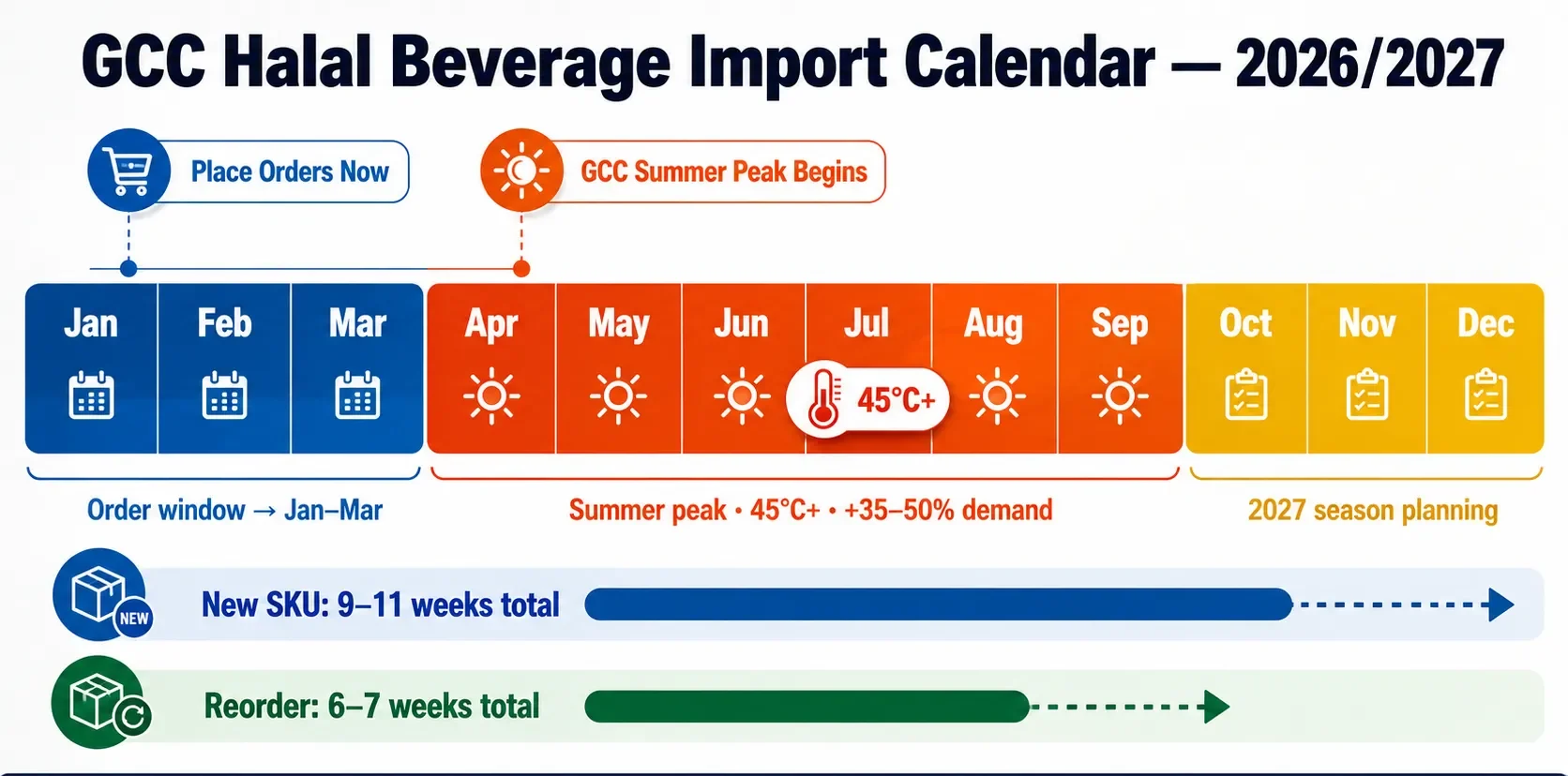
GCC halal beverage import seasonality calendar
The GCC summer creates a predictable, high-volume demand spike for cold beverages. Temperatures in Saudi Arabia, UAE, and Kuwait reach 45 degrees Celsius and above between April and September. Demand for chilled and shelf-stable cold drinks surges 35 to 50% above annual baseline in this period.
GCC distributors and wholesalers who manage summer inventory correctly place orders in January to March. Shipments arriving at Jebel Ali or Jeddah in April through June cover the critical peak season through Ramadan and the summer months.
The risk of ordering late is real. Container availability from Ho Chi Minh City tightens in Q1 each year. Production slots at certified factories fill. Distributors who miss the January to March order window frequently face either supply gaps during the summer peak, or higher spot freight costs in March and April.
Production and shipping timeline from Interfresh to GCC:
New private label SKU from confirmed brief: 6 to 8 weeks production, plus 12 to 18 days shipping. Total lead time: 9 to 11 weeks to GCC port.
Reorder of approved formula with existing label: 3 to 4 weeks production, plus transit. Total: 6 to 7 weeks to GCC port.
For peak season 2027, order windows open from October 2026. Contact our export team now to reserve production allocation.
GCC Halal Compliance: What Every Importer Must Verify
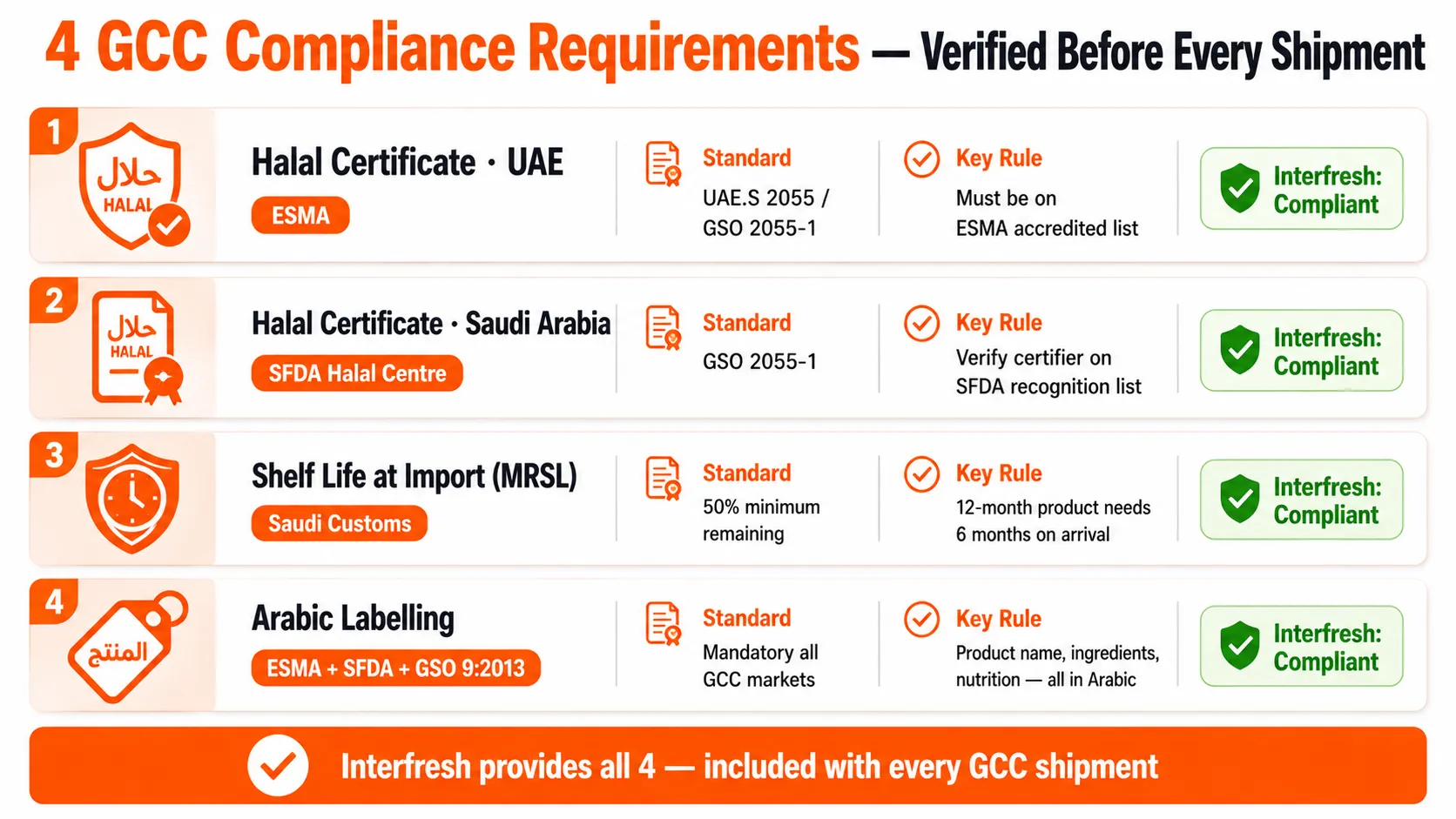
GCC halal compliance requirements checklist for beverage importers
Halal certification in the GCC is not a single standard managed by one authority. Each GCC member state has its own regulatory framework. A certificate that clears Dubai may require supplementary documentation for Riyadh or Kuwait City.
For any halal OEM beverage Vietnam supplier to be commercially viable for GCC distribution, the following four requirements must be verified before placing a purchase order.
Requirement
Authority
Standard
Key rule for importers
Halal certificate — UAE
ESMA (Emirates Authority for Standardisation and Metrology)
UAE.S 2055, aligned with GSO 2055-1
Certificate must be issued by a body on the current ESMA-accredited list. Certificates from unlisted bodies are rejected at port.
Halal certificate — Saudi Arabia
SFDA Halal Centre
GSO 2055-1
SFDA accepts certificates from internationally recognised bodies aligned with GSO 2055-1. Verify certifier is on the current SFDA recognition list before printing packaging.
Minimum shelf life at import (MRSL)
Saudi Customs (SFDA-enforced)
Saudi food import regulations
Minimum 50% of declared shelf life must remain at point of import. A 12-month product needs 6 months remaining on arrival at Jeddah or Dammam.
Arabic labelling
ESMA (UAE), SFDA (Saudi), GSO 9:2013
GSO 9:2013 general labelling standard
Arabic is mandatory on all consumer packs. Must include: product name, ingredient list, net content, nutrition information, country of origin, manufacturer and importer details.
Interfresh prepares Arabic-English bilingual label artwork as standard for all GCC-bound orders. If you are navigating this requirement for the first time, our FDA, ISO, Halal, and certification guide explains the full certification stack and what each document covers.
Interfresh Halal Certification: What We Hold and What We Provide
Interfresh holds active halal certification covering our full beverage production scope. The following documentation is provided with every GCC-bound commercial shipment.
Document
Issued by
Purpose
GCC relevance
Per-shipment Halal Certificate
Internationally accredited halal certification body (GSO 2055-1 aligned)
Confirms halal compliance of specific products and batch numbers
Required for customs clearance at all GCC ports of entry
Certificate of Analysis (COA)
Third-party accredited laboratory
Confirms nutritional values, microbiological results, and heavy metals per batch
Requested by GCC port authorities and retail buyers for product qualification
ISO 22000 Certificate
Accredited certification body
Documents food safety management system scope and validity
Required for UAE Dubai Municipality and Saudi SFDA product registration
HACCP Certificate
Accredited certification body
Documents hazard analysis and critical control point procedures
Required alongside ISO 22000 for GCC product registration processes
Export documentation set
Interfresh and relevant Vietnamese authorities
Commercial Invoice, Packing List, Bill of Lading, Certificate of Origin, Health Certificate, Phytosanitary Certificate
Complete set required for GCC customs entry processing
For UAE-destined shipments requiring Dubai Municipality or Abu Dhabi ADAFSA product registration, Interfresh provides the manufacturer documentation package needed by your local distributor to complete registration. Product registration in Dubai typically takes 2 to 4 weeks for compliant, pre-documented products.
Halal Beverage Categories for GCC and MEA Markets
Interfresh manufactures 7 halal certified beverage categories for Middle East export. Each is formulated with zero alcohol content, no pork-derived ingredients, and no non-halal additives in either product or primary packaging.
Coconut water. Interfresh is a halal certified coconut water supplier producing pure and flavoured variants for GCC distribution. No alcohol, no artificial preservatives. Available in 250ml and 330ml aluminium cans, 330ml to 1L Tetra Pak. Strong demand in UAE and Saudi hypermarkets for hydration positioning.
Aloe vera drinks. Multiple flavour variants. Real aloe vera pulp. Natural colour. No non-halal ingredients. One of the highest-demand categories from GCC buyers in Interfresh’s export portfolio.
Tropical fruit juice. Passion fruit, mango, guava, lychee, tamarind blends. Natural flavour, no artificial additives. Compliant with GSO 1217 (fruit juice standard for GCC markets).
Basil seed drinks. Distinctive texture. Natural fruit flavour. High repeat purchase rate in South Asian expatriate communities across UAE and Qatar. A growing category for GCC retail buyers.
Sparkling fruit beverages. Carbonated, naturally flavoured, no alcohol. Popular in Saudi Arabia and Kuwait where carbonated soft drink shelf space is significant.
RTD herbal and functional beverages. Lemongrass, ginger, chrysanthemum. No artificial additives. Growing placement in premium and health-oriented UAE retail channels.
Energy drinks. Taurine-based formulations, B-vitamin-enriched. Zero alcohol. Compliant with GCC GSO standards on energy drink composition.
All categories are available under private label (your brand), OEM (your formula), or ODM (our formula adapted for your brand). Our product range covers all 12 categories with MOQ and format details.
MOQ, Lead Times, and GCC Pricing Structure
Middle East importers typically ask three questions before advancing a supplier conversation. Here are direct answers.
MOQ. Private label orders using an existing Interfresh ODM formula with halal-certified GCC-compliant label artwork start at 3,000 to 5,000 units per SKU. Full OEM orders with a custom formula require a minimum of one FCL. A standard 20-foot container holds approximately 20,000 to 24,000 units of 250ml canned product.
Lead time. New private label SKU from confirmed brief: 6 to 8 weeks production plus transit. Reorder with approved formula and label: 3 to 4 weeks production plus transit. Sample turnaround: 5 to 7 business days from confirmed brief, dispatched to any GCC address.
Pricing. All pricing is quoted FOB Ho Chi Minh City or CIF destination port (Jebel Ali, Jeddah, or other GCC ports on request). Interfresh provides fully itemised quotations with no broker markup. Cost per unit varies by category, packaging format, order volume, and halal documentation scope.
For detailed pricing aligned with your specific requirements, the fastest path is a direct conversation with our export team. Response within 24 hours is guaranteed on all qualified enquiries.
FAQs
Q: Is halal certification mandatory for all beverages exported to GCC countries? For most packaged food and beverage categories, halal certification is not legislatively mandated for non-meat products in all GCC states. However, it is a practical commercial requirement. GCC retail chains, hypermarkets, and importers will not accept a non-halal certified beverage from a foreign manufacturer. Saudi Arabia and the UAE both have regulatory frameworks that require halal documentation for certain product categories. Any beverage containing ingredients that could be derived from non-halal sources (including certain food additives, emulsifiers, and flavour compounds) requires halal certification to enter mainstream GCC distribution.
Q: Which halal certifying bodies are accepted by UAE ESMA and Saudi SFDA? The UAE ESMA publishes a list of accredited halal certification bodies (ACBs) whose certificates are accepted for UAE import. The list is updated periodically. For Saudi Arabia, the SFDA Halal Centre maintains a separate recognised body list. A halal certificate from a body not on either list will be rejected at port regardless of the certificate’s legitimacy in the issuing country. Exporters must verify that their certifying body is currently listed by the destination country’s authority before printing packaging. Interfresh’s halal certificate is issued by a body maintaining international accreditation recognised in GCC markets.
Q: What Arabic labelling requirements apply to beverages entering the UAE and Saudi Arabia? Arabic is mandatory on all consumer-facing food and beverage packaging in GCC markets. The Arabic label must include: product name, full ingredient list, net content, nutrition information in GSO-compliant format, country of origin, manufacturer name and address, and UAE or Saudi importer name and address. The nutritional information panel format for GCC markets differs from EU and US formats. Interfresh prepares bilingual English and Arabic label artwork as standard for all GCC-bound orders, built against GSO 9:2013 general labelling requirements.
Q: What is the minimum shelf life required at import for beverages entering Saudi Arabia? Saudi Arabia requires a minimum of 50% of the declared product shelf life to remain at the point of import for most food categories. For a product with a 12-month shelf life, at least 6 months must remain on arrival at Jeddah or Dammam port. Interfresh schedules production to ensure a minimum of 10 months remaining shelf life on all GCC-destined shipments from our facility.
Q: Can Interfresh produce halal beverages with Arabic labelling and GCC-compliant documentation? Yes. Interfresh provides halal certified production, per-shipment Halal Certificate, Arabic-English bilingual label artwork built to GCC labelling standards, Certificate of Analysis, and the full export documentation package required for GCC port clearance and product registration. Our export team has experience managing UAE Dubai Municipality and Saudi SFDA documentation requirements for distributor clients across the GCC.
Q: How does Interfresh compare to other Vietnamese beverage manufacturers for Middle East export? The key differentiating factors for MEA-bound production are: active halal certification from a GCC-recognised body, Arabic labelling capability, confirmed minimum shelf life management, and established GCC export documentation capability. Many Vietnamese manufacturers hold general halal certification without confirming GCC-specific body recognition. We recommend buyers verify the specific certifying body’s accreditation status with ESMA and SFDA before committing to any supplier.
Start Your GCC Halal Beverage Order
Interfresh is a leading halal certified beverage supplier in Vietnam, exporting to the UAE, Saudi Arabia, Kuwait, Qatar, Oman, and Bahrain. Samples reach GCC addresses within 7 to 10 business days of a confirmed brief. Full Halal Certificate, COA, and GCC-compliant documentation provided with every commercial shipment.
The April to September summer peak season starts soon. Place your order before the window closes.
Emergen Research (October 31, 2025). Halal Food and Beverage Market Size, Share and Forecast 2026 to 2034.
Key data: Saudi Arabia halal food imports USD 18.5 billion in 2023. UAE halal trade reached USD 45 billion with 18% annual growth 2021 to 2023. UAE Ministry of Economy allocated AED 2.3 billion for halal industry development 2022 to 2025. URL: https://www.emergenresearch.com/industry-report/halal-food-beverage-market