How to Import Beverages from Vietnam to USA: The Complete Compliance and Logistics Guide for B2B Buyers (2026)
How to Import Beverages from Vietnam to USA has become one of the most strategic moves for American distributors, bulk wholesalers, and private label brand owners in 2026.
US goods imports from Vietnam reached $193.8 billion in 2025 — a 42% increase over 2024, according to the US Trade Representative. Vietnam is now the second largest import partner for US goods after China, and a growing share of that trade is food and beverage. For US importers, distributors, and private label brand owners looking to diversify supply chains, add competitive margins, and access tropical ingredients not available elsewhere, importing beverages from Vietnam to USA represents one of the most commercially attractive opportunities in FMCG sourcing today.
But the path from a Vietnamese factory floor to a US retail shelf, Amazon FBA warehouse, or wholesale distribution center is not a simple transaction when you import beverages from Vietnam to USA. It involves a layered compliance framework — the FDA food facility registration, Foreign Supplier Verification Program obligations, Prior Notice filing, US Customs and Border Protection entry procedures, HTS classification, and labeling requirements — that trips up even experienced importers when documentation is incomplete or supplier credentials are not verified.
This guide walks through every step of importing beverages from Vietnam to USA. Whether you are placing your first container of private label coconut water or scaling an established beverage line, the information below covers exactly what you need to know, in order you need to know it.
Why Vietnam Is the Primary Sourcing Market for US Beverage Importers in 2026
Before getting into compliance mechanics, it is worth understanding why importing beverages from Vietnam to USA has become a structural shift rather than a temporary opportunity for American distributors and bulk wholesalers.
Tariff Position Versus China
One of the strongest advantages when you import beverages from Vietnam to USA is the favorable tariff structure compared to China.
China-origin beverages: Subject to Section 301 tariffs ranging from 7.5% to 100%, depending on the product category.
Vietnam-origin beverages: No Section 301 tariffs apply. You only pay standard MFN base duty rates (often 0% for non-alcoholic beverages) plus a temporary 10% Section 122 surcharge (scheduled to expire on July 24, 2026).
Result for non-alcoholic packaged beverages (0% MFN base rate): Your effective tariff is currently 10%, and potentially drops to 0% after July 2026.
In contrast, equivalent Chinese products often face 25% or higher total tariffs.
For a US distributor or bulk wholesaler importing 10 full containers per year, this tariff differential can deliver significant landed cost savings when you import beverages from Vietnam to USA.
Ingredient origin advantage. Coconut water, aloe vera, passion fruit, guava, lychee, basil seed, and nata de coco are grown in Vietnam on commercial scale… For US brands building a product around tropical or functional ingredients, importing beverages from Vietnam to USA is not just competitive — it is the primary viable sourcing origin.
Trade volume confirming demand. Total US goods imports from Vietnam hit $193.8 billion in 2025… That volume reflects an established logistics infrastructure perfect for distributors and wholesalers who regularly import beverages from Vietnam to USA.
The Four Regulatory Bodies Every US Beverage Importer Must Understand
Import beverages from Vietnam to USA means dealing with four federal agencies. Misrouting a compliance question to the wrong agency is one of the most common sources of avoidable import holds for B2B importers.
US Food and Drug Administration (FDA)
The FDA regulates all non-alcoholic packaged food and beverages entering the US market. Its jurisdiction covers product safety, labeling, facility registration, and import screening. For beverage importers sourcing from Vietnam, FDA is the primary regulatory relationship.
US Customs and Border Protection (CBP)
CBP processes all import entries, collects duties and fees, enforces HTS classification, and screens cargo at ports of entry. An FDA-compliant shipment that has a CBP classification error can still be held or assessed additional duties. CBP and FDA work together — Prior Notice filed with FDA is cross-referenced against CBP entry data.
Alcohol and Tobacco Tax and Trade Bureau (TTB)
TTB has jurisdiction over alcoholic beverages — wine, spirits, and beer. If you are importing non-alcoholic beverages, RTD coffee, coconut water, aloe vera drinks, or fruit juice, TTB is not relevant. If your product contains any alcohol above 0.5% ABV, TTB requirements apply in addition to FDA, including importer permits and Certificate of Label Approval (COLA).
USDA Animal and Plant Health Inspection Service (APHIS)
APHIS is relevant for beverages containing certain plant-derived materials that require phytosanitary documentation. Fruit juices and coconut products exported from Vietnam require a Phytosanitary Certificate issued by Vietnamese plant health authorities. A credible Vietnamese beverage manufacturer handles this documentation as standard export procedure.
Step-by-Step Process: How to Import Beverages from Vietnam to USA
Step-by-Step Process: How to Import Beverages from Vietnam to USA
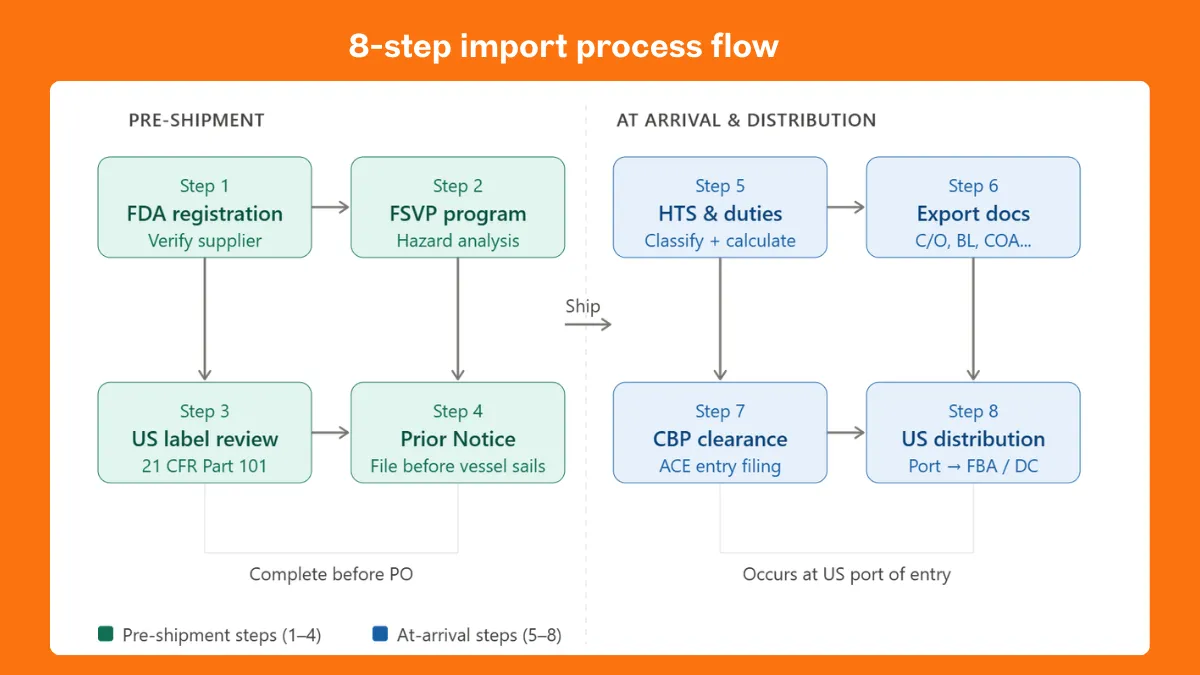
The following eight steps represent the complete import process when you import beverages from Vietnam to USA — from supplier selection to final US distribution. Steps 1 through 4 occur before goods are produced or shipped. Steps 5 through 8 occur at and after arrival. Following this sequence helps US distributors and bulk wholesalers avoid common compliance pitfalls and reduce landed costs.
Step 1 — Verify FDA Food Facility Registration
Before placing any purchase order to import beverages from Vietnam to USA, confirm that your Vietnamese supplier holds an active FDA Food Facility Registration. Under FSMA Section 415, any foreign facility that manufactures, processes, packs, or holds food or beverages intended for US consumption must register with the FDA. Registration must be renewed every two years during the October-December period.
What to request from your supplier:
FDA registration number (ten digits)
Unique Facility Identifier (UFI) — typically a DUNS number
Confirmation of the most recent biennial renewal date
A supplier whose FDA registration has lapsed cannot legally support your effort to import beverages from Vietnam to USA. Shipments from unregistered facilities will be refused entry.
Interfresh status: Active FDA Food Facility Registration, biennial renewal confirmed, DUNS number available on request.
Step 2 — Establish Your Foreign Supplier Verification Program (FSVP)
The Foreign Supplier Verification Program is the most frequently misunderstood — and the most frequently violated — element when you import beverages from Vietnam to USA. Under FSMA, the US importer of record is legally responsible for verifying that each foreign supplier produces food that meets US safety standards.
FSVP is a living compliance program with four required components: hazard analysis, supplier evaluation, verification activities, and record-keeping. For low-risk shelf-stable non-alcoholic beverages such as coconut water or aloe vera drinks, annual supplier questionnaires combined with Certificate of Analysis review often suffice.
Common FSVP failure modes to avoid: FDA issued warning letters in 2025 for missing hazard analyses and inadequate supplier evaluation. Engaging a qualified customs broker or food safety consultant is strongly recommended for first-time importers.
US food labeling requirements under 21 CFR Part 101 differ significantly from other markets. When you import beverages from Vietnam to USA, verify that all labels meet current FDA standards before production begins.
Key requirements include:
Updated Nutrition Facts panel (added sugar declaration, per serving + per container)
Major allergen declarations (including sesame per FASTER Act)
Dual unit net content (metric + US customary)
“Product of Vietnam” country of origin statement
Interfresh advantage: Our in-house design team produces full US-compliant label artwork as standard service for clients who import beverages from Vietnam to USA.
Step 4 — File Prior Notice with FDA
Prior Notice is mandatory for all food and beverage shipments when you import beverages from Vietnam to USA, including samples. It must be filed electronically through the FDA Prior Notice System Interface (PNSI) or ACE before the goods arrive.
Timing requirements:
Ocean freight: 8 hours to 5 days before vessel arrival
Air freight: 4 hours to 5 days before arrival
Incorrect Prior Notice is a leading cause of FDA holds and demurrage charges. Most professional customs brokers handle this as part of their service.
Step 5 — HTS Classification and Duty Calculation
Every product must be classified under a 10-digit HTS code when you import beverages from Vietnam to USA. This determines duty rates and additional requirements.
Key HTS codes for popular Vietnamese beverages:
Coconut water (not concentrated): 2009.89 / 2202.99
Aloe vera drinks: 2202.99.9080
Fruit juice (not concentrated): 2009.xx
Note: Vietnamese goods currently face a 10% Section 122 temporary surcharge (until July 24, 2026). Most non-alcoholic beverages still enjoy low or zero MFN base rates, making import beverages from Vietnam to USA highly competitive versus Chinese-origin products.
Step 6 — Export Documentation from Vietnam
A complete Vietnamese export documentation package is essential for smooth customs clearance when you import beverages from Vietnam to USA. Your supplier should provide:
Commercial Invoice
Packing List
Bill of Lading
Certificate of Origin Form B (VCCI)
Phytosanitary Certificate
Health Certificate
Certificate of Analysis (COA)
Interfresh prepares the full documentation package for every US-bound shipment.
Step 7 — Customs Entry and CBP Clearance
Formal entry (for shipments over $2,500) is filed through CBP’s ACE system by a licensed customs broker. FDA and CBP cross-check Prior Notice and entry data. Proper preparation significantly reduces the risk of refusal when you import beverages from Vietnam to USA.
Step 8 — US Distribution Logistics
Once cleared, goods move to your distribution center, Amazon FBA warehouse, or wholesale network. For imported beverages from Vietnam to USA, West Coast ports (Los Angeles/Long Beach) offer the fastest transit (18–22 days). Shelf-stable beverages typically do not require reefer containers.
Amazon FBA note: We prepare cartons to Amazon inbound specifications, including FNSKU guidance.
Beverage Categories Best Suited for Import Beverages from Vietnam to USA
Coconut water is Vietnam’s flagship export category to the US. Pure, flavored, and coconut water with pulp are all available in cans, Tetra Pak, and PET formats. The 0% MFN base rate makes import beverages from Vietnam to USA particularly attractive in this segment.
Aloe vera drinks are one of Vietnam’s fastest-growing export beverage categories. Multiple flavor profiles, multiple packaging formats, and strong demand in US natural and ethnic grocery channels.
Tropical fruit juice — passion fruit, guava, mango, lychee, soursop — commands premium positioning in US natural trade and specialty retail. Vietnam’s domestic fruit supply makes unit economics substantially better than equivalent products manufactured elsewhere when you import beverages from Vietnam to USA.
Functional and herbal beverages, including basil seed drinks, chrysanthemum tea, and lemongrass ginger, are experiencing strong growth in US multicultural retail, health food, and online channels.
RTD tea in Asian flavor profiles is a well-established import category from Vietnam with existing US retail shelf presence.
Choosing a Compliant Vietnamese Beverage Supplier: The Six-Point Checklist
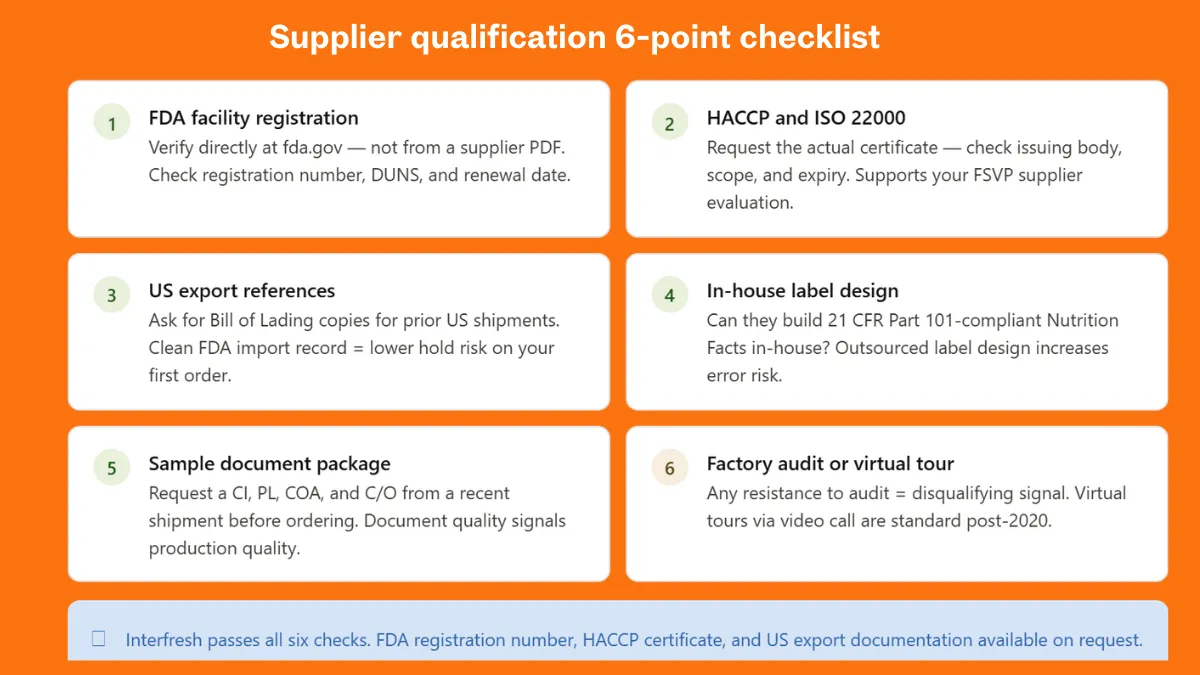
The Six-Point Checklist for Choosing a Compliant Vietnamese Beverage Supplier
The single largest variable in successful imported beverages from Vietnam to USA program is supplier qualification. The following six verification points protect your FSVP compliance, prevent import holds, and ensure product quality meets US retail standards.
1. Confirm active FDA Food Facility Registration. Verify directly at fda.gov, not from a supplier-provided document. Check the registration number, expiry period, and DUNS match.
2. Request current HACCP and ISO 22000 certification. These are the minimum quality certifications required for a US-bound beverage supplier. Check the issuing body (must be an accredited certification body), scope of certification, and current validity date.
3. Review export references. Ask for documented US export history — Bill of Lading copies or FDA import record references. A supplier exporting to the US market for the first time carries higher compliance risk than an established exporter with a clean FDA import record.
4. Assess in-house R&D and label design capability. Can the supplier produce US-compliant Nutrition Facts panels and allergen declarations in-house, or will this be outsourced? In-house capability reduces the risk of labeling errors.
5. Request a sample documentation package. Before placing a production order, ask the supplier to provide a sample Commercial Invoice, Packing List, COA, and C/O for a recent US-bound shipment. The quality of the documentation tells you a great deal about the supplier’s US export competency.
6. Conduct a factory audit or virtual tour. A supplier with nothing to hide welcomes buyer audits. Virtual factory tours via video call are standard post-2020. Any resistance to an audit is a disqualifying signal.
Interfresh meets all six criteria above and has helped multiple US distributors successfully import beverages from Vietnam to USA with minimal compliance risk.
Why US Importers & Distributors Work with Interfresh
Interfresh is an FDA-registered, ISO 22000 and HACCP-certified beverage manufacturer in Southern Vietnam with an established US export record. For US importers, distributors, and bulk wholesalers who import beverages from Vietnam to USA, Interfresh’s US-market capabilities specifically include:
FDA compliance package. Active FDA Food Facility Registration, HACCP-certified production, Certificate of Analysis per batch from an accredited laboratory, and full US export documentation including Form B Certificate of Origin and Phytosanitary Certificate.
US-compliant label artwork. In-house design team produces Nutrition Facts panels to 21 CFR Part 101 specifications, allergen declarations compliant with the FASTER Act, and net content in dual units — reducing the risk of labeling refusal at the port of entry.
FBA-ready export packing. Carton specifications prepared to Amazon FBA inbound requirements. FNSKU label placement guidance provided for importer-side labeling if required.
Sample turnaround in 5 to 7 business days. Physical samples dispatched to US addresses via international courier within 5 to 7 business days of a confirmed product brief.
Established West Coast shipping connections. Regular FCL shipments to Los Angeles and Long Beach ports via established freight carrier relationships. Transit time of 18 to 22 days to West Coast ports.
Start Your Import Project
If you are evaluating sourcing beverages from Vietnam for the US market, Interfresh’s export team is available to scope your project within 24 hours — including a sample quotation, product specification sheet, and FDA documentation summary.
Q: Do I need an import license to import beverages from Vietnam to USA?
No single federal import license is required for non-alcoholic beverages. However, you need a licensed US customs broker for formal entries over $2,500 and must designate an FSVP importer of record. Alcoholic beverages require additional TTB permits.
Q: What FDA certifications does a Vietnamese beverage manufacturer need to export to the USA?
The manufacturer must hold an active FDA Food Facility Registration (renewed every two years). HACCP and ISO 22000 certifications strongly support your FSVP obligations but are not FDA-issued certificates.
Q: What is FSVP and who is responsible for it?
FSVP (Foreign Supplier Verification Program) is the US importer’s legal responsibility under FSMA to ensure foreign suppliers meet US safety standards. The importer of record must maintain hazard analysis, supplier evaluation, and verification records for at least two years.
Q: What are the import duties on beverages from Vietnam to USA in 2026?
Most non-alcoholic beverages face low MFN base rates (0% to 7.9 cents per liter) plus a 10% Section 122 temporary surcharge (until July 24, 2026). Vietnam has no Section 301 tariffs. Always verify exact HTS codes at hts.usitc.gov.
Q: How long does shipping take when I import beverages from Vietnam to USA?
Ocean freight from Ho Chi Minh City to US West Coast ports takes 18–22 days. East Coast transit via Suez Canal takes 28–32 days. Allow 6–10 weeks total from order to port arrival for new products.
Q: What documents are required to import beverages from Vietnam to USA?
Key documents include Commercial Invoice, Packing List, Bill of Lading, Certificate of Origin Form B, Phytosanitary Certificate, Health Certificate, and COA. A reliable supplier like Interfresh prepares the complete package.
Q: Can I import Vietnamese beverages to sell on Amazon USA?
Yes, provided they meet all FDA requirements (facility registration, FSVP, compliant labeling). Amazon FBA also requires specific carton marking and FNSKU labeling prepared at origin.
Q: What is the minimum order quantity for importing beverages from Vietnam?
MOQ varies by product and customization. For a private label with Interfresh, orders typically start at 3,000–5,000 trays. Full custom OEM usually requires one 20ft container.
References
US Trade Representative (USTR) – Vietnam Country Trade Profile 2025–2026. View Report
US Food and Drug Administration (FDA) – FSMA Foreign Supplier Verification Programs (FSVP). Read FDA FSVP Rule
US Customs and Border Protection (CBP) – Harmonized Tariff Schedule (HTSUS). HTS Search Tool