
Global spending on functional beverages reached an estimated USD 106.93 billion in 2026, according to New Hope Network. Inside that number, aloe vera drink demand is moving faster than most categories realize. Distributors, wholesalers, and private label brand owners keep asking the same question. Why is aloe vera drink demand rising now, and will it last. This article answers that question with verified 2026 data, not a repeated list of health benefits. Aloe vera drink demand does not exist on its own. It sits inside a much larger shift in how buyers choose beverages. Understanding that shift matters more than memorizing one growth number.
Aloe Vera Drink Demand Sits Inside a Larger Functional Beverage Shift
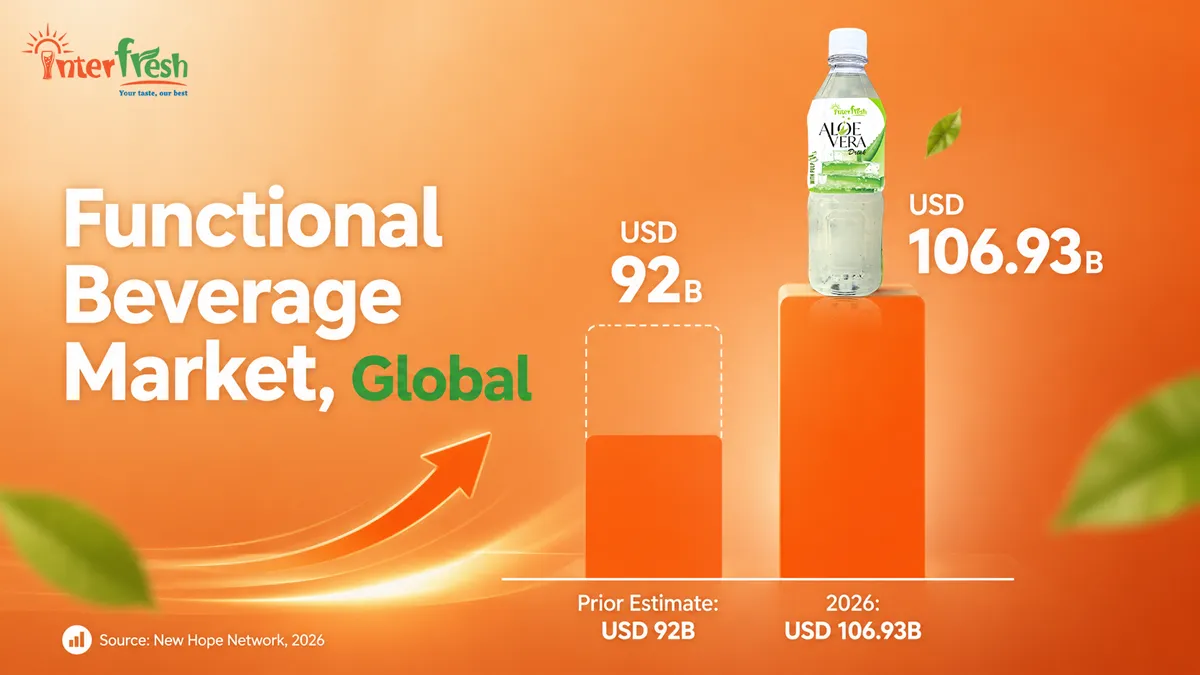
The global functional beverage category grew from roughly USD 92 billion to USD 106.93 billion in 2026. That is not a niche wellness trend anymore. It is where mainstream beverage spending is heading. Aloe vera drink demand benefits directly from this shift.
Newer functional categories still need to build consumer trust from scratch. Aloe vera already carries decades of recognition as a wellness ingredient. That head start is exactly why category growth is accelerating faster than new entrants can match.
Our aloe vera drink manufacturer overview breaks down the flavor and packaging choices behind this shift. It is a useful starting point for buyers comparing suppliers against category growth.
Trend One. Gut Health Has Gone Mainstream, and Aloe Vera Was Already There
Gut health used to be a niche supplement conversation. In 2026, it sits at the center of mainstream beverage strategy. This shift is one of the strongest forces behind rising aloe vera drink demand.
The GLP-1 Ripple Effect on Digestive Wellness Drinks
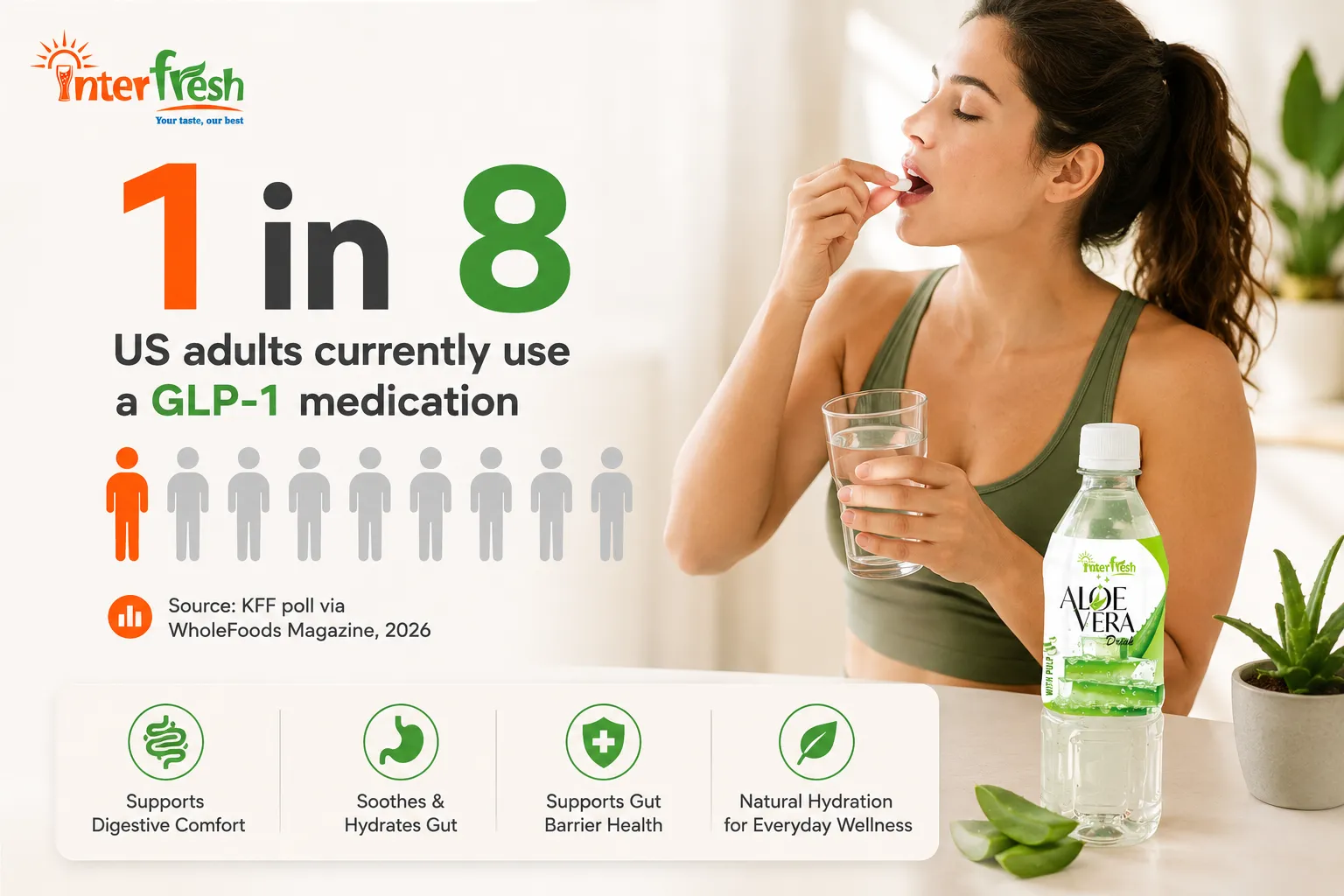
One in eight American adults now uses a GLP-1 medication, based on a 2026 KFF poll cited by WholeFoods Magazine. These consumers actively search for companion products that support digestion and mood. Beverage brands are racing to formulate for this exact need.
This ripple effect reaches far beyond weight management drinks. It is reshaping which functional ingredients buyers prioritize across the entire RTD aisle. Aloe vera sits naturally inside that reshaped priority list.
Acemannan and the Polysaccharide Appeal
Aloe vera’s acemannan content gives it a natural gut health positioning that newer ingredients still have to prove. Innova Market Insights’ 2026 global trend report notes that prebiotic and postbiotic claims now reach snacking and confectionery too.
That expansion signals something important. Gut health is no longer a category. It is becoming a baseline consumer expectation across food and beverage.
Many consumers search for: does aloe vera help digestion. Aloe vera juice is widely marketed for digestive comfort, largely due to its polysaccharide content. Results still vary by formulation and by individual. Brands should present this as a wellness association, not a medical claim.
Trend Two. Consumers Are Rejecting Sugar, Not Function
Consumers are not walking away from functional drinks. They are walking away from sugar. BevSource’s 2026 beverage trend report names sugar reduction and fiber enrichment as this year’s defining reformulation trend.
For aloe vera specifically, this means brands are reformulating toward lower sugar recipes without losing the taste consumers expect. That balance is difficult, which is exactly why suppliers who can deliver it well are gaining share.
Buyers evaluating a private label launch should treat sugar content as a primary formulation decision, not an afterthought. Our private label beverage manufacturers guide walks through how formulation choices affect production timelines.
Trend Three. Aloe Vera Is Leaving the Medicinal Aisle Through Flavor
For years, aloe vera drink meant a bitter, medicinal tasting product aimed at a narrow health enthusiast audience. That positioning is changing fast in 2026.
Flavor Engineering Solves the Bitterness Problem
Mordor Intelligence’s 2026 industry report credits flavor engineering with softening aloe’s natural bitterness while keeping polysaccharide levels intact. This single technical shift is unlocking mainstream retail shelf space that pure aloe formulas could never reach.
Market data on flavored versus unflavored share is mixed, and buyers should read both figures carefully. Grand View Research reported unflavored aloe vera drinks held 62.6 percent of global revenue in 2024. Future Market Insights uses a different methodology. It estimates flavored variants now hold close to 55 percent of category revenue. The direction is clear even where the exact split is not.
Buyers selecting a launch flavor should review real SKU performance data before committing. Our peach aloe vera juice wholesale and grape aloe vera drink export pages cover each signal closely. Our strawberry aloe vera drink bulk page does the same.
Trend Four. Gen Z and Millennial Buyers Are Discovering Aloe Vera Online
Aloe vera drink used to be a health food store product, found by consumers who already knew what they wanted. That discovery path has changed completely.
Online Retail Is Outpacing Traditional Grocery Channels
Online retail for aloe vera based drinks is projected to grow at 12.62 percent CAGR through 2031. This comes from Mordor Intelligence data. That is well ahead of supermarket and hypermarket channel growth, which still holds 41.05 percent of distribution share today.
New Hope Network’s 2026 wellness guide highlights younger consumers researching ingredient function before ever reaching a shelf. For aloe vera drink demand, this means packaging and labeling now do work that a salesperson used to do.
Many consumers search for: is aloe vera juice good for skin. Aloe vera is commonly associated with skin hydration and antioxidant support in consumer research. That association drives much of the younger buyer interest. Brands increasingly reference this on pack, alongside digestive claims.
Trend Five. Retail Shelf Space for Aloe Vera Drink Is Expanding
Shelf space is not static. Retailers actively decide where to invest it, and 2026 shows clear signals for this category.
In June 2026, ALO Drink’s parent company moved its Original line to fully recyclable, BPA free PET bottles. That is not a small packaging tweak. It signals a leading brand investing in long term category infrastructure, not just a seasonal flavor launch.
Whole Foods Market’s Trends Council published its 2026 outlook in late 2025. Gut health and functional beverages again ranked among its top retail priorities. Aloe vera drink sits directly inside that priority category, which explains why buyer interest keeps climbing through 2026.
Where Aloe Vera Drink Demand Concentrates. A Regional Snapshot
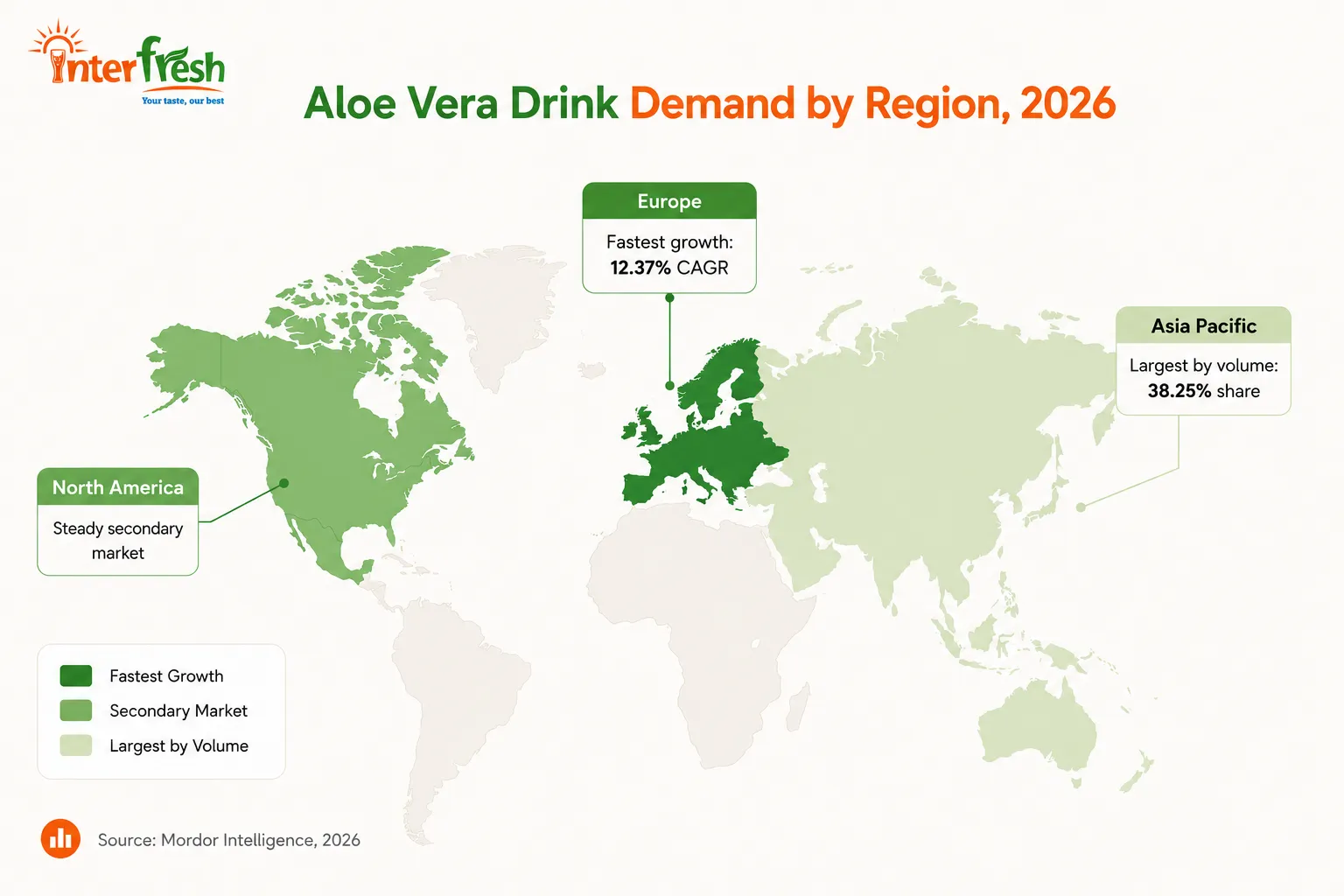
Demand growth is not evenly distributed. Understanding where it concentrates helps distributors plan market entry with more precision.
North America and Europe Are Growing Fastest
Europe is currently the fastest growing region for aloe vera based drinks worldwide. Mordor Intelligence projects a 12.37 percent CAGR there. North America remains a strong secondary market, driven largely by the trends already covered above.
Asia Pacific Remains the Volume Engine
Asia Pacific still commands 38.25 percent of global aloe vera based drink value as of 2025. Cultural familiarity with the ingredient keeps volume high, even as percentage growth slows compared to newer markets.
Buyers who need exact market size figures by region can use our dedicated market size analysis. It breaks the numbers down further. Contact our export team if you would like early access to that data ahead of publication.
What Rising Aloe Vera Drink Demand Means for Distributors and Wholesalers
Growth statistics only matter if they change how a buyer acts. Here is what these five trends mean in practical terms.
| Trend | Consumer Driver | Action for Buyers |
|---|---|---|
| Gut health mainstreaming | GLP-1 companion product search | Prioritize digestive wellness messaging on pack |
| Sugar reduction | Clean label preference | Request lower sugar formulation options early |
| Flavor engineering | Bitterness barrier removed | Test flavored SKUs before unflavored ones |
| Online discovery | Ingredient research before purchase | Invest in clear, factual product copy |
| Retail shelf expansion | Retailer category investment | Move now, before shelf space competition increases |
The Private Label Window Is Open Right Now
Supermarket and hypermarket channels still hold the largest distribution share, but online retail is catching up quickly. That gap creates a window for new private label entrants before either channel becomes saturated.
Distributors who move in the next two quarters are entering ahead of the curve, not behind it. Our bulk aloe vera drink page outlines current SKU availability for buyers ready to act on this window.
How to Read These Trends Before You Commit to a Supplier
Trend data is only useful if it shapes a real sourcing decision. Before selecting a supplier, ask three questions.
- Does the flavor align with the sugar reduction trend, or does it fight against it.
- Does the packaging format suit online sales, retail shelf placement, or both.
- Can the supplier document gut health and clean label claims with real certification, not marketing language alone.
Buyers who answer these honestly avoid the most common private label mistake. They launch a product built for last year’s shelf, not this year’s buyer.
How Interfresh Supports Brands Riding Aloe Vera Drink Demand
Interfresh manufactures aloe vera drinks in Vietnam for distributors, wholesalers, and private label brand owners. Buyers across the United States, Europe, Australia, and the Middle East rely on this supply.
Flavors, Packaging, and Certifications Built for This Moment
Interfresh currently produces 10 aloe vera flavors, including Original, Strawberry, Peach, and Grape. Formats include 360ml PET, 500ml PET, and 320ml can. Every production line holds FDA registration, HALAL certification, ISO 22000, GMP, and HACCP as standard.
Buyers targeting the United States should read our aloe vera drink manufacturer for USA importers page. It covers FDA and FSVP requirements in full. Buyers targeting Australia should review our aloe vera drink import Australia guide before placing a first order.
Our dedicated custom label and OEM flavor guide covers exact MOQ and lead time details. It walks through custom label specifications step by step. Request a free sample or ask our export team for an FOB quote to see current lead times firsthand.
Frequently Asked Questions
What is the best time to drink aloe vera juice? Yes, timing does affect how consumers experience aloe vera juice, with many preferring it before meals for digestive support. Morning consumption is also common among wellness focused buyers. Neither timing changes the core nutritional profile of the drink.
Is bulk aloe vera drink supply available for private label brands? Yes, bulk aloe vera drink supply is widely available for private label brands sourcing from Vietnam. Suppliers typically require a minimum order per flavor, with mixed flavor containers accepted under agreed terms. Buyers should confirm certification documents before placing a first order.
How do I find an aloe vera drink supplier for import? The most reliable path is working directly with a certified Vietnam based manufacturer rather than a trading intermediary. Look for FDA registration, HALAL certification, and ISO 22000 as baseline requirements. Request samples before committing to a full container order.
What is the MOQ for aloe vera drink OEM from Vietnam? MOQ for aloe vera drink OEM from Vietnam typically starts at 400 trays per flavor. Mixed flavor containers are often accepted at lower per flavor minimums. Exact terms vary by supplier and packaging format.
Is the aloe vera drink market still growing in 2026? Yes, the aloe vera drink market continues to grow through 2026. Most industry reports project a compound annual growth rate above 10 percent through 2031. Growth is strongest in Europe, with Asia Pacific remaining the largest market by volume. North America is expanding steadily behind functional beverage demand.
Does flavored aloe vera drink sell better than unflavored? This depends on the market and distribution channel, with reports showing different results. Some data shows unflavored still holding a majority revenue share globally. Other data shows flavored variants gaining ground quickly as new products launch.
References
- New Hope Network. 2026 Wellness Beverage Trends eGuide. 2026.
- Mordor Intelligence. Aloe Vera Based Drinks Market Overview, Size and Trends. 2026.
- Grand View Research. Aloe Vera Drinks Market Size, Share and Trends Report, 2030. 2026.
- Future Market Insights. Aloe Vera Drinks Market Size, Trends and Insights, 2025 to 2035. 2025.
- WholeFoods Magazine. What’s Driving Functional Foods and Beverages in 2026. 2026.
- BeverageDaily. GLP 1 Drinks Take Off as Brands Race for Functional Growth. March 2026.
- Innova Market Insights. Top 10 Food and Beverage Trends 2026, Global Report. 2026.
- Specialty Food News. ALO Drink Unveils BPA Free, Recyclable PET Bottles. June 2026.
- Whole Foods Market. Top Food and Beverage Trends for 2026, Trends Council. October 2025.
- BevSource. 2026 Beverage Trends, the Flavors, Functions and Forces. 2026.
Aloe vera drink demand keeps shifting as new formulations and channels mature. For deeper sourcing detail, explore our aloe vera drink manufacturer hub, our USA import guide, and our Australia import guide. Our flavor pages for peach, grape, and strawberry aloe vera drink cover each flavor in depth. Contact our export team for current samples and quotations.