
Private label beverage manufacturers are transforming how modern brands enter and scale in the global drink market. Instead of investing in factories, businesses can now partner with professional private label beverage manufacturers to create custom-branded beverages with full control over quality, flavor, and packaging.
This guide is Part 1 of the Interfresh Private Label Beverage Playbook. Each part builds on this one, moving from core concepts here into sourcing, cost and market specific execution next. For the full production model behind everything in this playbook, start with our OEM and private label beverage manufacturer guide for Vietnam. Bookmark this page as your reference point through the rest of the series.
What are private label beverage manufacturers?
Imagine putting your brand name on a drink that’s 100% yours – the flavor, the design, the story. That’s the magic of private label beverage manufacturers.
These beverage manufacturing partners create ready-to-market drinks that reflect your brand’s identity without the need to build your own factory. They handle production, compliance, and packaging, you own the brand. With a high profit margin. This is a core piece of Interfresh’s OEM and private label beverage manufacturer guide for Vietnam, which covers the full production model in depth.
The rise of private label beverage manufacturing
In today’s world, where consumers crave authenticity, transparency, and healthier choices, private labels are booming. Supermarkets, cafés, and startups alike are launching their own beverage lines to capture this growing demand.
Private labels no longer simply provide shoppers with competitive price points, it is now starting to win-out on quality, cost, and shopper experience
Source: NielsenIQ (2024)
Vietnam factories are capturing much of this shift, a trend our 7 step guide to starting a beverage brand explores from the buyer’s side.
Regional profit trends in private label beverages
- Europe: Hold 35–37% of the FMCG market. Countries such as Spain, Belgium, and Germany have exceeded the 40% threshold. Persistent inflation drives price-sensitive behavior and expansion of store-brand beverage manufacturing lines.
- North America: The Circana Store Brand Insights 2024–2025 report shows the private label FMCG share at ~20–21% in early 2025. Consumers seeking value without compromising quality. Demand for functional drinks – vitamin-enriched water, energy drinks, kombucha – continues to rise, creating opportunities for private label beverage manufacturers.
- Middle East & Africa: Projected to reach USD 35 billion by 2026, offering significant margin potential for new private label drink entrants.
Comparison table: OEM, ODM, White Label, Private Label in the beverage industry
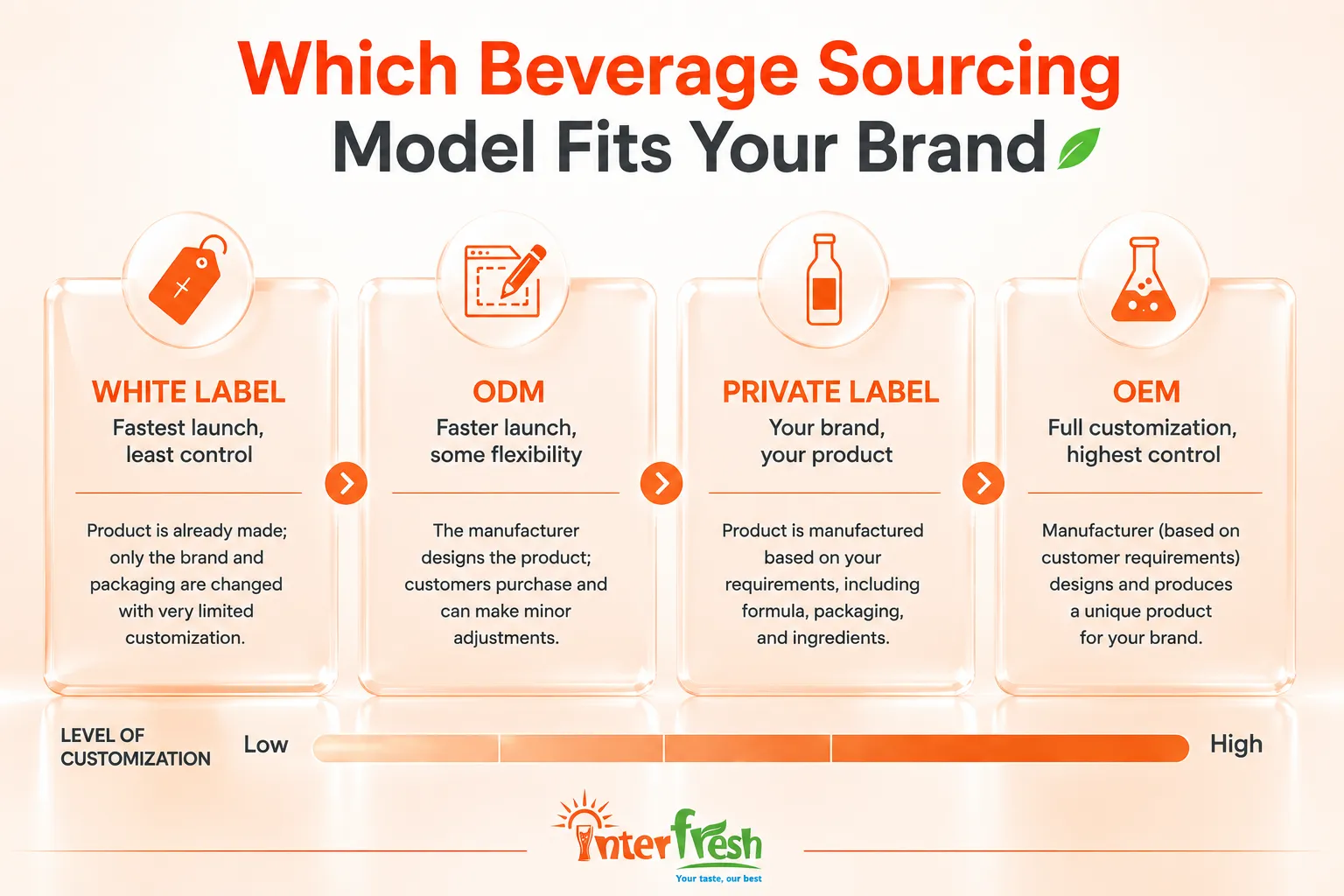
While the idea sounds simple, the business models behind it – OEM, ODM, Private Label, and White Label, each come with different levels of control, cost, and customization.
Let’s break down how these four models compare
| Criteria | Private Label/OEM (Original Equipment Manufacturer) | ODM (Original Design Manufacturer) | White Label |
|---|---|---|---|
| Definition | Product is manufactured based on custom requirements, including formula, packaging, and ingredients. | The manufacturer designs the product themselves; customers purchase and can make minor adjustments. | Product is already made; only the brand and packaging are changed with very limited customization. |
| Who designs the product? | Manufacturer (based on customer requirements) | Manufacturer | Manufacturer |
| Level of customization | High: customize formula, packaging, and unique features | Medium: change labels, colors, some minor elements | Low: almost identical to the original product |
| Advantages | Strong brand ownership and differentiation. Fully customizable to fit brand strategy. Strong market differentiation | Faster product launch than OEM. Product often tested in the market | Very quick to launch. Lower production and R&D costs. Easy market entry |
| Disadvantages | Higher cost compared to White Label. Requires more expertise in product development | Less flexibility compared to OEM. Can be harder to stand out | Little to no product differentiation. Highly competitive, often price-focused |
| Best suited for | Established or growing brands that want a unique product and strong identity | Brands seeking a semi-custom product with faster entry into the market | Startups or brands wanting to test the market quickly and cheaply |
Who should build a private label beverage brand?
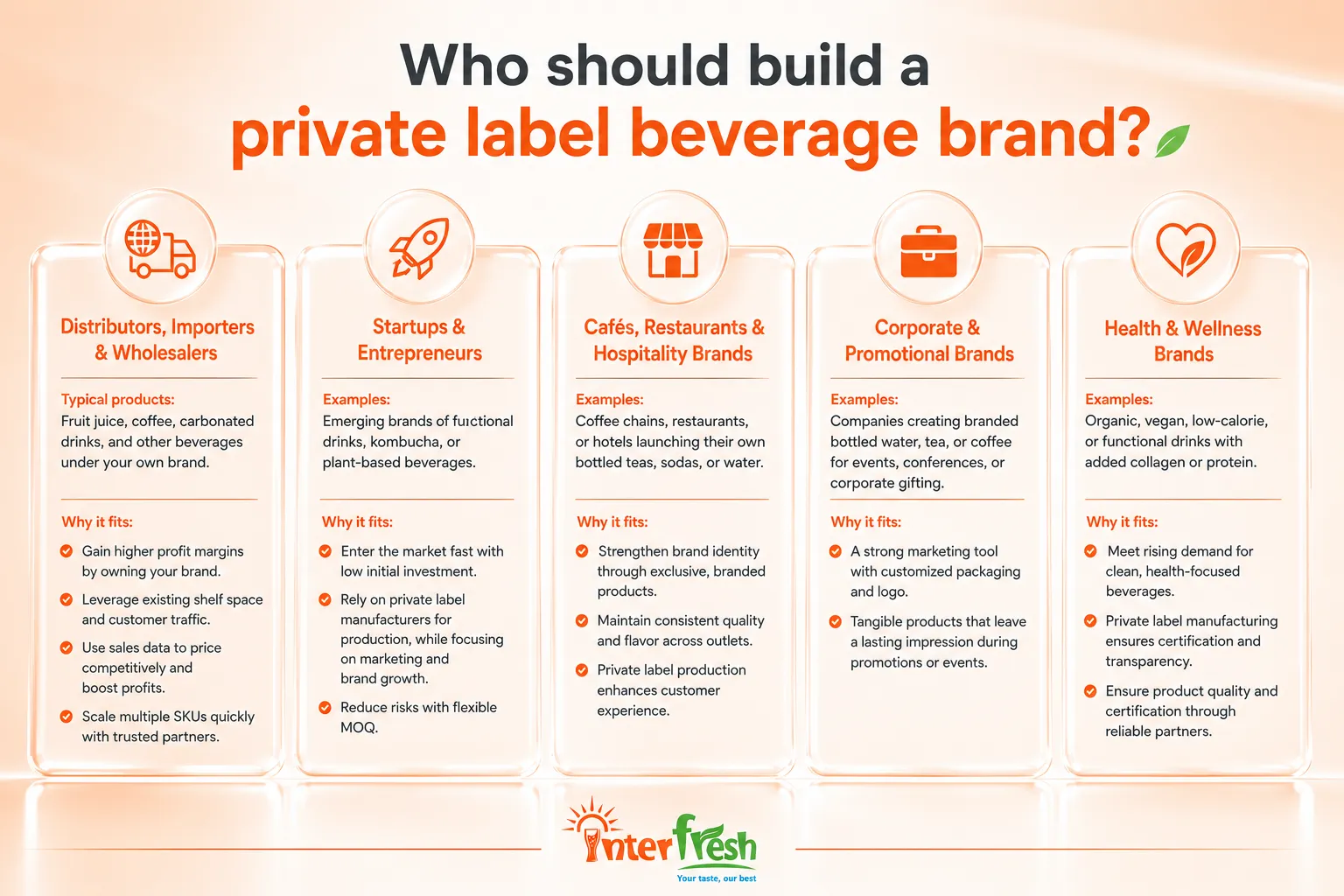
Partnering with private label beverage manufacturers is not just for large corporations. It’s a strategic move for any business that wants to control quality, increase margins, and build brand differentiation.
Distributors, Importers & Wholesalers
Typical products: Fruit juice drink, coffee, carbonated drinks, and other beverages under your own brand.
Why it fits:
- Gain higher profit margins by owning your brand.
- Leverage existing shelf space and customer traffic.
- Use sales data to price competitively and boost profits.
- Scale multiple SKUs quickly with private label beverage manufacturing partners. Review our MOQ guide for beverage OEM Vietnam before setting your first SKU count.
Startups & Entrepreneurs
Examples: Emerging brands of functional drinks, kombucha, or plant-based beverages.
Why it fits:
- Enter the market fast with low initial investment.
- Rely on private label beverage manufacturers for production, while focusing on marketing and brand growth.
- Reduce risks with flexible Minimum Order Quantities (MOQ).
Cafés, Restaurants & Hospitality brands
Examples: Coffee chains, restaurants, or hotels launching their own bottled teas, sodas, or water.
Why it fits:
- Strengthen brand identity through exclusive, branded products.
- Maintain consistent quality and flavor across outlets.
- Private label beverage production enhances customer experience.
Corporate & Promotional brands
Examples: Companies creating branded bottled water, tea, or coffee for events, conferences, or corporate gifting.
Why it fits:
- A strong marketing tool with customized packaging and logo.
- Tangible products that leave a lasting impression during promotions or events.
Health & Wellness brands
Examples: Organic, vegan, low-calorie, or functional drinks with added collagen or protein.
Why it fits:
- Meet rising demand for clean, health-focused beverages.
- Private label drink manufacturing ensures certification and transparency. Our clean label beverage manufacturer guide covers exactly what that transparency should include on pack.
- Ensure product quality and certification through reliable partners.
Why private label beverages are profitable
Private label beverage manufacturing delivers strong financial advantages due to significant cost savings, better pricing control, and the ability to use customer data to optimize sales and inventory.
Low marketing & distribution costs
- Explanation: Private label beverage brands do not need huge brand advertising budgets, since products are sold under existing retailer brands or through established sales channels.
- Profit impact: Lower operational costs directly increase profit margins.
Pricing control & brand positioning
- Explanation: Private label owners set their own prices, independent of the market prices of large, established brands.
- Profit impact: Flexible pricing allows brands to remain competitive while maintaining healthy margins.
Customer data utilization
- Explanation: Sales and shopper behavior data can be used to optimize SKUs, bundle offers, and plan promotional timing.
- Profit impact: Improves sales performance and reduces inventory risks.
Lower production costs
- Explanation: Bulk order volumes (MOQ) or direct partnerships with private label beverage manufacturers reduce middlemen, per-unit costs.
- Profit impact: Lower cost of goods sold (COGS) results in higher gross profit. Our cost to manufacture beverages in Vietnam guide breaks these savings down by product category.
Understanding Financial Tiers (Costs per SKU)
Based on our market analysis for Vietnam, businesses developing a private label beverage should budget for two key types of costs.
- Private Label Fee: Typically ranges from $1,500 – $2,000 per SKU. This covers research and development to create or customize the recipe, label and packaging design, printing, and compliance with local regulations on product quality and labeling.
- Production Cost: Usually $2,000 – $4,000 for the first batch of 10,000 units per SKU. The exact amount depends on the type of beverage and the formulation quality. Packaging choices also play a major role – PET bottles are generally more cost-effective compared to aluminum cans or glass bottles, while premium or specialty packaging technologies can raise costs significantly.
Financial Tiers
| Tier | Production Volume (units) | Cost per Unit (USD) | Typical Fixed Costs (USD) | Key Cost Drivers |
|---|---|---|---|---|
| Small Volume | 5,000 – 10,000 | $0.40 – $0.60 | Private Label Fee: $1,500 – $2,000. Initial Production (10,000 units): $2,000 – $4,000 | Higher R&D expenses, small-scale packaging, less favorable raw material pricing |
| Medium Volume | 20,000 – 50,000 | $0.28 – $0.40 | Private Label Fee: $1,500 – $2,000. Initial Production: $2,000 – $4,000 | Optimized procurement, improved packaging efficiency, reduced overhead |
| Large Volume | >100,000 | $0.18 – $0.28 | Private Label Fee: $1,500 – $2,000. Initial Production: $2,000 – $4,000 | Economies of scale, bulk material discounts, automated packaging lines |
Private Label Beverage Success Stories From Leading Retailers
Private label beverage manufacturing is not a small experiment for a handful of brands. It built some of retail’s largest and most trusted store brand programs.
Costco’s Kirkland Signature is one of the most recognized private label programs globally, spanning beverages alongside thousands of other SKUs. The brand built its reputation on consistent quality at a lower price point. Private label beverage manufacturers now replicate that model for far smaller order volumes.
Trader Joe’s took this further. Public reporting consistently places its private label penetration above 80 percent of total shelf space, beverages included. That level of brand control is only possible through dedicated private label beverage manufacturing partnerships, not one off production runs.
Walmart’s Great Value and Target’s Good and Gather show the same pattern at national scale. Each retailer used private label beverage lines to build price competitive, high margin categories under full brand control.
The lesson for a smaller distributor or startup is simple. Private label beverage manufacturing scales down as well as it scales up. Many of these category shifts follow the same demand signals covered in our top healthy drink trends report. Any new private label brand should review it before finalizing a formula.
5 Fastest steps to complete your private label beverage order
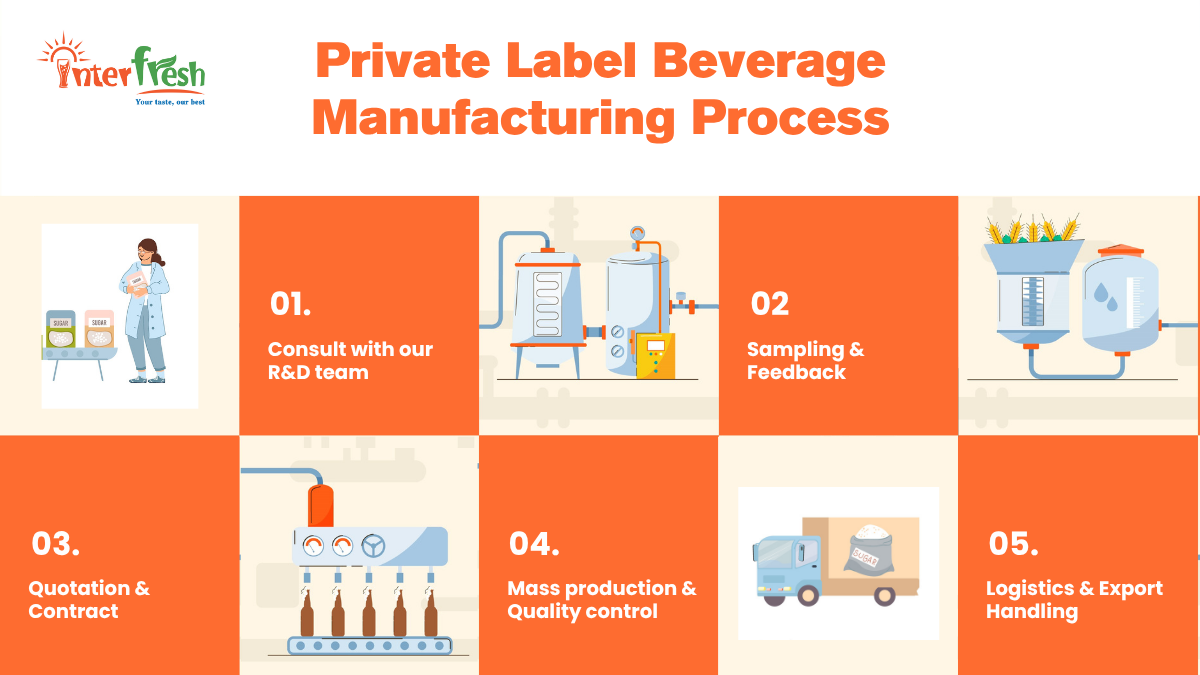
Interfresh’s Private label beverage manufacturing process
Most private label drink manufacturers in Vietnam take around 3–4 months to complete an export-ready order. From product design approval to mass production and ready for shipment.
However, Interfresh, one of the leading private label drink manufacturers, streamlines this entire process up to 2.5× faster — while maintaining consistent quality standards.
Step 1. Consult with our R&D team
Got a drink idea you want to bring to life? Send it to us.
Our R&D experts will help you choose the right ingredients, formula, packaging size, and design that match your brand identity and target market.
We also analyze beverage trends, consumer insights, and regional preferences to ensure your drink has strong market positioning from day one. With experience working with beverage private labels and OEM brands worldwide, we create formulas that meet the strict standards of global markets.
Step 2. Sampling & Feedback
Within 5–7 days after confirming the concept, Interfresh sends your first product samples for testing. We gather your feedback and make fast adjustments until you’re completely satisfied.
Once finalized, we confirm all product specifications:
Ingredients, volume, and packaging type
Labeling design and HS code
Required certifications (HACCP, ISO, FDA, etc.)
This agile sampling process helps private label beverage manufacturers move from idea to approval in record time.
Step 3. Quotation & Contract
Interfresh provides a transparent quotation, flexible MOQ options, and straightforward contract terms. Which is suitable for both new distributors and established brands expanding their portfolios. See our full MOQ guide for beverage OEM Vietnam to prepare realistic volume expectations before this call.
Our international sales team assists with secure payment terms, export documentation, and customs clearance, simplifying every step of your OEM drink manufacturing journey.
Step 4. Mass production & Quality control
Interfresh operates modern, HACCP and ISO 22000-certified production lines to ensure quality at every stage.
Ingredients are sourced from GlobalGAP-certified farms.
Our closed filling and sterilization systems preserve freshness and natural flavor.
Every batch includes a COA (Certificate of Analysis) before shipment.
Thanks to automation and synchronized production workflow, Interfresh completes private label beverage production up to 2.5× faster than the industry average.
Step 5. Logistics & Export handling
From packaging and inspection to export documentation and global shipping, Interfresh handles every step with precision. Our strong logistics network and international partners guarantee on-time delivery, optimized freight costs, and smooth customs clearance across Asia, the Middle East, Africa, and Europe. For Middle East specific requirements, our Halal beverage supplier guide covers documentation retailers expect.
After shipment, we track performance, gather feedback, and support your reorders or product extensions. Ensuring your private label drink brand stays ahead of market trends.
Private Label Beverage Risks and Misconceptions Beginners Should Know
Private label beverage manufacturing carries real advantages, but a few myths still stop beginners from starting. Clearing these up protects your first order.
Myth: private label means lower quality. Reality is different. Certification requirements, including HACCP, ISO 22000 and FDA registration, apply the same way regardless of brand size. Our comparison of ISO 22000, HACCP and BRC certifications explains exactly what each standard verifies.
Myth: minimum order quantity is always massive. Many beginners assume they need tens of thousands of units to start. In practice, private label beverage manufacturers structure MOQ in tiers. Our MOQ guide for beverage OEM Vietnam breaks down real volume options, from a small market test upward.
Myth: outsourcing means losing control. A private label brand owner still controls formula direction, packaging, labeling and pricing. The manufacturer executes production, not brand strategy. This is the core difference private label buyers should hold onto through every stage of sourcing.
Real risk: skipping documentation review. A private label beverage order needs a confirmed Certificate of Analysis, correct HS code, and complete export paperwork. Skipping any of these can stall a shipment at customs. Buyers shipping to the US should review our FDA requirements for importing beverages from Vietnam guide first.
Real risk: comparing origins on price alone. Cost matters, but landed cost, certification depth and lead time matter just as much. Our Vietnam versus China OEM beverage comparison covers this trade off in full.
Private label beverage manufacturing rewards buyers who plan around these risks early, not after a first shipment runs into trouble.
Why can Interfresh complete OEM Orders faster without compromising quality?
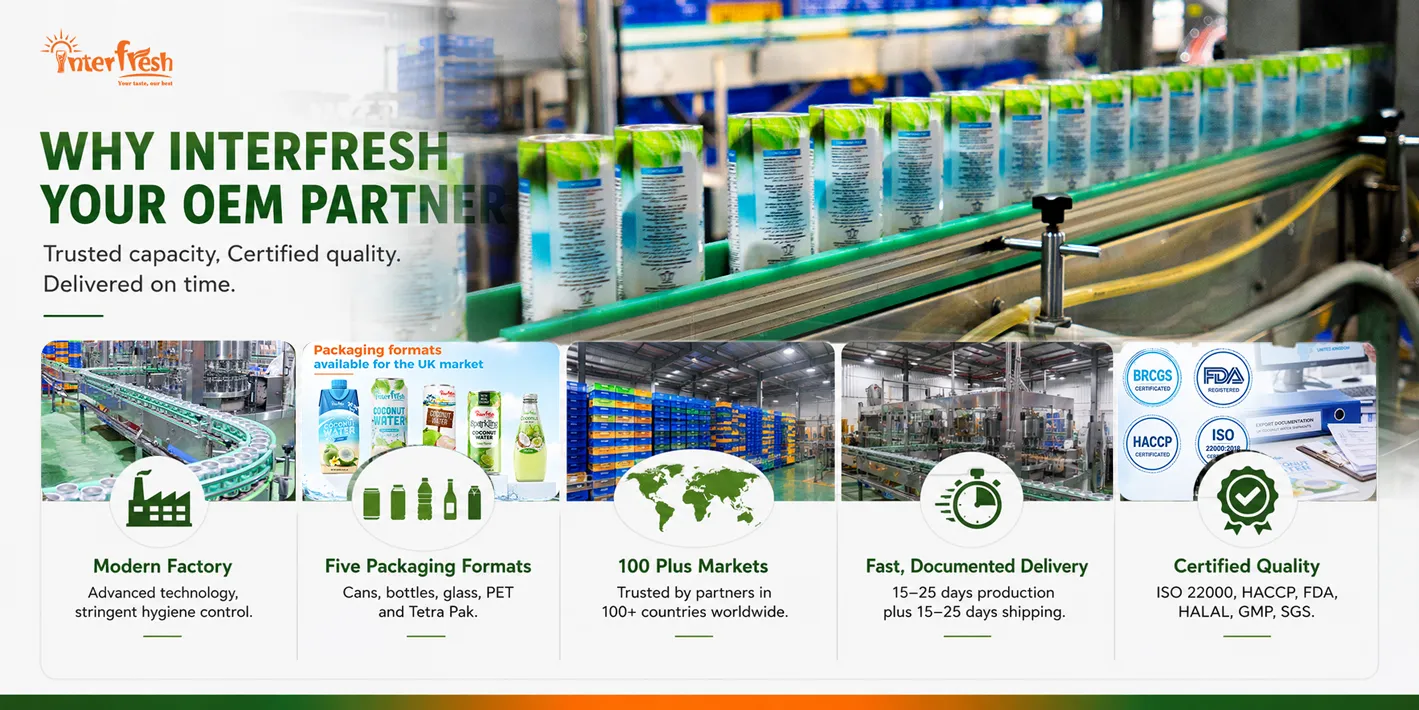
Integrated OEM System: All processes – R&D, design, production, and logistics – operate under one roof. This eliminates third-party delays and ensures seamless coordination among private label drink manufacturers.
Modern Technology: Fully automated aseptic filling and sterilization lines shorten production time while maintaining taste integrity and food safety.
Experienced Global Team: Our OEM specialists export to 40+ countries across Asia, the Middle East, Africa, and Europe. Ensuring full regulatory compliance for private label beverage brands.
Real-Time Communication: You receive daily updates and instant feedback via our project management system, keeping every drink private label order transparent and on schedule.
Interfresh’s private label drink categories
Interfresh offers a full portfolio of export-ready private label drink lines, designed for distributors and brand owners worldwide.
Fruit juice drinks
Over 14 premium juice ranges are made from 100% tropical fruits. From classic apple and grape to exotic mango and pineapple blends. Each formulation is crafted for diverse global palates, from organic to sugar-free. Offered in more than 12 aluminum can sizes for flexible, shelf-ready packaging.
Coconut water & Aloe vera drinks
We harness the pure refreshment of fresh Bến Tre coconuts, combine aloe vera’s natural benefits with subtle fruit notes. Available in aluminum cans or PET bottles, ideal for distribution across Asia and Europe.
Basil seed & Herbal infusions
Basil seed and chia seed beverages combine texture and nutrition with energizing fruit juices. Herbal and tea infusions offer aromatic flavors and natural wellness benefits.
Available in transparent PET or glass bottles, our products deliver a visually striking shelf presence while preserving maximum nutrition.
Sparkling & Functional beverages
Targeting health-conscious consumers, these drinks combine trending flavors with low-sugar or functional formulations. Sleek slim-can packaging delivers a youthful, on-the-go appeal for dynamic markets.
Energy drinks & Coffee-Based drinks
From classic energy formulas to vitamin-enriched blends and RTD coffee, Interfresh uses Vietnamese Arabica and Robusta beans for rich, authentic flavor. Ideal for private label beverage manufacturers targeting premium convenience drinks.
Tips for B2B buyers to speed up your OEM process
If you’re ready to start your own OEM beverage order, take a look at our quick tips to speed up your market launch. Buyers targeting the Middle East should also read our Halal beverage OEM manufacturer guide at this stage, not after formula approval.
4 Tips to speed up your private label beverage manufacturing
Don’t forget to download Interfresh’s latest product catalog and contact our team for a detailed consultation on building a successful private label beverage strategy today.
Compiled and analyzed by the Interfresh Marketing Team, specializing in private label beverage manufacturing and export market insights
What Comes Next in the Private Label Beverage Playbook
This playbook continues past definitions and process. The next parts cover the numbers behind private label beverage manufacturing in more depth.
Our cost to manufacture beverages in Vietnam guide goes further than the financial tiers above. It breaks pricing down by product category. Buyers ready to map their first purchase order have a next step. Our 7 step guide to starting a beverage brand picks up exactly where this guide leaves off.
Market specific parts of this playbook cover more ground. Halal certification for the Middle East, clean label positioning for Australia, and US import compliance all follow. Contact our team to get notified as each new part publishes. Or request a free sample now to start your own private label beverage order today.
FAQs
Who manufactures private label products?
Private label products are made by specialized private label beverage manufacturers who produce drinks according to each retailer’s specifications, branding, and quality standards.
Should national-brand manufacturers also supply private label brands?
National-brand manufacturers can benefit from supplying private label products by maximizing factory utilization, reducing idle capacity, and tapping into new consumer segments. This strategy allows them to boost revenue streams while strengthening long-term partnerships with retailers.
Should I private label my product?
Private labeling allows businesses to create a unique brand identity, maintain control over product quality, and potentially achieve higher profit margins. It’s a strategic choice for entrepreneurs who want to stand out in competitive markets while building customer loyalty.
Why are private label brands cheaper?
Private label brands are typically priced lower because they require minimal marketing budgets, have streamlined supply chains, and benefit from bulk production efficiencies. These cost advantages make them an attractive option for price-sensitive consumers without sacrificing quality.
References
PLMA & NielsenIQ. (2025, Q2). International Private Label Market Shares Report. Retrieved from https://www.plmainternational.com → Industry News → Market Shares → Latest NielsenIQ/PLMA data 2025.
NielsenIQ. (2025). Private Brands U.S. Market Report 2024–2025. Retrieved from https://nielseniq.com/global/en → News & Insights → Private Label Trends.
Circana. (2025). Store Brands Continue Growth Into 2025. Retrieved from https://www.circana.com → Press Releases → Grocery & Retail.
Mordor Intelligence. (2025). Middle East & Africa Private Label Food & Beverages Market – 2025 Update. Retrieved from https://www.mordorintelligence.com → Search “Middle East and Africa Private Label Food and Beverages Market”.
Investopedia. (2025). What Is a White Label Product, and How Does It Work?. Retrieved from https://www.investopedia.com/terms/w/white-label-product.asp
Investopedia. (2025). Private Label Credit Cards: Overview, Benefits and Examples. Retrieved from https://www.investopedia.com/terms/p/private-label-credit.asp
NielsenIQ. Vietnam Beverage Market Overview. NielsenIQ Research Report, 2024.
Euromonitor International. Soft Drinks in Vietnam 2024. Euromonitor Market Analysis, 2024.
Ministry of Industry and Trade (Vietnam). Ingredient and Packaging Price Report, Q3 2024.
Vietnam Sugar Association. Annual Price Update and Industry Trends, 2024.
Startup Case Studies: Private Label Beverage Brands in Vietnam, 2024.
Continue Building Your Private Label Beverage Playbook
These guides carry the playbook forward, covering cost, compliance and market specific execution in more depth.
- OEM and Private Label Beverage Manufacturer Guide for Vietnam
- MOQ Guide for Beverage OEM Vietnam
- Cost to Manufacture Beverages in Vietnam 2026
- How to Start a Beverage Brand: 7 Steps
- Vietnam vs China OEM Beverage Comparison
- ISO 22000 vs HACCP vs BRC Certifications
- FDA Requirements for Importing Beverages from Vietnam
- Clean Label Beverage Manufacturer for Vietnam and Australia
- Halal Beverage OEM Manufacturer for the Middle East
- Halal Beverage Supplier for the Middle East
- Top Healthy Drink Trends in the US Market