
Summer is peak sourcing season. Most distributors, bulk wholesalers and private label brand owners lock in suppliers before the next retail cycle. A Vietnam vs China OEM beverage decision is rarely simple. Cost, certification, minimum order quantity and tariff exposure can each shift the total landed price by double digits.
This guide breaks down the Vietnam vs China OEM beverage question using 2026 data. You will find cost structures, MOQ ranges, certification requirements, lead times and the tariff rules that changed this year. If you are comparing suppliers before a bulk order, bookmark this page.
For the full manufacturing model, see our OEM and private label beverage manufacturer guide for Vietnam. It explains OEM, ODM, private label and white label in plain terms.
Vietnam vs China OEM Beverage: Quick Comparison Table
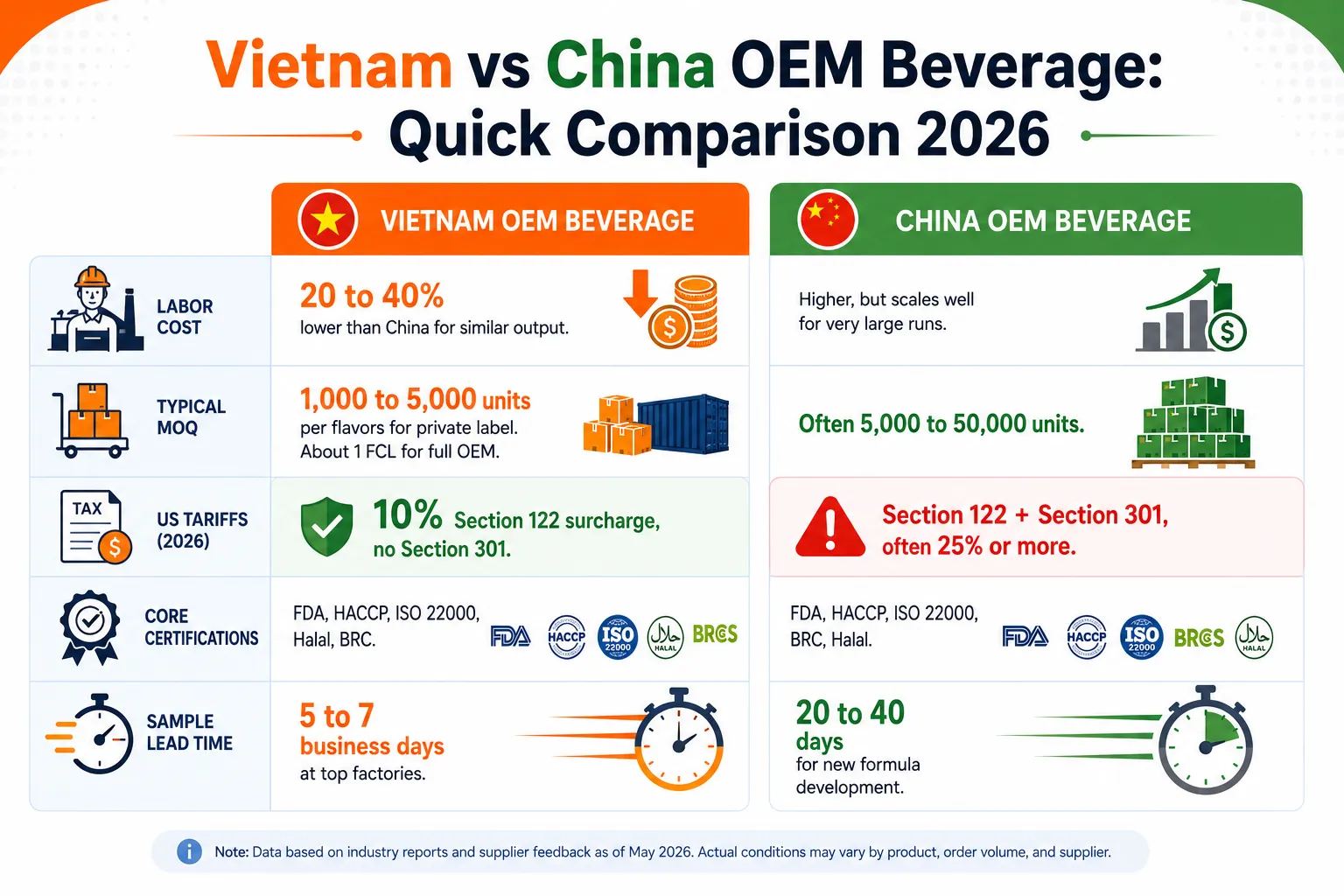
Buyers rarely have time to read a full report before a first call. The table below summarizes the core differences for a Vietnam vs China OEM beverage evaluation.
| Factor | Vietnam OEM Beverage | China OEM Beverage |
| Labor cost | 20 to 40 percent lower than China for similar output | Higher, but scales well for very large runs |
| Typical MOQ | 1,000 to 5,000 units per flavors for private label, about 1 FCL for full OEM | Often 5,000 to 50,000 units |
| US tariff 2026 | 10 percent Section 122 surcharge, no Section 301 | Section 122 plus Section 301, often 25 percent or more |
| EU tariff advantage | EVFTA, often 0 percent duty on qualifying goods | No equivalent EU free trade agreement |
| Core certifications | FDA, HACCP, ISO 22000, Halal, BRC | FDA, HACCP, ISO 22000, BRC, Halal, also common |
| Raw material access | Direct access to coconut, aloe vera, tropical fruit | Often imports tropical ingredients, adds cost |
| Sample lead time | 5 to 7 business days at top factories | 20 to 40 days for new formula development |
| Best fit | Startups, private label brands, mid volume distributors | Very large volume buyers needing maximum scale |
Keep this table as a quick reference. The sections below explain why each row looks this way, and what it means for your purchase order.
Cost Comparison: Vietnam vs China OEM Beverage Pricing in 2026
Cost is usually the first question a distributor asks. Unit price alone hides the full picture in a Vietnam vs China OEM beverage comparison.
Labor and Production Cost
Vietnam manufacturing labor costs run 20 to 40 percent lower than equivalent Chinese production. Labor here sits under 25 percent of the global average. Worker productivity also keeps climbing year over year. For a bulk wholesaler placing a full container order, that gap can translate directly into margin.
China still holds an edge on very large production runs. Its mature supply chain reduces per unit overhead at true scale. If your order volume regularly exceeds several container loads per SKU, China can partially close the labor cost gap.
Raw Material Sourcing
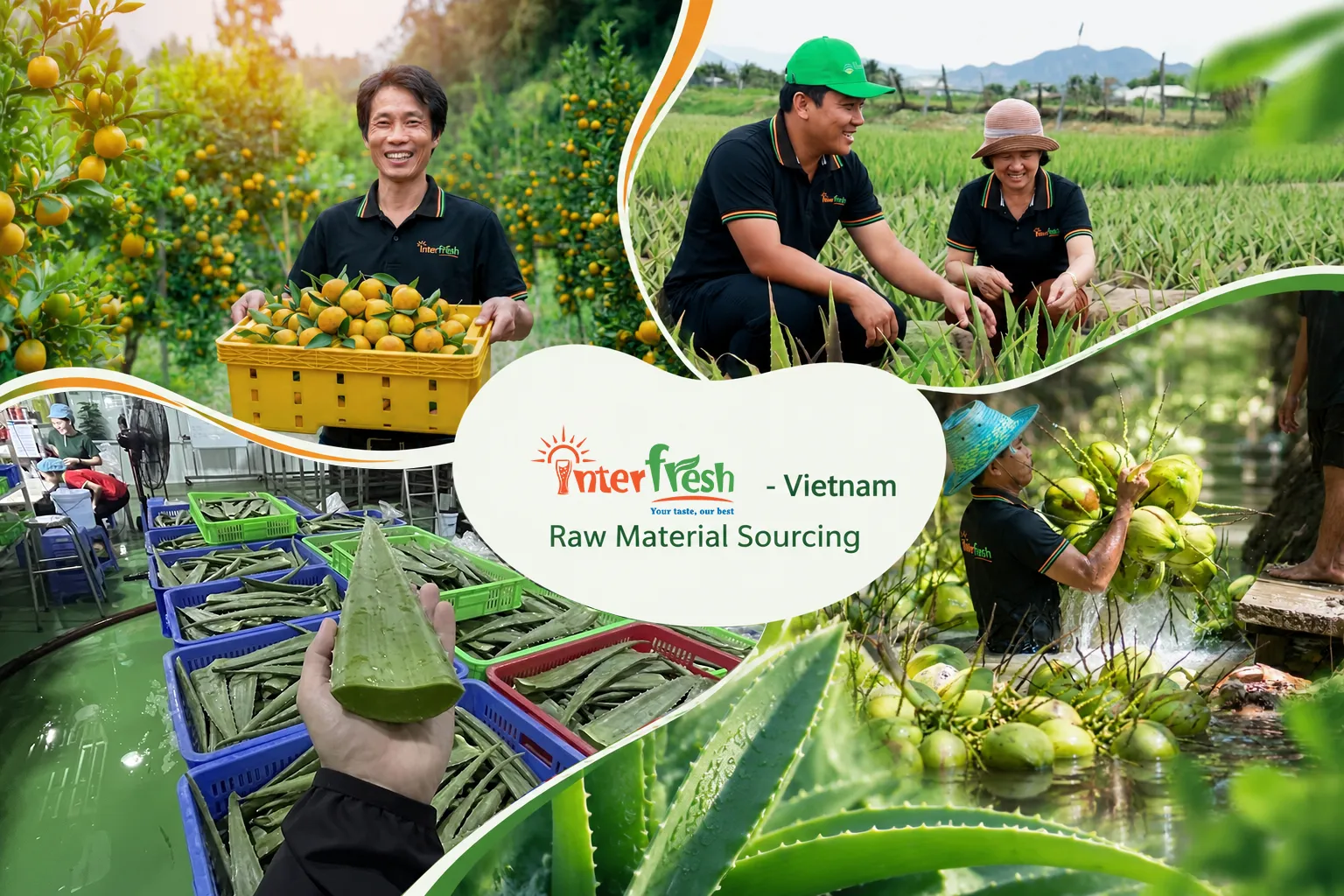
Vietnam’s tropical climate gives manufacturers direct access to coconut, aloe vera and passion fruit. These are the exact ingredients most B2B buyers request first. Our coconut water OEM manufacturer line, for example, sources fruit close to the factory floor.
China often imports tropical fruit concentrate and coconut derivatives instead. That adds freight cost and customs handling. It can also extend formulation lead time before production even starts.
Landed Cost After 2026 Tariffs
This is where the comparison shifts most in 2026. As of mid 2026, Vietnam origin goods face a 10 percent Section 122 surcharge. They carry no Section 301 tariff at all. China origin goods face that same Section 122 layer. On top of it, they carry Section 301 tariffs from 7.5 percent up to 25 percent or higher.
For a distributor importing non alcoholic beverages, the effective landed cost gap is significant. Vietnam sourced goods can run 15 to 30 percentage points lower on total duty. Buyers evaluating this shift should also read our guide on how to import beverages from Vietnam to USA. It covers FDA and customs steps in full.
The Section 122 surcharge is scheduled to expire around July 24, 2026. This is subject to ongoing litigation and policy review. Buyers should verify current rates at purchase time. Trade policy in this category continues to shift through the year.
Quality and Certification: Vietnam vs China OEM Beverage Standards
A decade ago, “Made in Vietnam” carried less certification weight than “Made in China.” That gap has closed by 2026.
What Vietnam Factories Now Hold
Leading Vietnamese beverage factories routinely carry ISO 22000, HACCP and FDA Food Facility Registration. Many also hold Halal, BRC or FSSC 22000. These are the same credentials that Walmart, Carrefour and major pharmacy chains require worldwide. See our breakdown of ISO 22000 vs HACCP vs BRC certifications for which credential matters per market.
What China Factories Typically Hold
Large Chinese beverage factories also hold ISO, HACCP, BRC and FDA registration. This is especially true among export focused manufacturers serving Western retail. Scale gives these factories easy access to accredited labs like SGS, Intertek and TUV Rheinland.
The Real Difference: Consistency and Transparency
The gap in a Vietnam vs China OEM beverage certification review is less about paperwork. It is more about verification. Buyers should always request certificate copies directly. Confirm the issuing body, the scope and the expiry date, regardless of origin country.
Ask any prospective factory a simple question. Is production done entirely in the house, or subcontracted without disclosure? This one question protects quality control more than any certificate alone. For Middle East buyers, our Halal beverage OEM manufacturer page explains what Halal certification actually requires.
For clean label positioning in Australia, review our clean label beverage manufacturer resource before finalizing a supplier shortlist.
MOQ Comparison: Vietnam vs China OEM Beverage Minimum Orders
Minimum order quantity often decides whether a startup or mid size distributor can enter a category at all.
Vietnam MOQ Structure
Vietnamese OEM beverage manufacturers generally offer more flexible entry points. White label and standard ODM products often start at 500 to 3,000 units per flavor. Private label orders on an existing formula typically start at 2,000 to 5,000 units. Full custom OEM usually needs about one full container load. That is roughly 20,000 to 24,000 units for 250ml cans.
For a full breakdown of each stage, see Private Label Drink Manufacturers: 5 Steps to Launch.
China MOQ Structure
China’s MOQ model is often driven by packaging tooling cost, not the beverage itself. Custom can printing frequently requires a packaging MOQ near 12,500 cartons. Some factories allow split shipments to reduce upfront production volume. General industry MOQ across Chinese beverage OEM suppliers spans 5,000 to 50,000 units. This depends heavily on packaging complexity and formulation.
What This Means for a First Order
A startup testing one flavor before committing capital will likely prefer Vietnam’s lower entry MOQ. A retail chain planning a five SKU rollout may find China competitive once volume clears the tooling threshold. Review our guide for private label beverage manufacturer for US brands if you fall into the first group.
Lead Time: Vietnam vs China OEM Beverage Production Speed
Speed to shelf matters as much as unit cost. This is especially true for seasonal categories like hydration and summer drinks.
Vietnam Lead Times
Top tier Vietnamese factories dispatch physical samples within 5 to 7 business days. New product development for ODM or private label usually takes 4 to 6 weeks. Full custom OEM with new packaging runs 6 to 10 weeks. Reorders on an approved formula move faster, often 3 to 4 weeks.
China Lead Times
Chinese factories report new product development in roughly 20 to 40 days. This applies once formula and packaging design are confirmed. Reorders on existing molds and formulas run 15 to 30 days. High speed canning lines give large Chinese factories a real advantage on pure throughput.
Shipping Time Adds to the Real Comparison
Ocean freight from Ho Chi Minh City to US West Coast ports takes about 18 to 22 days. Shipping from major Chinese ports runs a similar range. Port congestion at either origin can add delays during peak season. For buyers stocking ahead of retail resets, total lead time should guide the timeline. Factory lead time alone is not enough.
Trade Agreements: The Structural Advantage in Vietnam vs China OEM Beverage Sourcing
Trade agreements are the least visible line item on any quotation. Yet they often decide the winner in a Vietnam vs China OEM beverage bid.
Vietnam has ratified several major trade agreements. These include EVFTA with the European Union and CPTPP with Canada, Australia, Japan and Mexico. RCEP covers ASEAN plus China, Japan, South Korea, Australia and New Zealand. UKVFTA also covers the UK market. A European distributor sourcing private label coconut water from Vietnam can often secure preferential tariffs through EVFTA. This sometimes reaches a 0 percent duty rate on qualifying products.
China has no equivalent free trade agreement with the European Union. It also carries the broadest Section 301 tariff exposure into the US market of any major sourcing origin. As of March 2026, USTR opened Section 301 investigations covering structural excess capacity. These span 16 economies, including both China and Vietnam. Buyers should track policy updates through their customs broker rather than assume static rates.
For US bound shipments, our FDA requirements for importing beverages from Vietnam guide covers registration steps that apply either way.
Compliance and Documentation Risk
Certification on paper means little if export documentation fails at the port. This is a practical layer of the Vietnam vs China OEM beverage decision that buyers often overlook.
A complete export package should include a Commercial Invoice, Packing List and Bill of Lading. It also needs a Certificate of Origin, Phytosanitary Certificate, Health Certificate and Certificate of Analysis. Ask any supplier, regardless of country, for a sample documentation set. Request one from a recent shipment to your target market before signing a purchase order.
CBP has intensified enforcement against transshipment in 2026. This is where goods made in China get routed through Vietnam to dodge Section 301 tariffs. Genuine Vietnamese manufacturing requires substantial transformation on Vietnamese soil, not simple relabeling. Buyers should request factory audit access or a virtual factory tour. This confirms real production, not just paperwork.
A Practical Checklist Before You Sign a Purchase Order
Use this checklist for any Vietnam vs China OEM beverage quotation you receive this quarter. It works for both origins equally well.
Confirm the factory owns its production line, not a subcontracted workshop. Request current ISO 22000, HACCP and FDA certificate copies with issuing body details. Ask for a sample documentation set, including Certificate of Origin and Certificate of Analysis. Compare landed cost, not just factory price, including all 2026 tariff layers. Confirm MOQ in writing, along with any packaging tooling surcharge. Verify sample lead time and full production lead time separately. Ask about reorder MOQ, since it often differs from a first order. Review our private label beverage manufacturer for US brands guide for a US specific version of this checklist.
Which Origin Fits Your Business: A Dec
ision Framework
Not every buyer needs the same answer to the Vietnam vs China OEM beverage question. Consider these three profiles.
Startups and entrepreneurs. Lower MOQ, faster sampling and tariff free US access make Vietnam the more accessible starting point. See our ODM, original design manufacturer service for a fast route to market without in-house formulation.
Mid volume distributors and wholesalers. Buyers moving 1 to 5 containers a year generally benefit most from Vietnam. Lower landed cost pairs well with FTA access for EU or ASEAN resale. Our beverage wholesale supplier strategy resource covers how to structure multi SKU orders.
Very large retail chains. Buyers placing extremely high volume, single SKU orders across many containers may find China competitive. Even then, factor in full Section 301 exposure before comparing quotations side by side. Our OEM ODM services overview can help you scope which model fits your volume first.
Why Distributors Choose Interfresh for Vietnam OEM Beverage Sourcing
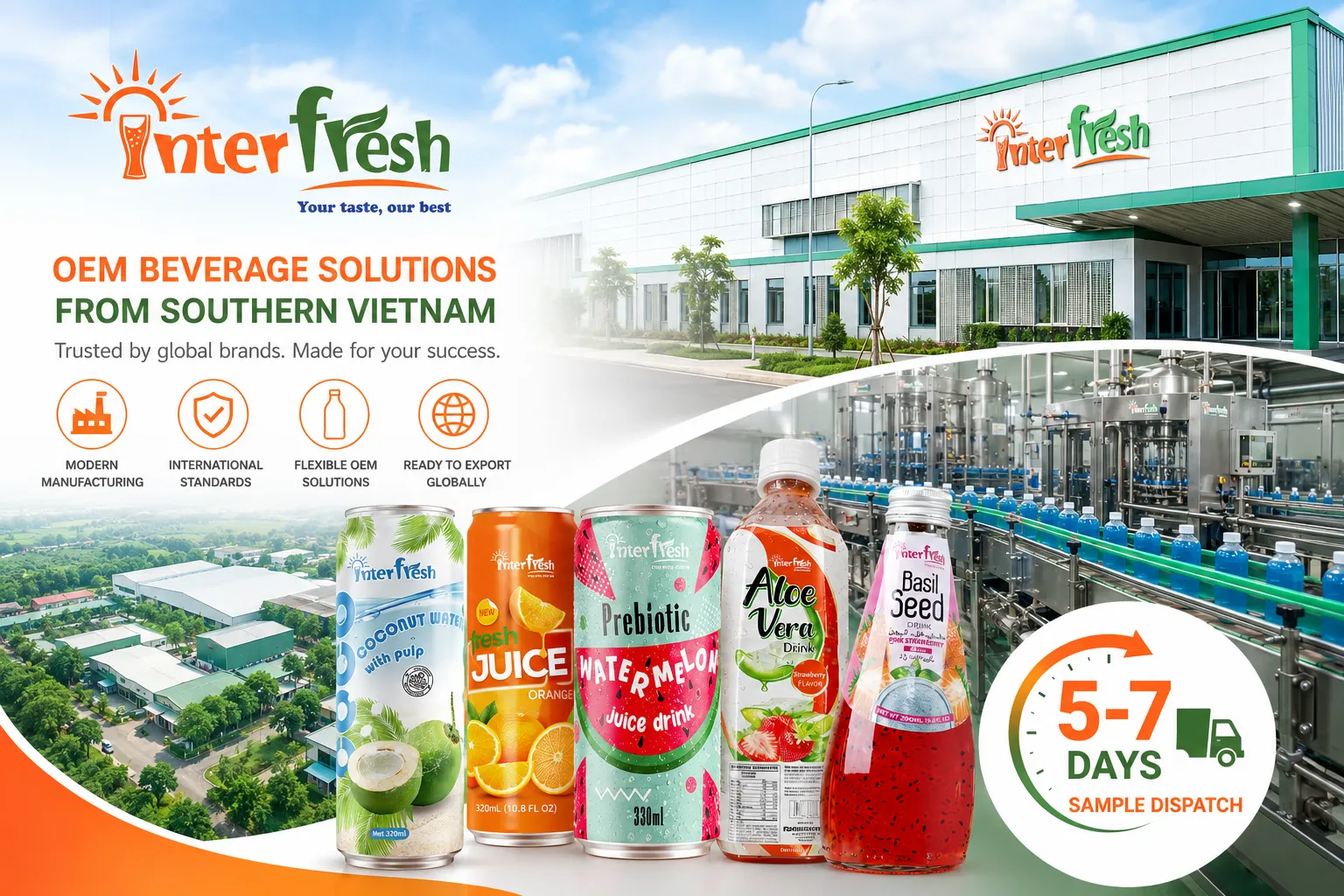
Interfresh operates its own factory in Long An province, Southern Vietnam. Production is not subcontracted through a trading company. These matters for buyers worried about the transshipment risk described above. Production, quality control and export documentation all happen on one site.
The factory holds ISO 22000, HACCP, Halal and FDA Food Facility Registration under the FSVP rule. Every batch runs through in-house lab testing before release. Third party verification is also available on request. This gives buyers an independent Certificate of Analysis when needed.
On speed, Interfresh dispatches physical samples within 5 to 7 business days of a confirmed brief. That is well inside the multi-week range many first time buyers budget for. Full OEM orders with new packaging typically ship in 6 to 10 weeks. Reorders on an approved formula move in 3 to 4 weeks once the mold is locked.
On formulation, the team works from over 30 existing recipes. These span coconut water, aloe vera, basil seed, fruit juice and functional drinks. Most private label projects start from an existing base, not a blank page. This alone can cut several weeks off a typical development timeline. Custom OEM using a buyer’s own recipe is also available. A dedicated formulation team handles taste matching and shelf life validation before the first production run.
Entry points scale with order size. A first private label test order can start at 3,000 to 5,000 units per SKU. A full container load OEM order runs about 20,000 to 24,000 units for 250ml cans. This matches the ranges discussed earlier in this guide. Buyers targeting the Middle East can request Halal certified lines with segregated processing, a common requirement for GCC import clearance.
For distributors still building a shortlist, three requests are worth making before signing anything. Ask for a factory audit, a documentation sample and a written quotation. Compare each one side by side against any China based quote. You can request a free quote or sample from our export team, or download the OEM catalogue for full specifications.
FAQs: Vietnam vs China OEM Beverage
Is Vietnam cheaper than China for OEM beverage manufacturing in 2026? For most non alcoholic categories, yes. Vietnam labor costs run 20 to 40 percent lower than China. 2026 tariff rules also remove Section 301 exposure that still applies to Chinese origin goods.
What is the minimum order quantity for OEM beverage manufacturing? Vietnam factories often start private label orders at 3,000 to 5,000 units. Chinese factories frequently require 5,000 to 50,000 units, driven by packaging tooling cost.
Which certifications should I request from a beverage OEM manufacturer? Request FDA Food Facility Registration, HACCP, ISO 22000 and Halal where relevant. Always verify the certificate directly with the issuing body, not the supplier alone.
Do Vietnam beverages have a tariff advantage over China in the US market? Yes. As of mid 2026, Vietnam origin goods carry only a 10 percent Section 122 surcharge. China origin goods carry that surcharge plus Section 301 tariffs, often 25 percent or higher.
How long does OEM beverage production take in Vietnam versus China? Vietnam sample turnaround is typically 5 to 7 business days. Full OEM production runs 6 to 10 weeks. Chinese factories report 20 to 40 days for new product development, plus separate shipping time.
Can a small brand order private label beverages with a low MOQ from Vietnam? Yes. Many Vietnamese OEM manufacturers accept white label or ODM orders of 1,000 units per flavor. This suits the first time a brand launches well.
Is China better for very large volume beverage orders? China’s packaging and filling infrastructure can offer strong per unit pricing at true scale. This applies once order volume clears the packaging tooling MOQ, typically several container loads per product.
Does EVFTA give Vietnam an advantage over China for EU buyers? Yes. Vietnam’s EVFTA agreement with the EU can reduce duty to 0 percent on qualifying beverages. China has no equivalent free trade agreement with the European Union.
References
-
InsightAsia (2025). Vietnam Beverage Market 2025: A New Taste of Change. Usage and Attitude Study across 5 major cities.
-
US Trade Representative (USTR). Vietnam Country Trade Profile, 2025 to 2026. ustr.gov.
-
US Trade Representative (USTR). Section 301 investigations on structural excess capacity, initiated March 2026.
-
US Court of International Trade and US Court of Appeals for the Federal Circuit. Rulings on Section 122 tariff authority, May and June 2026.
-
US Food and Drug Administration (FDA). FSMA Foreign Supplier Verification Programs (FSVP) rule.
-
International Organization for Standardization (ISO). ISO 22000:2018 Food Safety Management Systems standard.
-
PLMA and Circana Unify+ (January 2026). US Private Label Industry Sales Report 2025.
-
Vietnam Briefing, Dezan Shira and Associates (2026). US Section 301 forced labor investigation coverage for Vietnam exporters.
-
Vietnam Ministry of Industry and Trade. Guide to Vietnam’s free trade agreements, including EVFTA, CPTPP and RCEP.
This article is part of Interfresh’s OEM and Private Label Beverage Manufacturer hub. Explore the full hub at OEM Private Label Beverage Manufacturer Vietnam for the full production process and certification details.