How to Start a Beverage Brand: 7 Steps from Idea to Export Ready, 2026 Guide
You have a beverage idea. You do not have a factory. You do not have a regulatory team yet. That is completely normal.
Most people researching how to start a beverage brand are exactly where you are now. They are two to four weeks out from their first real decision. This guide covers the full path in seven steps. Concept, budget, production model, manufacturer, packaging, compliance, and launch.
By the end, you will know what a distributor, wholesaler, or bulk buyer expects to see. That expectation must be met before they place a first order.
Whether you plan to start a beverage brand for a national retailer or a smaller wholesaler, the same seven steps apply. Only the scale changes.
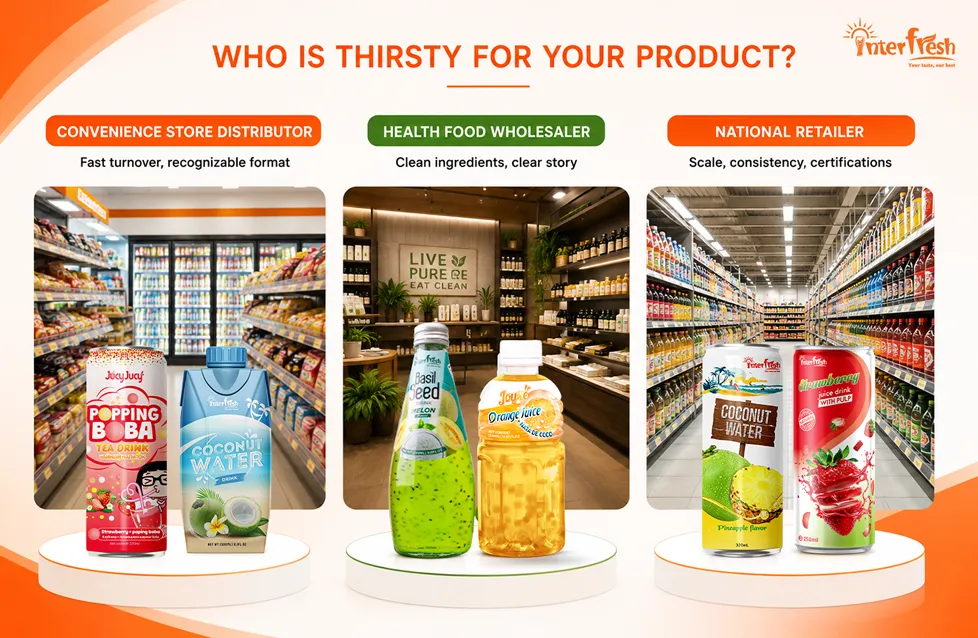
Beverage brand positioning by buyer type: convenience, health food, retail
Every strong beverage brand starts with one clear answer. Who exactly is thirsty for this product?
Category matters first. Functional drinks, clean label juice, ready to drink tea, and energy drinks each pull a different type of shopper. A private label beverage manufacturer in Vietnam can produce any of these categories. Your concept choice does not limit your sourcing options. The global functional drinks market reached an estimated 178.9 billion US dollars in 2026. It is growing at 8.5 percent a year through 2033, according to Grand View Research. That growth is real, but it also means more competition on the shelf.
Positioning matters second. A distributor stocking convenience stores wants fast turnover and a recognizable format. A wholesaler serving health food retailers wants clean ingredients and a clear story. Decide early which buyer you are building for. This single decision shapes every choice you make as you start a beverage brand, from packaging to certifications.
If your idea leans toward hydration or functional claims, review current category demand before you lock a formula. Interfresh’s market data on healthy drink trends for the US market breaks down current flavors and functional claims. It shows which ones are pulling repeat orders right now, so you are not guessing at what buyers actually want.
This is also the moment to write a one line brand statement. State what the drink is, who it serves, and what makes it different. Keep it to a single sentence. If you cannot, the concept still needs work before you move forward.
Founders who skip this step often waste months later. They discover, only after production, that their positioning does not match any real buyer segment. Spend real time here. It is the cheapest step in the entire process to get right.
Step 2: Validate Demand and Model Your Startup Budget
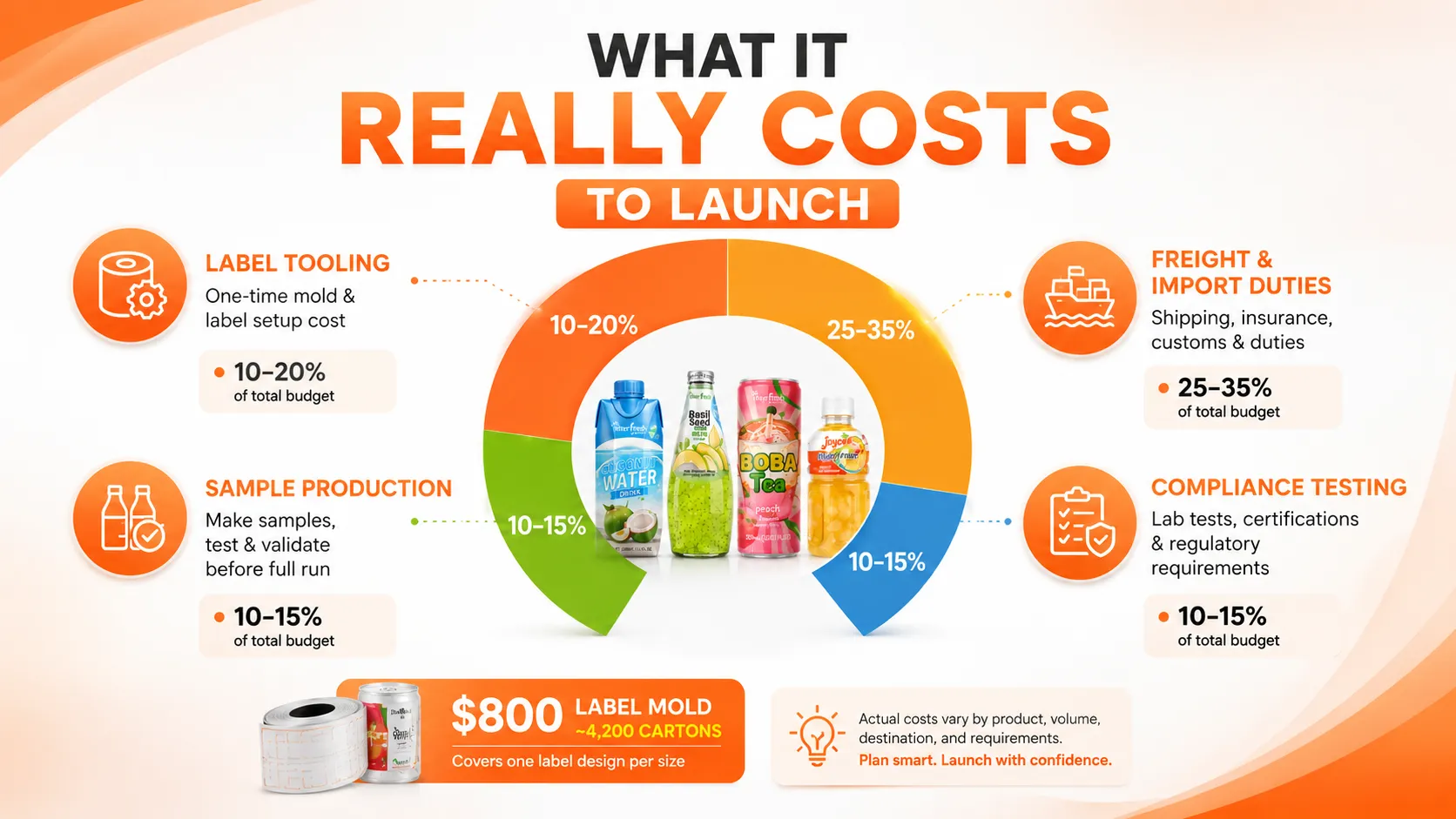
Startup budget breakdown for a new beverage brand: label, freight, compliance costs.
Before you spend a dollar on production, validate that people actually want this beverage brand. Talk to potential buyers directly. Run small taste tests with your target audience. Check search demand for your category online.
Budget realistically from day one. First container orders, sample development, and label printing all carry real costs. Skipping this step is the single biggest reason new beverage brands stall before their first shipment.
One cost buyers rarely plan for is label tooling. A new custom label mold typically runs around 800 US dollars with an established Vietnam manufacturer. This cost is usually returned to you once roughly 100,000 labels are produced. That works out to about 4,200 cartons across your first several production runs. Ask any manufacturer for this exact figure during your first call. It varies by factory and by label complexity.
Sample production, freight, import duties, and compliance testing all add further cost on top of your unit price. Build a simple spreadsheet covering these four categories before you approach any manufacturer. A supplier who cannot walk you through each cost line honestly is a risk. Treat that as a warning sign, not a minor detail.
Consider your working capital carefully too. Most B2B buyers expect payment terms, not upfront cash, once your beverage brand has a sales track record. Early on, though, you will likely need to self fund your first order in full.
Step 3: Choose Your Production Model
There are four common paths into beverage manufacturing. Each one trades off cost, control, and speed differently. It pays to understand all four before you start a beverage brand around any single model.
Private label means you select from a manufacturer’s existing formulas. You apply your own branding on top. This is the fastest and lowest cost route to start a beverage brand for the first time.
OEM, or original equipment manufacturer, means the factory builds a beverage to your specification. It uses their production lines and formulation expertise. ODM, or original design manufacturer, goes one step further. The factory also contributes to formula design, not just production. White label sits close to private label, but the same formula is often sold to multiple different brands.
Most first time founders start with private label or OEM when they first launch a beverage brand. Both models let you enter the market in months, not years. For a full breakdown of how these four models compare, see Interfresh’s private label beverage manufacturer guide. It covers cost, timeline, and control in detail. Interfresh also runs dedicated pages on OEM manufacturing and ODM manufacturing that go deeper into each model.
Whichever model you pick, confirm it matches your buyer’s expectations. A retail chain evaluating your line will ask which model you used. This signals how much formula control and exclusivity your beverage brand actually owns, and buyers weigh this heavily during due diligence.
Step 4: Select a Manufacturer and Request Samples
This is the step where your beverage brand becomes real. A manufacturer is not just a factory. It is your quality control partner. It is often your compliance guide and logistics coordinator too.
Start by checking certifications directly. A credible manufacturer for your beverage brand should hold FDA registration, HALAL certification, ISO 22000:2018, GMP, and HACCP at minimum. This applies to any product headed toward US, EU, or Middle East markets. Ask for copies of these documents, not just verbal claims.
Check minimum order quantity next. Standard practice among established Vietnam beverage exporters centers on one 20 foot container per flavor. That is commonly quoted as roughly 400 trays for a single SKU. Some manufacturers allow you to mix five or six flavors within one container to lower your entry cost. Always ask directly, since this figure is rarely fixed across every factory.
Sample turnaround speed tells you a lot about a factory’s operations. A well run manufacturer typically ships physical samples within 10 to 14 business days of a confirmed brief. If a supplier cannot commit to any clear timeline, treat that as a warning sign early in the relationship.
If you are comparing Vietnam against other sourcing regions, check the numbers first. Interfresh’s Vietnam versus China OEM comparison covers cost, certification speed, and trade agreement advantages in detail. Buyers targeting the Middle East should also review Halal beverage OEM options in Vietnam before they finalize a manufacturer shortlist.
Do not choose based on price alone. The cheapest quote often hides a real problem. It may mean slower samples, weaker certifications, or unclear MOQ terms that surface only after you have already committed.
Step 5: Finalize Formulation, Packaging, and Label Design
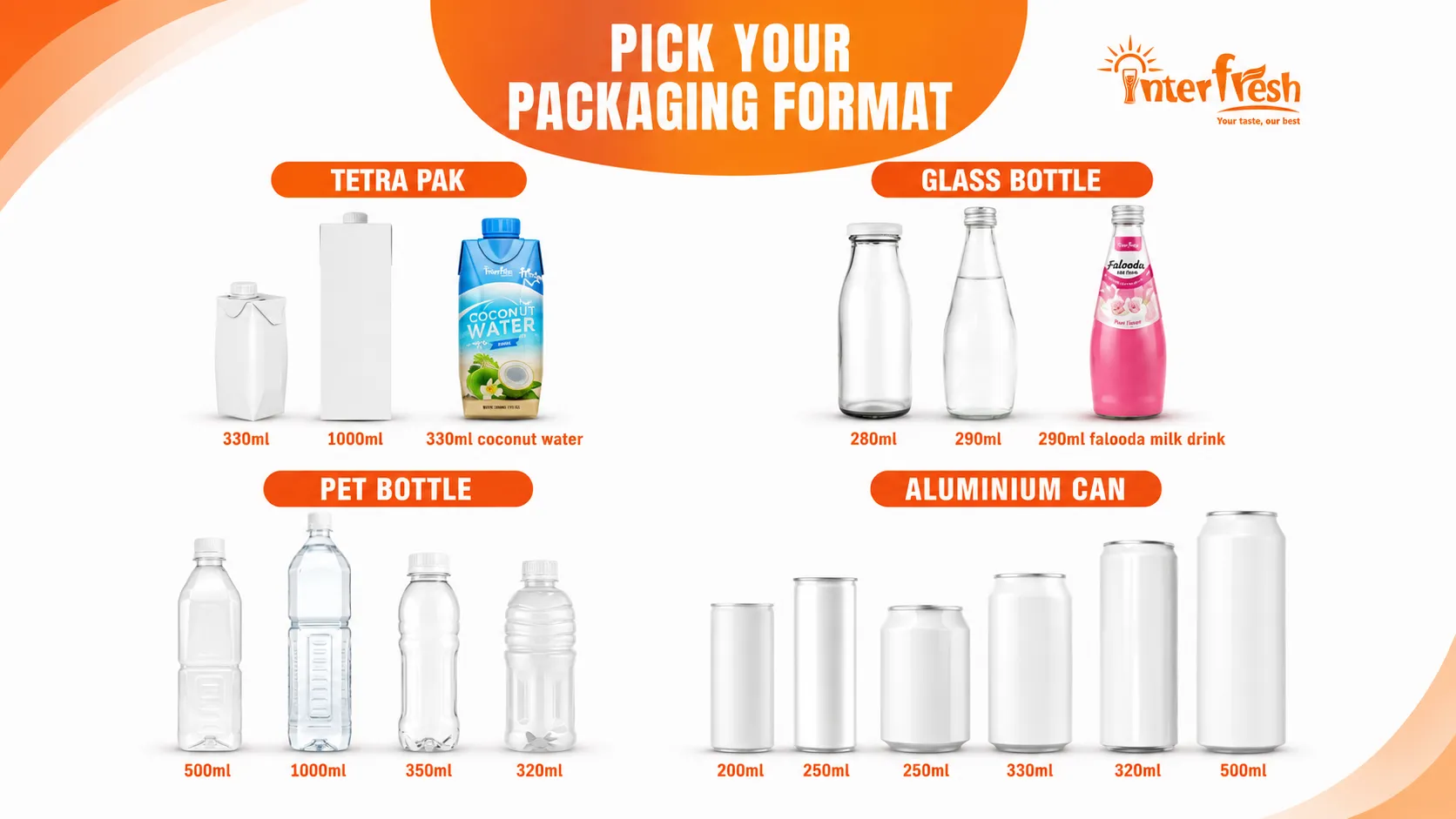
Aluminum can, PET bottle, and glass bottle packaging options for beverage export
Packaging is not decoration for a beverage brand. It determines shelf life, freight cost, and how a buyer perceives your product before they even taste it.
Aluminum cans remain the most common export format. They typically run from 200ml to 500ml, with a shelf life of 18 to 24 months. PET bottles and glass bottles, usually 290ml to 500ml, suit premium or health focused positioning well. PET generally carries a slightly shorter 18 month shelf life than canned formats do.
Choose your format based on your buyer, not just your budget. A convenience channel wholesaler favors slim cans for cooler visibility. A health food distributor often favors glass or clear PET instead. Clear packaging signals a natural, less processed product to that specific shopper.
Label compliance varies sharply by destination market too. Does your positioning lean toward clean ingredients or minimal processing. If so, review Interfresh’s guide to clean label beverage manufacturing for Vietnam, Australia, and EU markets. It explains exactly which claims require supporting documentation before they can legally appear on a label.
Finalize your formula and your packaging together, not separately. A great tasting drink in the wrong format will still struggle to win shelf space from a distributor.
Step 6: Navigate Certifications and Import Regulations
This is where many first time beverage brands lose weeks, sometimes months, if they have not planned ahead. Regulatory requirements differ completely by destination market. Getting this wrong can hold an entire container at port.
For the United States, the FDA requires Prior Notice for every food shipment entering the country. Facility registration for the manufacturer is also required. These rules sit under the Bioterrorism Act and FSMA, enforced through 21 CFR Part 1, Subpart I. Review the FDA requirements for importing beverages from Vietnam early. Do this before you finalize your first purchase order, not after.
Certification standards themselves are not interchangeable. ISO 22000:2018, HACCP, and BRC each cover food safety differently. Different retailers or import authorities may require one standard over another. Interfresh’s comparison of ISO 22000 versus HACCP versus BRC breaks down exactly which certification matters for which market.
If your target market is the Middle East, Halal certification is not optional. It is a baseline requirement most retailers will not negotiate away. Interfresh’s page on Halal beverage supply for the Middle East outlines what documentation buyers typically request. That documentation comes up early in a buyer’s due diligence process.
Build a compliance checklist for every target country before you sign a purchase order. Look for a manufacturer experienced in export, not only domestic sales. That kind of factory will already have most of this documentation on file, ready to share with you.
Do not treat compliance as an afterthought once your beverage brand launches. Buyers evaluating a new beverage brand will ask for this documentation before they commit to a first order, not after.
Step 7: Production, Shipping, and Go to Market
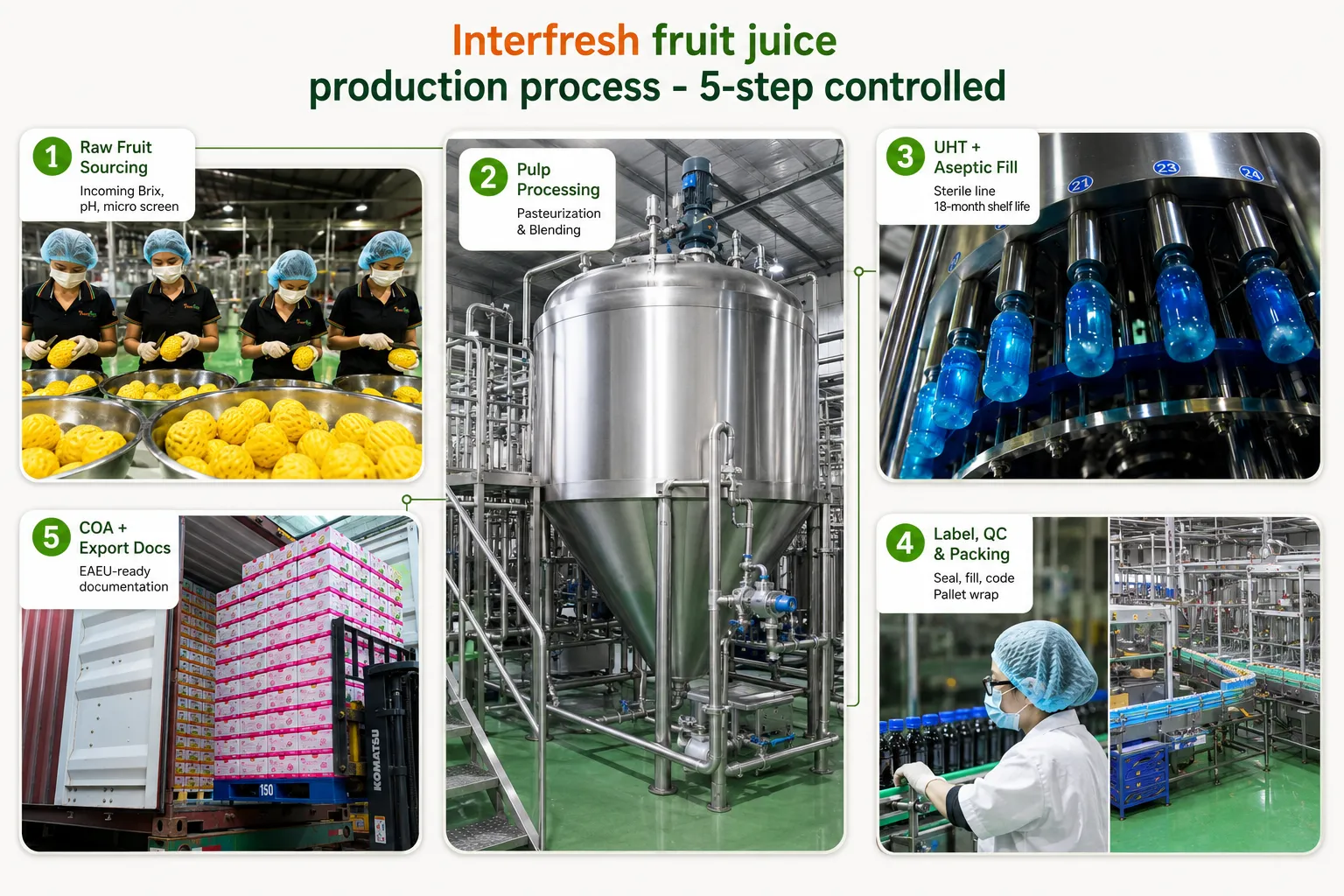
Every Interfresh batch follows a 5-step controlled production flow: from incoming inspection of raw fruit pulp to pre-shipment documentation compliant with EAEU requirements.
Once samples are approved and your purchase order is confirmed, your beverage brand moves into production. Standard SKUs typically run 15 to 25 days at an established Vietnam factory under normal conditions. Complex formulations or new label tooling can extend that timeline, so build in a buffer for your first order.
Payment terms in Vietnam beverage export commonly follow a 50 percent deposit. The balance is due before shipment leaves port. Confirm Incoterms early, since most Vietnam factories quote FOB from Ho Chi Minh City port. This shifts freight cost and risk to you once the container leaves Vietnamese waters.
For your actual launch, consider a hybrid approach rather than betting everything on one channel. Many successful beverage brands pilot with direct to consumer sales first. Others start with a small local retail run instead. Both approaches let you gather early sales data before negotiating terms with larger distributors.
This staged approach reduces risk for your beverage brand while you are still learning what resonates with real buyers. It also gives you proof points, actual sales numbers, to bring into your next distributor conversation.
If your first export lane is the United States, walk through the complete process end to end. Interfresh’s step by step guide to importing beverages from Vietnam to the USA covers customs, duties, and required documentation. Everything is laid out in the correct sequence.
Common Mistakes First Time Founders Make
Even a well planned beverage brand can stumble on avoidable mistakes during launch. Watching for these early saves real time and real money.
Skipping the buyer conversation. Some founders start a beverage brand around a flavor they personally love. They never confirm a distributor or wholesaler actually wants that product first. Talk to real buyers before you lock a formula, not after.
Underestimating compliance timelines for your beverage brand. Certification and Prior Notice requirements take real time to complete correctly. Founders who treat this step as a formality often see shipments delayed at port, sometimes for weeks.
Choosing a manufacturer on price alone. The lowest quote rarely reflects the full cost. Slower samples, weaker certifications, and unclear MOQ terms often surface only after a contract is signed.
Ignoring packaging and freight cost together. A beautiful glass bottle can double your freight cost compared with aluminum cans. Weigh packaging decisions against your actual shipping budget, not just shelf appeal.
Launching everywhere at once. Brands that try to enter five markets simultaneously often struggle with all five. A staged launch, one or two markets first, lets you fix problems before they scale.
Avoiding these five mistakes will not guarantee success. It will meaningfully improve your odds as you start a beverage brand for the first time.
Why Vietnam, and Why Now
Vietnam is a strong base for anyone ready to start a beverage brand for export. Exporters here benefit from strong cost advantages and mature food safety infrastructure. Trade agreements including the EU Vietnam Free Trade Agreement reduce tariffs for qualifying EU bound shipments too. Compared with sourcing from China, Vietnam factories are increasingly competitive on both certification speed and total landed cost. That gap is explored fully in the Vietnam versus China OEM comparison.
Private label beverages are also simply winning more shelf space right now. In the United States, private label sales reached 330 billion US dollars in 2025. That figure represents a 24 percent unit share of the total market, according to Circana. Beverages specifically posted 1.8 percent unit growth in the first half of 2026 alone. That places beverages among the strongest categories tracked by that same research.
The window to start a beverage brand right now is genuinely open. Buyers are actively looking for new private label partners across nearly every beverage category. Trade events such as THAIFEX and ANUGA continue to bring buyers and Vietnam exporters together each year. That makes 2026 an especially active year to start a beverage brand and enter the market.
Once you have chosen a manufacturer, you are ready to move from research into a live order. Take that next step now. Review Interfresh’s own OEM process for a closer look at how consultation, sampling, and production run. It shows the full journey from start to finish.
Frequently Asked Questions
How much money do you need to start a beverage brand? Costs vary widely by category and order size. Most first time founders budget for sample development and one full container of finished product. Label tooling and basic compliance testing add further cost before the first sale.
What is the minimum order quantity for a private label beverage? Standard MOQ among established Vietnam manufacturers centers on one 20 foot container per flavor. Many suppliers also allow mixing several flavors within a single container to lower your entry cost.
How long does it take to launch a private label drink? From concept to export ready product, a realistic timeline runs 10 to 14 days for samples. Add 15 to 25 days for production after approval. Most brands move from a confirmed brief to shipped product within six to ten weeks total.
What certifications does a beverage brand need to export to the US? At minimum, FDA facility registration and Prior Notice compliance are required for every shipment. The manufacturer should also hold food safety certifications such as HACCP or ISO 22000.
What is the difference between OEM and private label? Private label means selecting from a manufacturer’s existing formulas under your own brand. OEM means the manufacturer builds a beverage to your exact specification. This gives you more formula control, at a higher development cost.
Can a small distributor or startup really start a beverage brand without owning a factory? Yes. This is precisely what private label and OEM manufacturing exist to solve. Thousands of beverage brands on shelves today were built this way, without their founders ever owning production equipment.