
Most people researching MOQ for beverage OEM Vietnam are not confused about what MOQ means. They are worried about one specific thing. Getting stuck with thousands of cans nobody buys.
That fear is reasonable. A first order is real money, tied up in a product that has not proven itself yet. This guide addresses that fear directly, with real volume tiers instead of one vague range.
This guide maps MOQ for beverage OEM Vietnam across five actual volume stages. Each one reflects a different point in a brand’s growth. For the full production model behind these numbers, see our OEM and private label beverage manufacturer guide for Vietnam. Our private label beverage manufacturers guide also compares OEM, ODM and white label models side by side.
The MOQ Ladder: Quick Answer by Volume Tier
Figures below are shown per case, a standard secondary pack of 24 cans. This matches how most distributors track shelf orders and inventory. A full 20 foot container typically holds close to 1,000 cases.
|
Tier
|
Volume
|
Roughly
|
Best fit
|
|
1. Sample and pilot
|
Under 1 container
|
First product, market testing
|
|
|
2. Entry OEM
|
1,000 cases
|
1 container
|
Standard starting order
|
|
3. Growing private label
|
3,000 to 5,000 cases
|
3 to 5 containers
|
Repeat SKU, proven demand
|
|
4. Established distributor
|
10,000 to 20,000 cases
|
10 to 20 containers
|
Multi region distribution
|
|
5. National or large scale
|
50,000 cases and above
|
50 or more containers
|
Long term contract volume
|
This ladder is not fixed pricing. It reflects how export ready Vietnam beverage factories, Interfresh included, typically structure MOQ across a growing account. Always confirm exact terms for your product before budgeting.
What Each Tier Actually Gets You
A number on a table means little without context. Here is what changes at each stage, beyond just the case count.
Tier 1: Sample and Pilot, 500 Cases
Not every factory offers this tier. It exists mainly at manufacturers built for startup and DTC brands. Per unit cost sits at its highest point here, since fixed setup costs spread across fewer cases.
This tier suits a founder validating demand before a larger commitment. It also suits a crowdfunding launch or a single retail pilot. Expect fewer flavor and packaging customization options at this volume.
Tier 2: Entry OEM, 1,000 Cases
This is the most common starting point across Vietnam beverage exporters. It aligns closely with a single 20 foot container, the standard shipping unit for canned beverages. Our 7 step guide to starting a beverage brand covers how this stage fits into a full launch timeline.
At this tier, most factories allow real formula selection from an existing catalog. Custom label artwork is standard. Fully custom formulation is sometimes available, though it may carry a development fee.
Tier 3: Growing Private Label, 3,000 to 5,000 Cases
This tier signals a proven product, not a first test. Per case cost drops meaningfully here, since packaging tooling and testing costs are already spread across the first order.
Buyers at this stage often negotiate better payment terms too. A track record of one clean prior order builds real leverage. Our pricing guide for beverage manufacturing in Vietnam breaks down how volume moves per unit cost across categories.
Tier 4: Established Distributor, 10,000 to 20,000 Cases
At this volume, a distributor typically holds exclusive or semi exclusive rights in a defined region. Factories usually assign a dedicated production slot, reducing lead time uncertainty.
This is also where certification depth starts to matter more, not less. A distributor operating across several states or countries needs consistent documentation. Our comparison of ISO 22000, HACCP and BRC certifications explains which standard each retail channel actually requires.
Tier 5: National or Large Scale, 50,000 Cases and Above
Few brands reach this tier through a single purchase order. It usually reflects an annual volume commitment, built through several repeat orders over time. Pricing here is typically negotiated as a contract, not a per order quote.
Factories serving this tier often run dedicated lines for a single client. This reduces flavor changeover time and stabilizes lead time across the year.
What Actually Drives MOQ in Vietnam
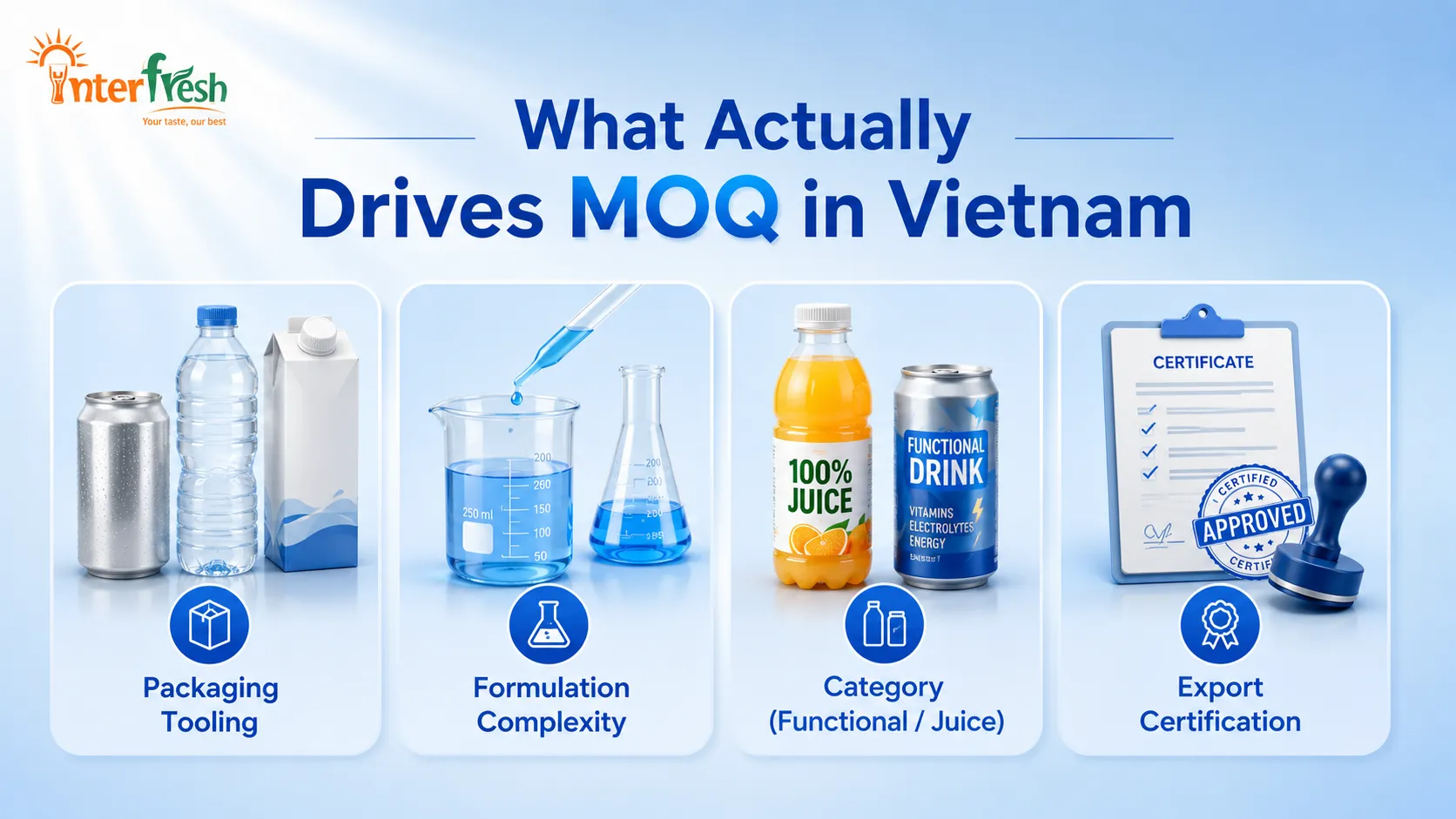
MOQ is not an arbitrary gatekeeping number. It exists because specific costs stay fixed, regardless of order size.
Packaging tooling is the single biggest driver. Custom can printing, bottle molds and label plates all carry a setup cost. That cost gets divided across the order, so smaller orders carry a heavier per unit share.
Formulation complexity adds a second layer. A stock recipe with a new label needs almost no extra testing. A fully custom formula needs shelf life trials and stability testing before a factory will commit a production slot.
Category matters too. Functional and prebiotic drinks often carry a higher MOQ than standard juice, due to specialized ingredient sourcing. Our guide on clean label beverage manufacturing covers how ingredient sourcing choices affect both cost and minimum volume.
Export certification adds a final layer, largely fixed per SKU. This cost does not scale down meaningfully at low volume. That is part of why very small pilot runs carry a real per unit premium. For US bound orders specifically, our FDA requirements for importing beverages from Vietnam guide outlines exactly which documents this covers. Buyers weighing origin against cost can also read our Vietnam versus China OEM comparison for a fuller picture.
How to Start Small Without Losing Negotiating Power
The good news is that MOQ is more negotiable than most first time buyers assume. A few practical strategies reduce real risk at the entry tier.
Mixing flavors inside one container is the most common tactic. Instead of 1,000 cases of a single flavor, many factories accept a split order. Two or three flavors can share the same container. This spreads your market test across more variants, without raising total volume.
Starting from a stock formula lowers both cost and risk. A proven recipe with your label needs far less testing than a brand new formulation. You can move to custom formulation once initial sales data supports it.
Asking for a phased commitment works well with established manufacturers. A written intent to place a second order within a defined window can sometimes unlock better first order terms. This works best once you can show a real sales channel, even a small one.
Halal and other market specific certifications can also affect this negotiation. Buyers targeting the Middle East should review our Halal beverage OEM manufacturer guide before finalizing volume. Certified lines sometimes carry different minimums than standard production. Our Halal beverage supplier guide for the Middle East covers the retail side of that same requirement.
A Realistic Growth Path: 500 to 50,000 Cases
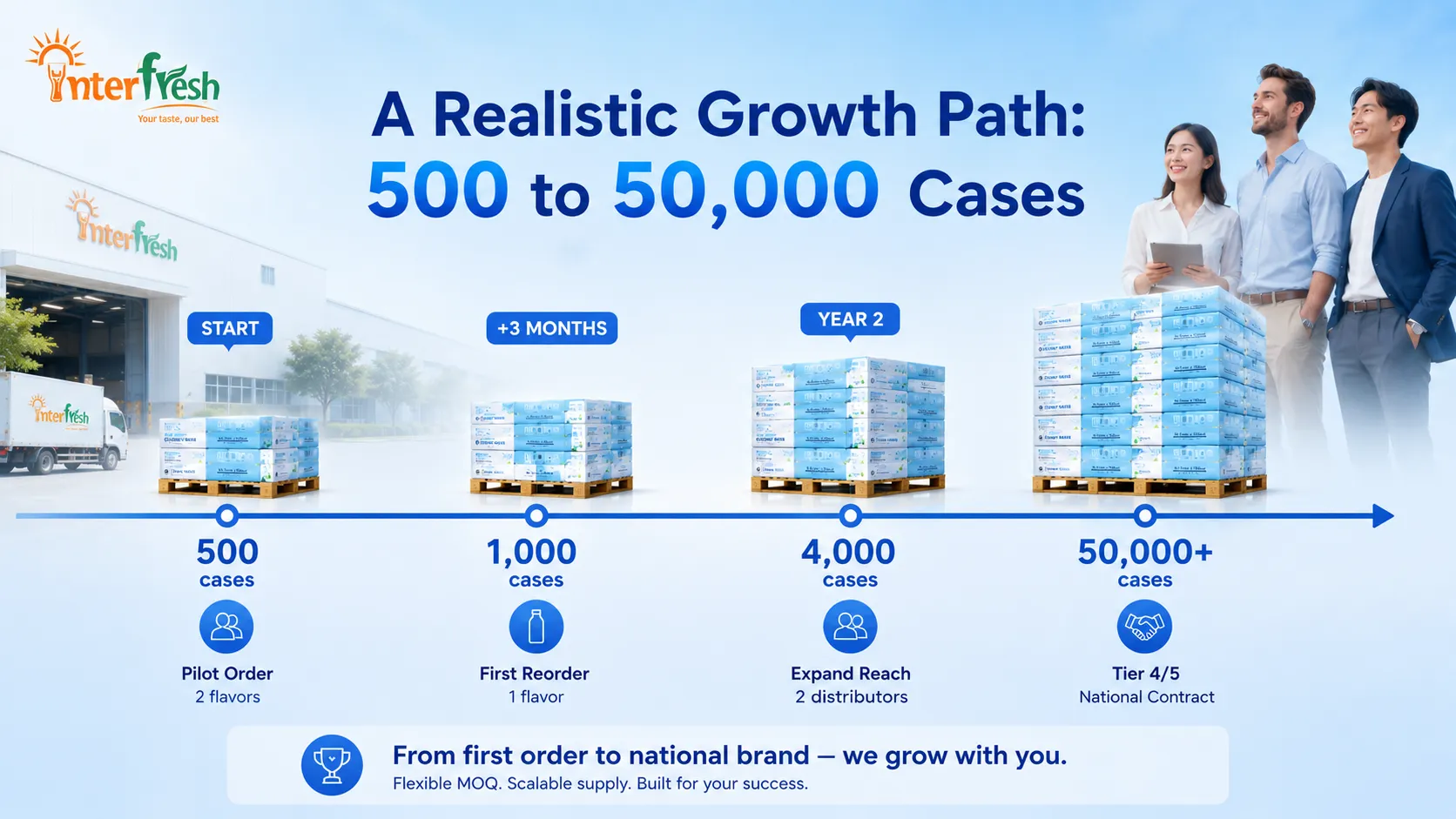
Picture a small beverage brand entering its first Vietnam sourcing relationship. It starts at Tier 1, a 500 case pilot split across two flavors. This validates taste and packaging before any larger spend.
Three months later, retail feedback confirms one flavor is outperforming the other. The brand places a full 1,000 case order at Tier 2, now as a single SKU with finalized label art. Lead time and cost both improve slightly here, since the format is already locked.
By the following year, the brand has secured shelf space with two regional distributors. It steps up to a 4,000 case order at Tier 3, unlocking noticeably better per case pricing. This is the volume where most private label brands settle for several years.
A smaller number continue scaling into Tier 4 and Tier 5, typically once a national retail contract is signed. At that point, the conversation shifts from a single purchase order to an annual supply agreement. Brands riding a functional or wellness trend often scale fastest here. Our guide to top healthy drink trends in the US market shows which categories are pulling repeat orders right now.
If you want to map your own volume plan, we can help. Contact Interfresh for a consultation and a free sample before your next order.
Mistakes That Make MOQ Feel Riskier Than It Is
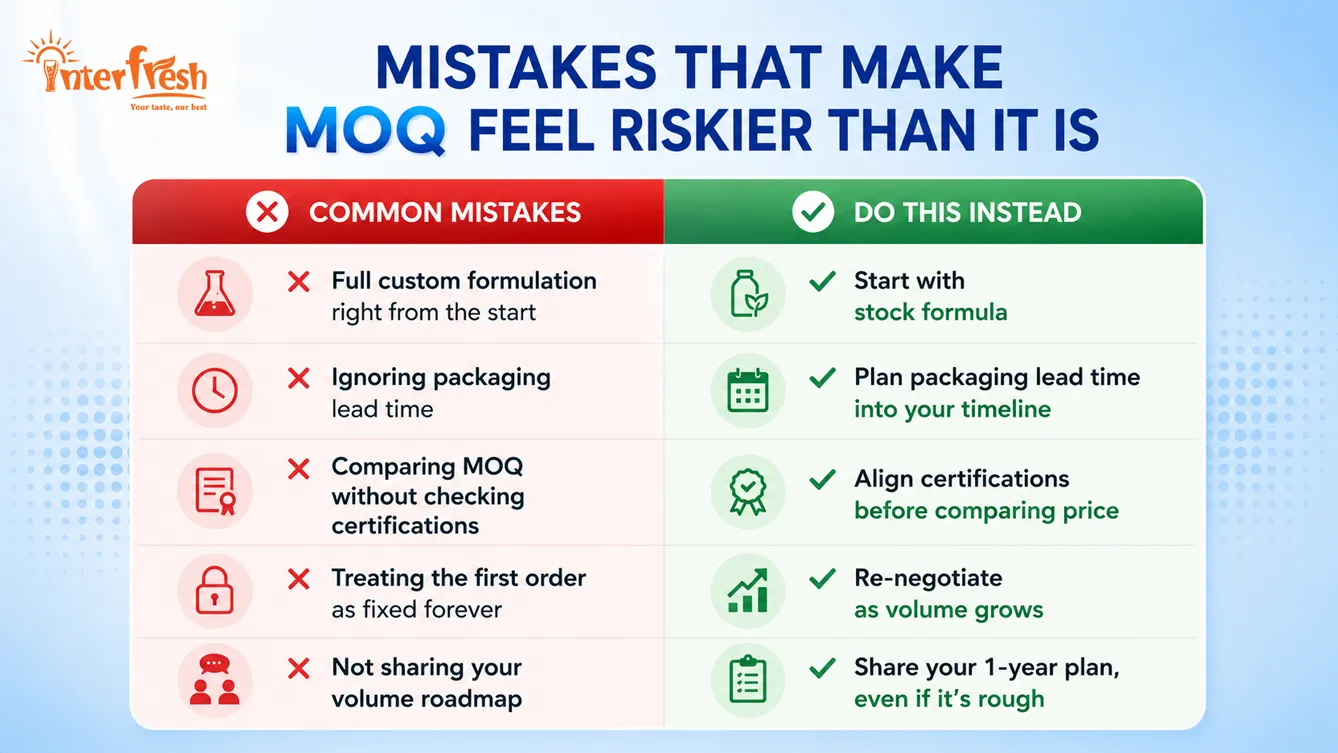
Several avoidable mistakes turn a manageable MOQ into a genuine financial risk. Watching for these early protects your first order.
Choosing full custom formulation on a first order. New formulas need testing time and carry more risk. A stock formula with your own label is almost always the safer entry point. Our OEM manufacturing services and ODM manufacturing services pages explain where each model fits.
Ignoring packaging lead time. Custom cans or bottles can add weeks before production even starts. Our step by step guide to importing beverages from Vietnam to the USA walks through the full timeline. That includes far more than production alone.
Comparing MOQ without comparing certification depth. A lower MOQ sometimes means a factory has skipped certifications your target retailer requires. Confirm this before comparing two quotes on price alone.
Treating the first order as final. Many buyers assume their first MOQ locks their long term relationship. In practice, most factories expect volume to grow, and price improves as it does.
Skipping a written volume roadmap. Manufacturers plan production capacity around expected growth. Sharing your rough one year volume plan, even informally, often improves your starting terms.
FAQs: MOQ for Beverage OEM Vietnam
What is a typical MOQ for beverage OEM Vietnam manufacturers?
Most factories start around 1,000 cases, close to one full container. Some accept smaller pilot orders near 500 cases, usually at a higher per unit cost.
Can I mix flavors within one MOQ order?
Yes, in most cases. Many Vietnam factories allow two or three flavors within a single container to lower first order risk.
Does a lower MOQ always mean a lower quality manufacturer?
Not necessarily. A lower MOQ can reflect a factory built for startups. Always verify certifications separately from volume terms.
How much does MOQ affect per unit cost?
Significantly. Packaging tooling and testing costs are largely fixed, so they weigh more heavily on smaller orders.
When should a brand move from private label to full custom OEM?
Usually once sales data supports the additional testing and development cost. Most brands wait until Tier 3 volume or beyond.
Is MOQ the same across all beverage categories?
No. Functional and prebiotic formulas often carry higher MOQ than standard juice, due to specialized ingredient sourcing.
References
-
PartnerSlate Academy. Production Volumes and MOQs.
-
ShipBob (2025). Minimum Order Quantity: How It Works and Calculation Guide.
-
Alibaba.com Seller Blog (2026). OEM Manufacturing with Low MOQ: A Complete Guide for Food and Beverage Exporters.
-
Wonnda (2026). Understanding Minimum Order Quantity: MOQ Explained.
Continue Reading on Vietnam OEM Beverage Sourcing
For a complete picture of sourcing, cost and compliance, these guides cover each stage in depth.