How to Import Coconut Water from Vietnam, Step by Step Guide
Who this guide is for
Distributors in the EU or Australia researching the full import process before choosing a supplier.
Buyers who already source coconut water but want to confirm their compliance steps are current.
Teams planning summer season orders who need HS codes, duty rates and documentation confirmed early.
If you are still comparing sourcing origins, this guide walks through the mechanics rather than the sales pitch. Our coconut water manufacturer hub covers the wider product range. This page shows exactly how to import coconut water from Vietnam, from factory to warehouse shelf.
Most EU and Australian distributors plan coconut water orders months before peak season demand hits. This includes buyers building toward our Coconut Water Supplier Australia summer window. Summer research now means stock lands on time later.
Getting HS classification, duty treatment and documentation confirmed early avoids a rushed decision in autumn. This guide gives you that groundwork in one place.
The Regulatory Framework, EU Versus Australia at a Glance
Two systems, two control bodies, one shipment
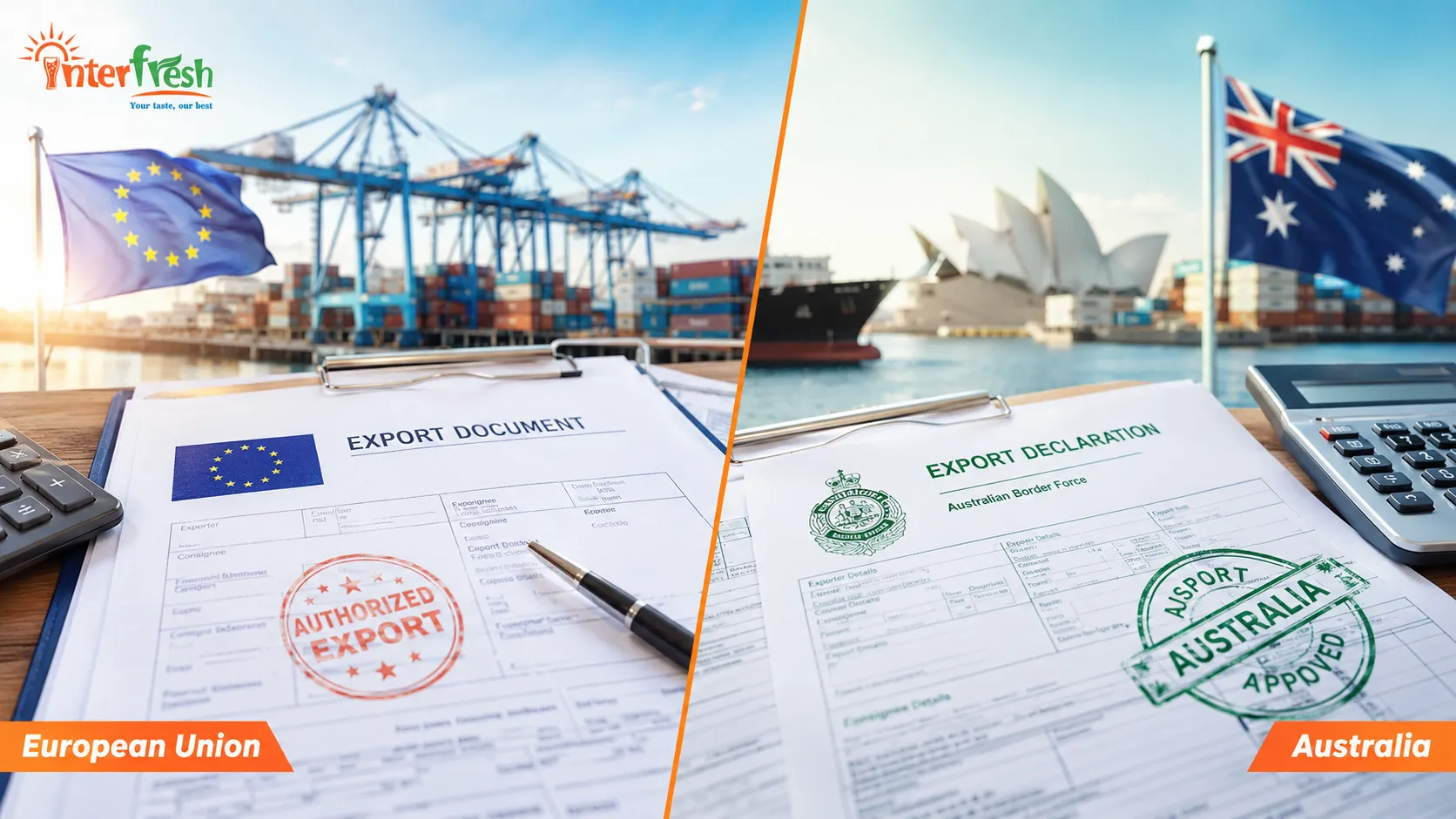
EU and Australia run separate systems, and treating them as interchangeable causes real delays. This EU process no longer covers the UK. The UK follows its own post Brexit rules, covered on our Coconut Water Supplier UK page. Each market has its own classification code, control body and permit process.
Area
European Union
Australia
Classification system
HS, CN, TARIC
HS based Working Tariff
Lead control body
European Commission, national customs
Department of Agriculture, Fisheries and Forestry
Import conditions database
Official Controls Regulation, CHED D where applicable
BICON
Trade agreement with Vietnam
EVFTA
AANZFTA and CPTPP
Food standards body
National food safety authorities
Food Standards Australia New Zealand
The sections below walk through each step in the order most importers actually follow, from classification through to distribution.
Step 1, Verify Supplier Certifications
Before you import coconut water from Vietnam, confirm the manufacturer holds current food safety certification. This is the foundation every later step depends on. Skipping this check is the single most common reason for first shipment stalls.
Look for ISO 22000:2018, HACCP and GMP as a minimum baseline, the same standard covered on our OEM manufacturing page. FDA registration, while a US requirement, also signals an exporter used to third country scrutiny. A supplier without current certificates cannot support smooth clearance in either market.
Step 2, Classify Your Product Correctly
Correct classification decides your duty rate
Correct classification determines your duty rate and which controls apply. Getting this wrong at the start creates problems at every later step.
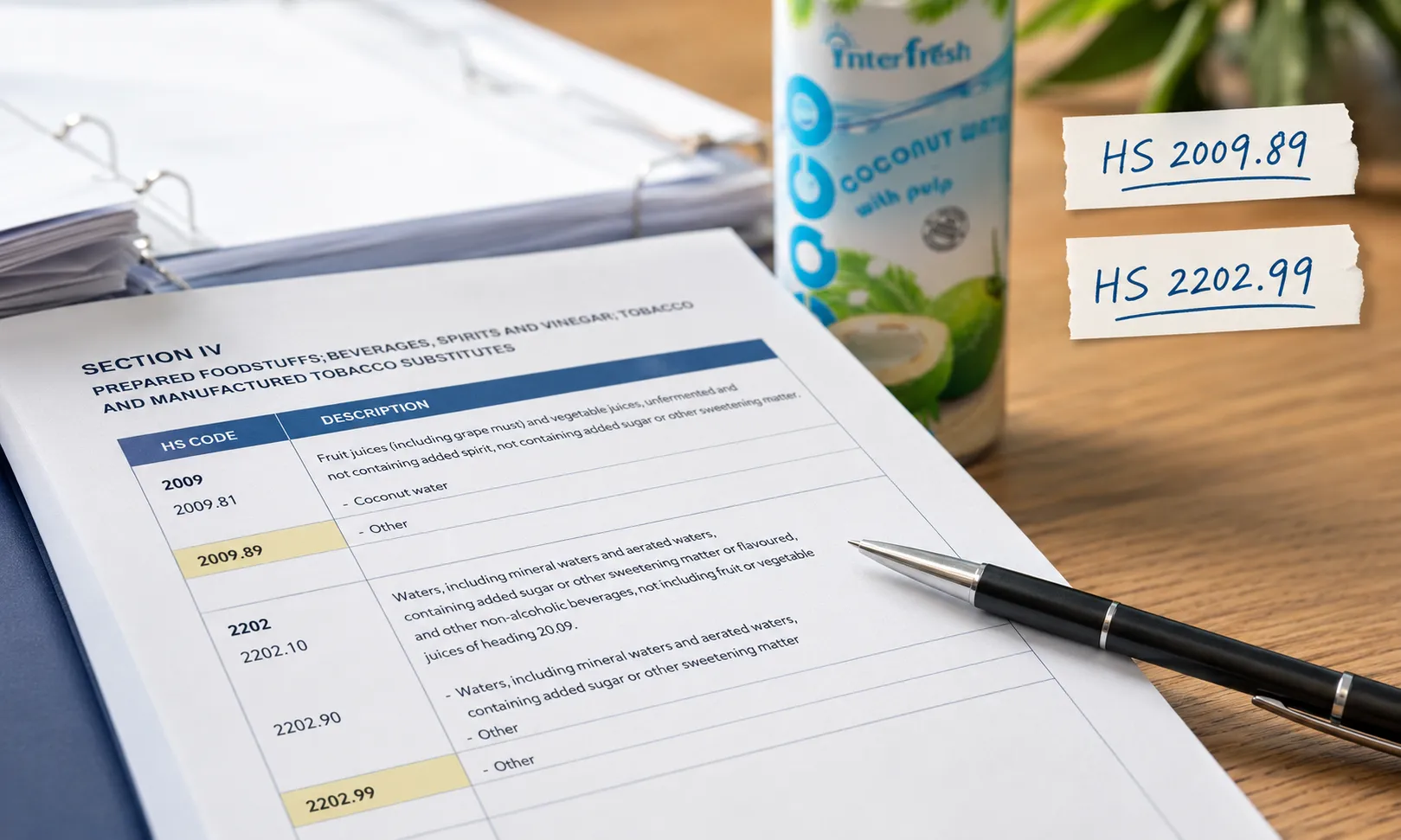
Pure coconut water, unflavored and unblended, typically falls under HS 2009.89. This is the code for unfermented fruit and vegetable juice, the same category as our pure coconut water wholesale line. Coconut water blended with other juice or flavoring typically shifts to HS 2202.99, the code for other non alcoholic beverages. This applies to blends like our flavored coconut water custom development range.
Product type
HS code
EU extension
Notes
Pure coconut water
2009.89
CN and TARIC 10 digit
No added juice or flavor
Flavored or blended coconut water
2202.99
CN and TARIC 10 digit
Includes added sugar or fruit blends
The EU extends the 6 digit HS code into an 8 digit CN code. A further 10 digit TARIC code then confirms the exact duty and any trade measure. Australia uses its own Working Tariff, built on the same HS base but maintained separately.
Codes update on 1 January each year. The full HS revision happens every 5 years, with the next due in 2027. Reconfirm your code each season rather than assuming last year’s classification still holds.
Step 3, Calculate Duties Under EVFTA and AANZFTA
Tariff treatment is where EU and Australia diverge most from a cost perspective. Both markets offer Vietnam meaningful preference. This differs from the US import route, which currently has no free trade agreement with Vietnam at all.
The EU Vietnam Free Trade Agreement, EVFTA, eliminates close to 99 percent of tariff lines on Vietnamese goods. It entered into force in August 2020, with a phase out schedule running up to 7 years on the EU side. Food and beverage lines, including coconut water, have largely reached zero duty within that schedule by 2026. A handful of more sensitive lines continue phasing down through 2027. Confirm your exact TARIC code rather than assuming the whole category is already duty free.
Origin documentation determines whether you can actually claim this preference. For shipments under 6,000 euros, any exporter can self declare origin directly on the commercial invoice. Above that value, the exporter needs a Registered Exporter, or REX, number to certify origin and unlock the preferential rate. A shipment without correct origin documentation pays the standard Most Favoured Nation rate instead. This applies even if the product itself would otherwise qualify for preference.
Australia offers two overlapping paths to preferential treatment. Vietnam and Australia have traded under the ASEAN Australia New Zealand Free Trade Agreement since 2010. Both countries have also traded under the Comprehensive and Progressive Agreement for Trans Pacific Partnership since 2019. Most coconut water tariff lines already enter Australia duty free under either agreement. This benefit only applies when a valid Certificate of Origin accompanies the shipment.
One distinction trips up first time importers. Australia’s 10 percent Goods and Services Tax still applies on import value even when customs duty reaches zero. A free trade agreement removes duty, not GST.
Step 4, Confirm Official Control Requirements
Duty free does not mean inspection free
Duty free entry does not mean an inspection free entry. Both markets run separate control systems that sit alongside tariff treatment. Our Coconut Water Supplier Singapore page describes a similar SFA process for that hub market.
The EU applies its Official Controls Regulation to all food imports, with checks scaled to risk level. Most processed, shelf stable products face routine documents and identity checks rather than physical inspection.
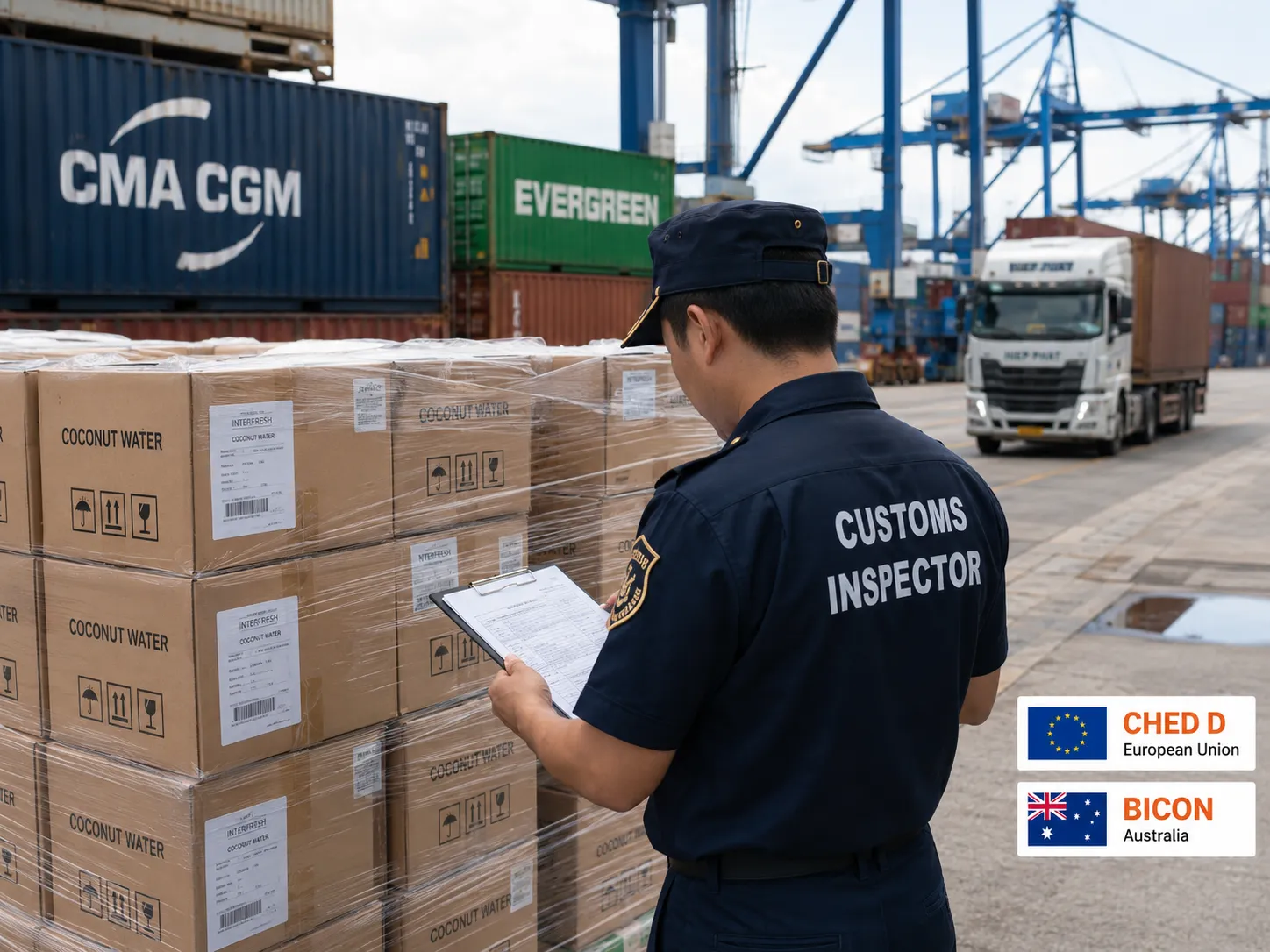
A smaller list of high risk food and feed of non animal origin faces mandatory checks at Border Control Posts. Consignments on that list travel with a CHED D document. This list is reviewed roughly every 6 months. Confirm current status before each shipping season rather than assuming last year’s rules still apply.
Australia routes every food import through BICON, the Biosecurity Import Conditions system. Coconut water sits within the coconut milk drinks category in BICON. This sits alongside textured options like our coconut water with pulp line. A separate listing covers plain coconut water without coconut milk.
Depending on the specific listing, a standard biosecurity permit may be required before goods arrive. That permit currently costs 209 Australian dollars. Standard applications are typically processed within 20 business days, while more complex cases can take up to 40. After biosecurity clearance, the Imported Food Inspection Scheme applies its own inspection tier. This tier reflects both the product type and the country’s compliance history.
Step 5, Prepare Compliant Labeling
A single generic label rarely satisfies both markets
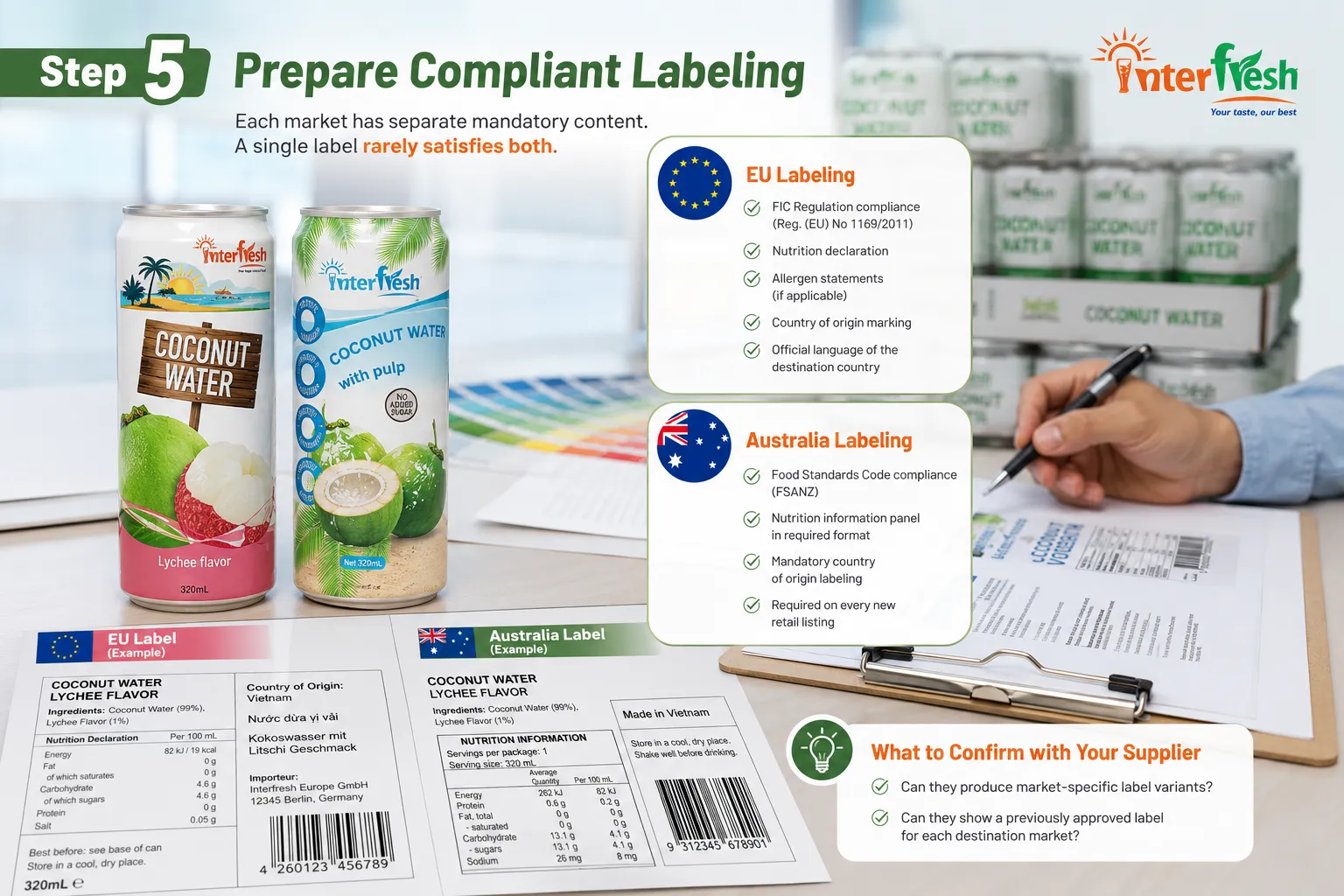
Labeling failures cause more shipment delays than duty miscalculation. Each market has separate mandatory content, and a single label rarely satisfies both.
EU labeling must meet the Food Information to Consumers Regulation. This covers nutrition declarations, allergen statements and clear origin marking. Labels must appear in the official language of the destination country, not only English. A product cleared at the border can still be rejected at retail if the local language requirement is missed.
Australia requires compliance with the Food Standards Code from Food Standards Australia New Zealand. This includes a nutrition information panel in the required format. It also requires mandatory country of origin labeling. This is a rule our pure coconut water wholesale buyers confirm on every new listing.
A supplier producing artwork for a single generic label risks rejection in one market or the other. Confirm your supplier can produce market specific label variants before committing to a production run. Ask to see a previous label approved for each destination market, not only a design mock up.
Step 6, Assemble Export Documentation From Vietnam
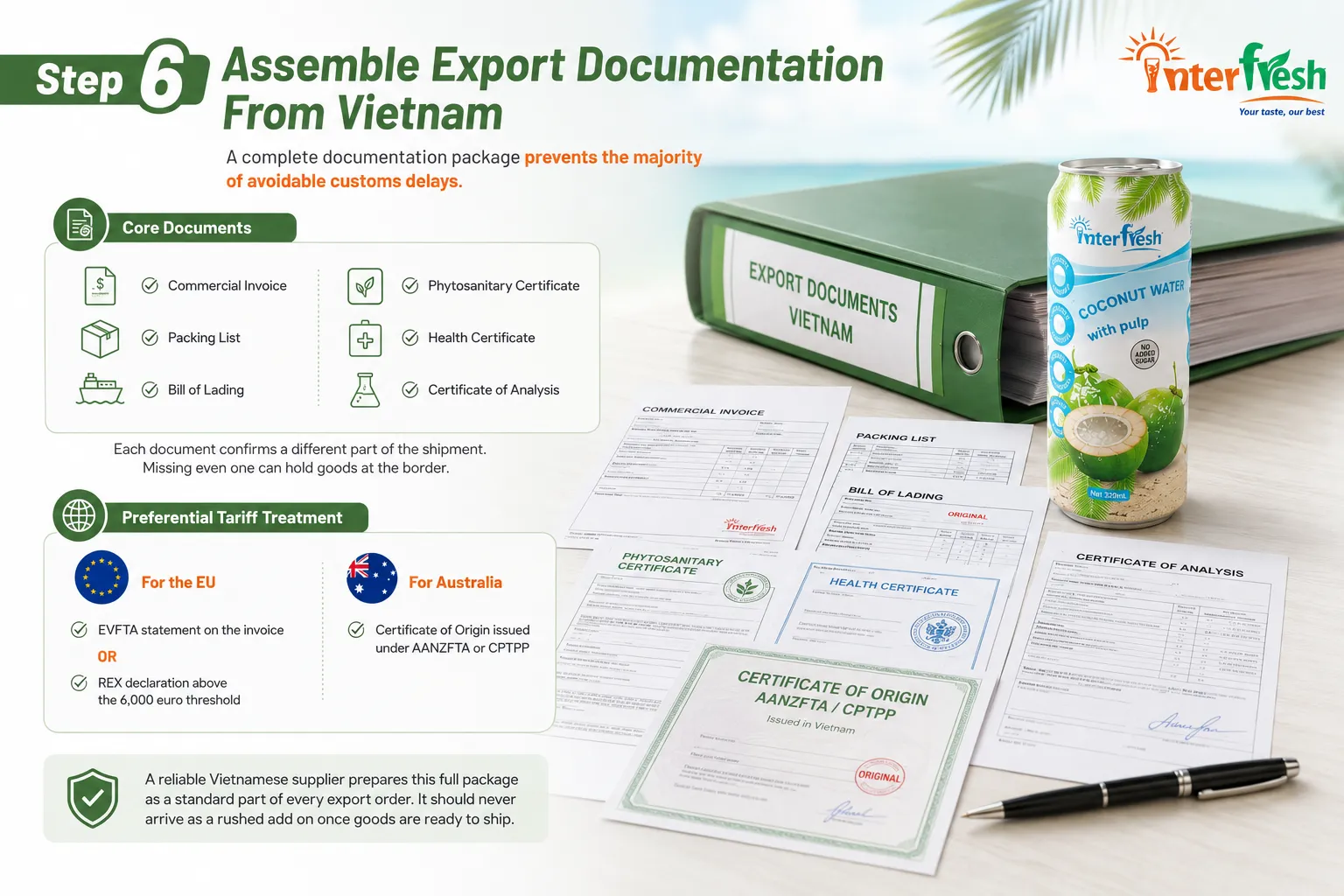
A complete documentation package prevents the majority of avoidable customs delays. Your Vietnamese supplier should prepare this as standard practice. Our beverage import guide for USA buyers follows this same documentation discipline for a different market.
Core documents include a commercial invoice, packing list, bill of lading, phytosanitary certificate, health certificate and Certificate of Analysis. Each document confirms a different part of the shipment, so missing even one can hold goods at the border.
Preferential tariff treatment requires an additional origin document. For the EU, this means an EVFTA statement on the invoice, or a REX declaration above the 6,000 euro threshold. For Australia, this means a Certificate of Origin issued under AANZFTA or CPTPP. A reliable Vietnamese supplier prepares this full package as a standard part of every export order. It should never arrive as a rushed add on once goods are ready to ship.
Step 7, Clear Customs at Destination
Once documentation and classification are correct, customs clearance becomes largely procedural. This holds whether you are clearing bulk Tetra Pak or a smaller 320ml can order. Most delays at this stage trace back to errors made in earlier steps.
In the EU, a licensed customs broker files the import declaration using the correct TARIC code. Border Control Post checks apply only if your product falls within the current high risk list from Step 4. Most shipments clear on documentation alone.
In Australia, formal clearance follows confirmation of any required BICON permit conditions. Australian Border Force manages the customs side of entry. The Imported Food Inspection Scheme separately manages the food safety side, applying whatever inspection tier your product has been assigned.
Step 8, Plan Distribution Logistics
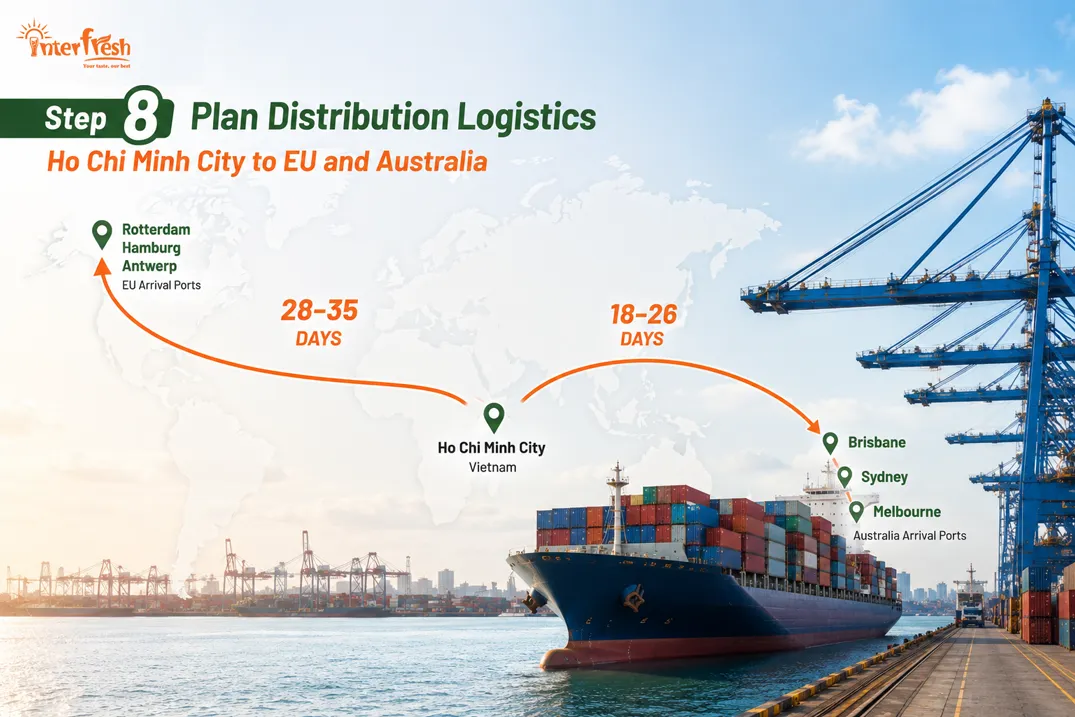
Shipping route from Ho Chi Minh City to EU and Australia ports
Ocean freight from Ho Chi Minh City typically arrives through Rotterdam, Hamburg or Antwerp for EU bound cargo. Australia bound cargo typically arrives through Sydney, Melbourne or Brisbane. Transit times vary by route, carrier and season. Build buffer time into your planning ahead of a target shelf date.
Shelf stable coconut water in cans, Tetra Pak or glass does not require refrigerated containers. This simplifies routing options and reduces freight cost compared to chilled categories. Buyers researching format specific shipping detail can review our Tetra Pak coconut water manufacturer page. Our canned coconut water OEM specification covers can format logistics in more depth.
Common Mistakes That Delay Coconut Water Shipments
Most delays trace back to a small set of recurring errors. Knowing them in advance saves real time once you actually import coconut water from Vietnam.
Classifying flavored product under the pure water code. A blended coconut water declared under HS 2009.89 instead of 2202.99 invites a customs query and possible reassessment. Confirm your exact formulation against both codes before filing.
Skipping the origin declaration threshold check. Shipments over 6,000 euros without a valid REX number lose EVFTA preference entirely. This single oversight can add a meaningful duty cost to an otherwise qualifying order.
Assuming last year’s BICON listing still applies. Import conditions get updated, and a permit approved for a previous shipment does not guarantee approval for a new one. Recheck BICON before every season, not only before your first order.
Treating GST as included in the tariff conversation. Australian buyers sometimes assume a zero duty rate under AANZFTA means a zero landed tax cost. The 10 percent GST still applies regardless of trade agreement status.
Using one label design across both markets. A label built for EU allergen and language rules rarely satisfies Australia’s country of origin labeling requirement without adjustment. Our Tetra Pak coconut water buyers usually budget for two label variants from the start.
Choosing a Compliant Vietnamese Coconut Water Supplier
Once you understand the process, supplier selection becomes the variable that determines how smoothly it runs. A handful of checks separate a reliable partner from a risky one.
Confirm current ISO 22000, HACCP and GMP certification directly, rather than relying on a supplier provided document alone. Ask for a sample export documentation package from a recent shipment to the market you plan to enter. Review whether the supplier can produce region specific label artwork in house, since outsourced labeling adds time and risk. Our own coconut water OEM catalogue shows the level of detail a documentation package should include.
A supplier that welcomes a factory audit or virtual tour signals confidence in its own process. Treat any resistance to this request as a warning sign. This matters most before you commit to importing coconut water from Vietnam at real container scale.
Why Interfresh for Your Import Program
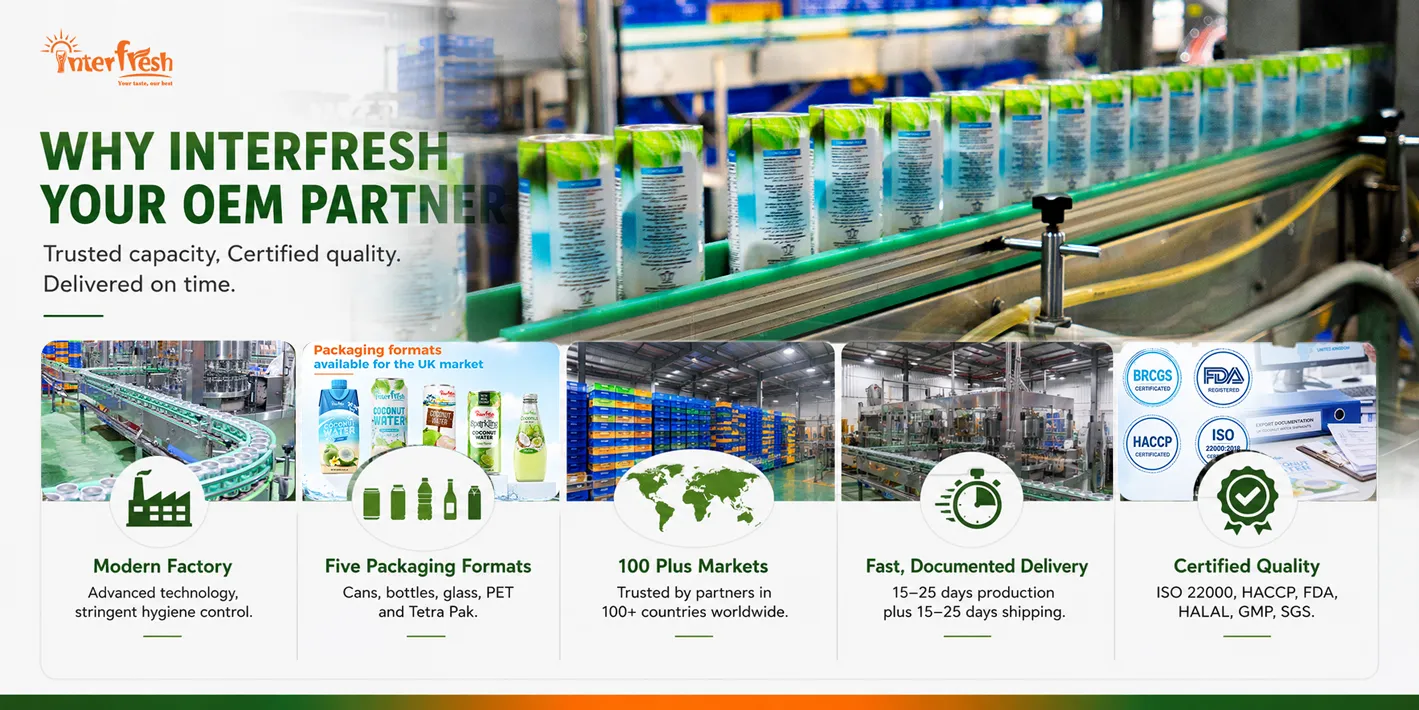
Interfresh maintains ISO 22000:2018, HACCP, GMP and FDA registration across every RTD production line
Interfresh maintains ISO 22000:2018, HACCP, GMP and FDA registration across every RTD production line. Our export team prepares market specific documentation for each shipment, rather than a single generic package. This is the same standard we apply whenever a distributor decides to import coconut water from Vietnam through us.
For buyers who have already decided on a destination market, our dedicated pages go deeper than this general guide. Distributors targeting the UK can review our Coconut Water Supplier UK page. It covers post Brexit rules that now run separately from the EU process described above. Buyers focused on Australia can review our Coconut Water Supplier Australia page. It adds MOQ and seasonal shipping detail specific to that market.
Buyers wanting the full product range before narrowing their specification can start from our coconut water manufacturer hub page. It links out to every packaging format and flavor option covered across this cluster.
Ready to scope your import project. Contact our export team for a documentation summary specific to your destination market.
FAQs
What is the correct HS code to import coconut water from Vietnam? Pure coconut water typically falls under HS 2009.89. Flavored or blended versions typically shift to HS 2202.99, so confirm classification against your exact formulation.
Does coconut water need a CHED D document to enter the EU? Only if it appears on the current high risk food and feed list. This list falls under the Official Controls Regulation and changes roughly every 6 months, so confirm status before each shipment.
Do I need an import permit to bring coconut water into Australia? Check the coconut milk drinks category in BICON for your specific product listing. A standard permit may be required, and it should be arranged before goods arrive.
Is coconut water duty free from Vietnam under EVFTA? Most food and beverage tariff lines have already reached zero duty under EVFTA’s schedule. Confirm your exact TARIC code, since a small number of lines still phase out through 2027.
Does an Australian free trade agreement remove GST as well as duty? No. AANZFTA and CPTPP remove customs duty, but the 10 percent Goods and Services Tax still applies on import value.
What documents does a Vietnamese supplier need to provide? A complete package includes commercial invoice, packing list and bill of lading. Add a phytosanitary certificate, health certificate, Certificate of Analysis and the relevant Certificate of Origin.
References
European Commission (2026) Combined Nomenclature and TARIC. Available at: https://taxation-customs.ec.europa.eu/customs/common-customs-tariff-cct/tariff-classification-goods_en (Accessed: 16 July 2026).
European Commission (2026) Import Controls on Food and Feed. Available at: https://food.ec.europa.eu/horizontal-topics/official-controls-and-enforcement/imported-products_en (Accessed: 16 July 2026).
European Commission (2026) EU Vietnam Free Trade Agreement. Available at: https://trade.ec.europa.eu/access-to-markets/en/content/eu-vietnam-free-trade-agreement (Accessed: 16 July 2026).
Department of Agriculture, Fisheries and Forestry (2026) Biosecurity Import Conditions System, BICON. Available at: https://www.agriculture.gov.au/biosecurity-trade/import/online-services/bicon (Accessed: 16 July 2026).
Department of Agriculture, Fisheries and Forestry (2026) Coconut Milk Drinks Import Requirements. Available at: https://www.agriculture.gov.au/biosecurity-trade/import/goods/food/type/coconut-milk-drinks (Accessed: 16 July 2026).
Vietnam Ministry of Industry and Trade (2026) EVFTA Main Commitments. Available at: https://vntr.moit.gov.vn/fta/31/1 (Accessed: 16 July 2026).