
The aloe vera drink market is entering 2026 with real momentum behind it. Global value now sits at USD 190.51 million, up from USD 172.07 million just one year earlier. For B2B distributors, wholesalers and private label brand owners, that growth curve is not just a headline. It is a signal about timing, category selection and where sourcing decisions should happen next.
This report walks through the current aloe vera drink market size, the forces driving it, where the growth concentrates by region and format, and what all of this means for a distributor planning a 2026 category expansion. Numbers alone rarely close an RFQ. Context does.
Global Aloe Vera Drink Market Size in 2026
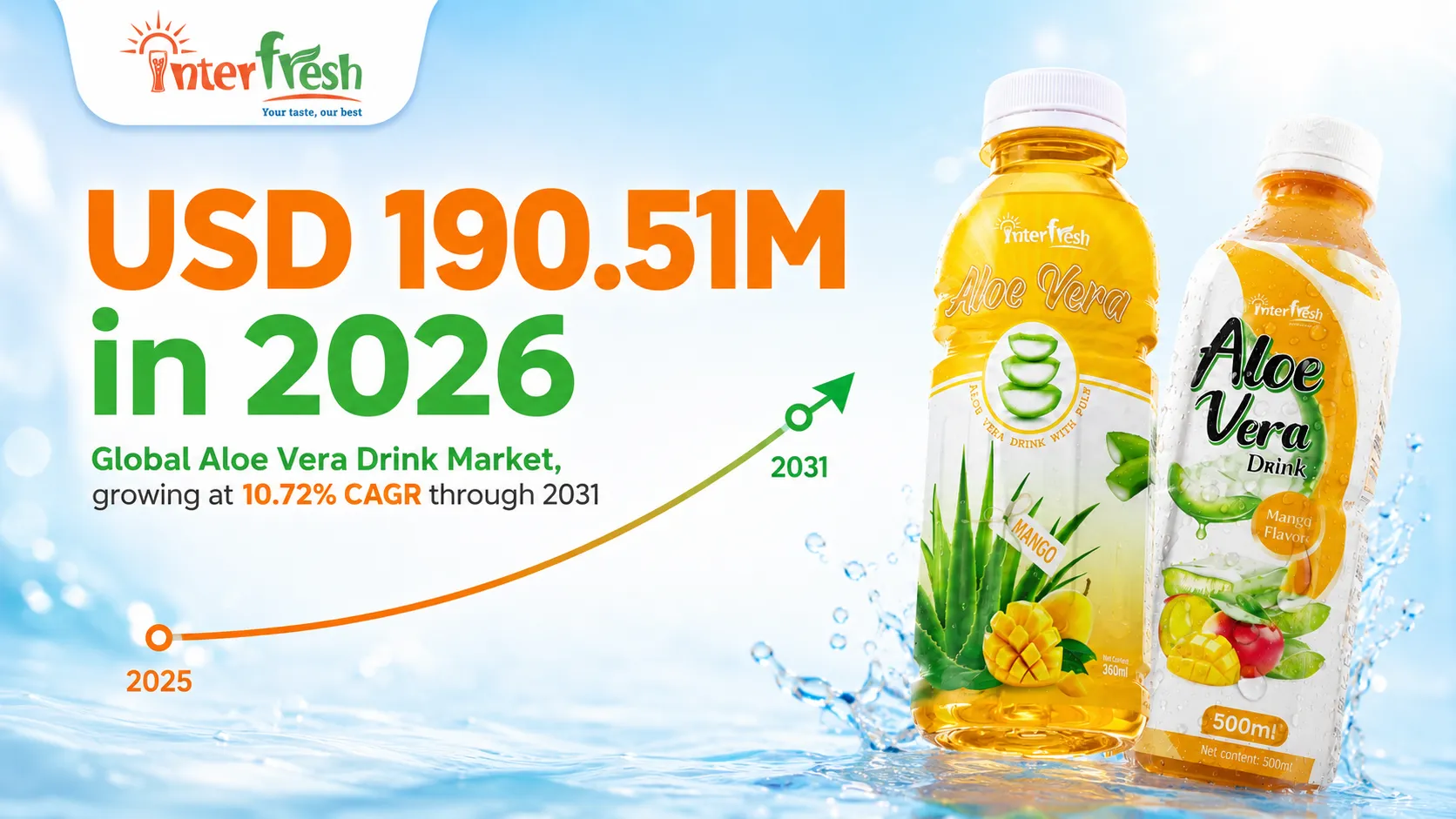
Multiple research houses tracked this category into 2026, and the consensus points the same direction. Mordor Intelligence, updated in January 2026, values the global market at USD 190.51 million this year. That is up from USD 172.07 million in 2025.
The same report projects the market reaching USD 317.02 million by 2031. That works out to a compound annual growth rate of 10.72 percent across the forecast window. Technavio, publishing separately in late 2025, expects the market to add USD 106.48 million in absolute value between 2026 and 2030, at a 13.8 percent CAGR.
DataM Intelligence lands close to Mordor’s base figure, citing USD 172.07 million for 2025 with a 10.9 percent CAGR through 2033. Three independent firms, three overlapping numbers. That convergence matters more than any single data point.
Many buyers search for: “aloe vera drink market size 2026.” The short answer is USD 190.51 million globally, growing at roughly 10.7 to 13.8 percent per year depending on the forecasting model used.
Why Aloe Vera Drink Market Size Estimates Vary So Widely
Search this topic and the numbers swing hard. Some reports cite hundreds of millions. Others cite figures in the billions. That gap is not a data error. It comes down to category definition.
Narrower reports, like Mordor Intelligence and Technavio, scope the market to ready to drink aloe vera beverages only. Broader reports fold in aloe based gels, supplements and cosmetic adjacent drink formats. That inflates the total figure by an order of magnitude.
For a distributor evaluating the beverage aisle specifically, the narrower figure is the relevant one. A private label buyer sourcing bottled or canned product should anchor decisions to the RTD focused estimate, not the blended category total. Confusing the two leads to inflated growth assumptions during business case planning.
Key Growth Drivers Behind the 2026 Aloe Vera Drink Market
Three forces are pushing the aloe vera drink market forward this year, and each one has a direct commercial angle for distributors.
- Digestive health positioning. Consumers increasingly buy functional beverages for a specific benefit, not general refreshment. Aloe vera carries an established digestive health association that reduces the marketing lift needed for a new SKU.
- Flavor engineering. Early aloe vera drinks struggled with a bitter, medicinal taste profile. Flavor development in peach, grape, mango and strawberry variants has largely solved that barrier. Our grape aloe vera drink export line is one example of that shift toward mainstream palatability.
- Clean label demand. Low sugar, additive free formulations align with broader retail trends across the United States and Europe, supporting premium shelf placement.
Packaging data reinforces the flavor point directly. PET bottles held 73.88 percent of category share in 2025, while canned formats are projected to grow at 11.39 percent CAGR, the fastest of any packaging type.
Market Restraints Distributors Should Plan Around
Growth numbers rarely tell the full story. Two structural restraints shape how fast a new entrant can actually scale in this category.
Raw material supply remains tighter than most fast growing beverage segments. Aloe vera requires specific growing conditions and careful inner leaf processing to control aloin content. That limits how quickly new suppliers can enter at scale.
Regulatory complexity compounds this. Labeling rules, permitted health claims and ingredient thresholds differ across the United States, European Union, Australia and the Middle East. A supplier without export documentation experience adds real delay to a launch timeline. Buyers evaluating a factory partner for the first time should review our OEM and private label beverage manufacturing guide before finalizing a shortlist.
Aloe Vera Drink Market Segmentation in 2026
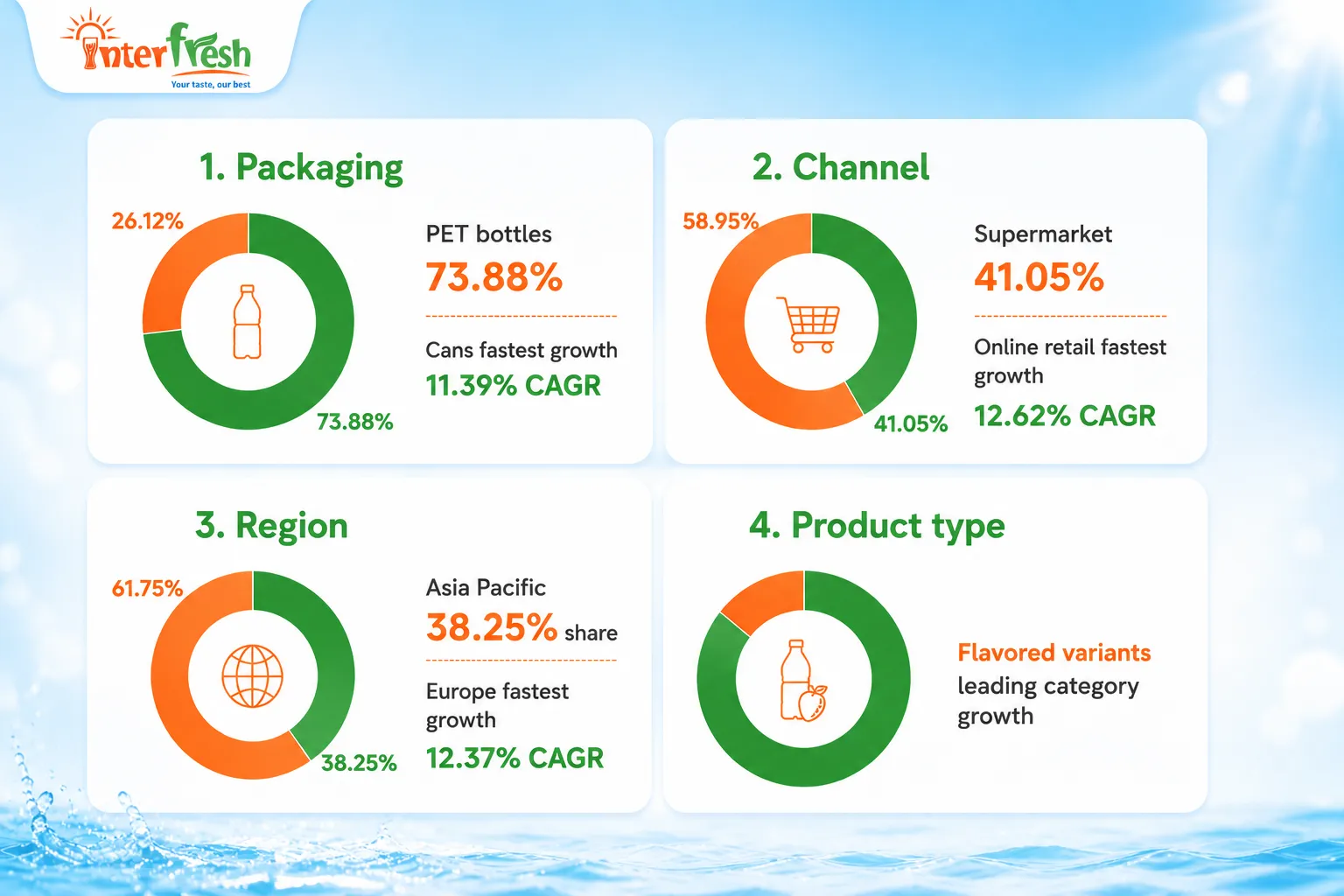
Segmentation data tells a distributor exactly where category growth concentrates, and where shelf space is opening fastest.
| Segment | 2025 to 2026 Position | Fastest Growing Sub Segment |
|---|---|---|
| Packaging | PET bottles hold 73.88 percent share | Aluminum cans, growing at 11.39 percent CAGR |
| Distribution Channel | Supermarkets and hypermarkets hold 41.05 percent share | Online retail, growing at 12.62 percent CAGR |
| Region | Asia Pacific holds 38.25 percent share | Europe, growing at 12.37 percent CAGR |
| Product Type | Unflavored historically dominant | Flavored variants, fastest CAGR through 2030 |
Many buyers also search for: “aloe vera drink packaging trends 2026.” Cans and PET bottles both remain relevant, but online retail is where the fastest volume growth is happening right now.
For a private label buyer, this table has one clear implication. A PET bottle SKU sold through a supermarket channel is the safest entry point. Cans and online first brands represent the higher growth, higher risk expansion path.
Regional Market Analysis for Sourcing and Distribution
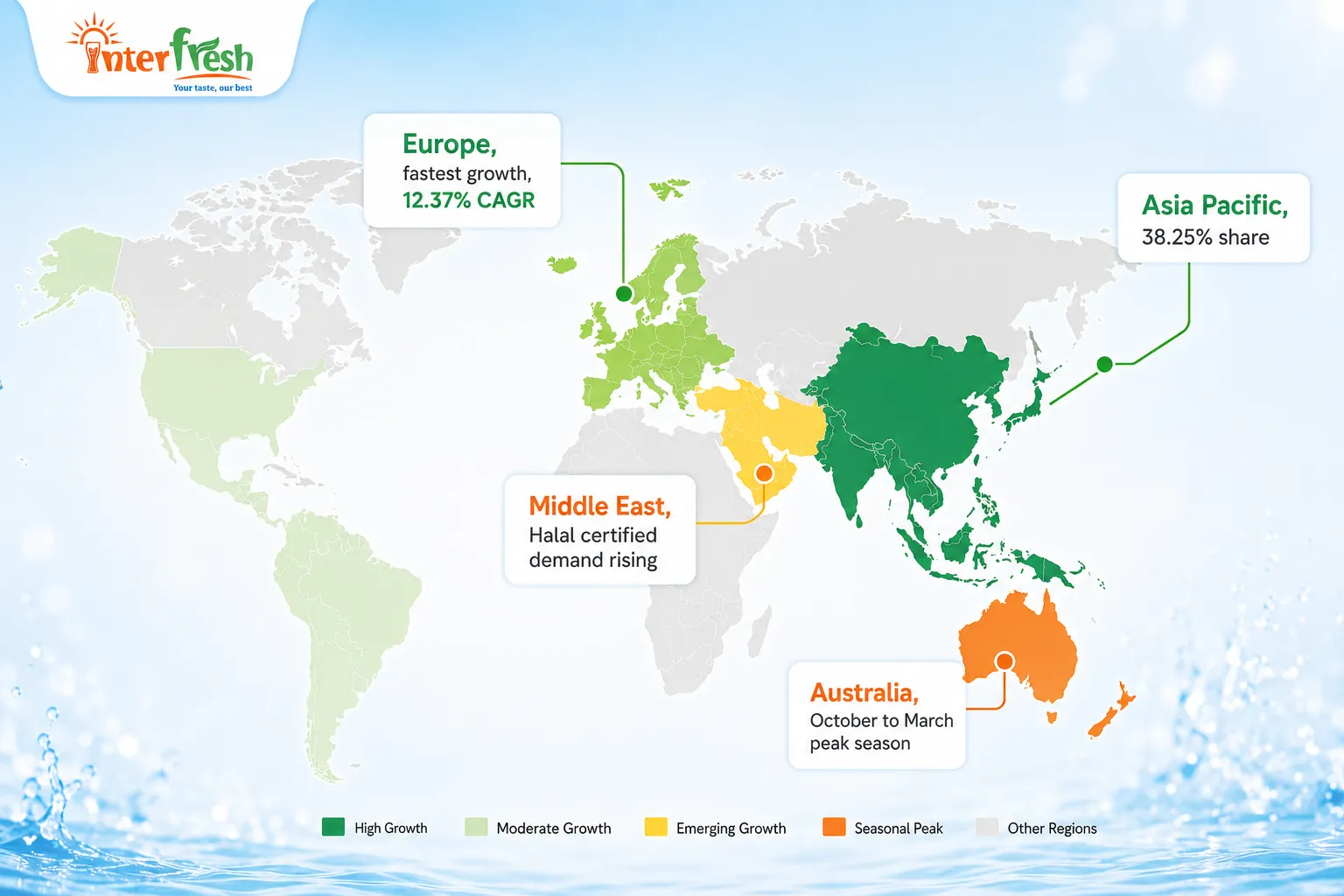
Region drives both cost and speed to market, and 2026 data shows a widening gap between mature and emerging demand zones.
Asia Pacific remains the largest consumption base at 38.25 percent share, supported by proximity to raw aloe vera cultivation. Europe is the fastest growing region at 12.37 percent CAGR, driven by clean label demand and recent regulatory clarity that opened space for new product launches.
North America continues steady import growth, particularly through natural and health food retail channels. The Middle East is expanding quickly as well, with Halal certified supply as a non negotiable entry requirement for that market. Buyers focused specifically on the United States import process should review our dedicated page on aloe vera drink sourcing for US importers.
Australia deserves separate mention because of its reversed seasonal calendar. Summer runs October through March there, meaning stock must land months ahead of Northern Hemisphere planning cycles. Full timing and compliance detail sits on our aloe vera drink import Australia page.
Competitive Landscape and Flavor Trends to Watch
Global brand leaders including OKF, ALO Drinks, Forever Living and Lily of the Desert continue to hold strong retail presence. None of them dominate private label supply, which keeps this category open for OEM entrants.
Flavor performance data across comparable Asia Pacific markets points to a fairly consistent ranking. Peach, strawberry and original lead adoption, with grape and mango close behind as secondary tier flavors. Distributors testing a new market often start with two or three of these before expanding the range. Our peach aloe vera juice wholesale and mango aloe vera juice wholesale pages carry full specification detail for each variant.
Buyers building a broader assortment often add strawberry aloe vera drink alongside grape as a second wave SKU, once the anchor flavor proves out in market.
What Aloe Vera Drink Market Growth Means for Distributors and Private Label Brands
Put together, this data supports one practical conclusion. The category is growing fast enough to justify entry, but not so saturated that late movers are locked out.
A distributor entering now still has room to claim shelf space ahead of full market maturity. The window is widest in canned formats, online retail and the European region specifically, where growth is outpacing overall category expansion.
Timing still matters within that window. Retail listing cycles typically lock in three to four months before shelf date, which means sourcing decisions for a 2026 launch need to happen now, not closer to year end.
Sourcing Aloe Vera Drink from Vietnam in 2026
Vietnam has become one of the more competitive sourcing origins for this category, and the reasons are structural rather than promotional.
Tropical growing conditions support high acemannan content in the raw aloe leaf. Production costs remain lower than comparable output from Thailand, China or South Korea, without a quality tradeoff when the supplier runs proper inner leaf processing controls.
Export infrastructure is also mature. Vietnam ships to more than 100 countries under FDA, HALAL and ISO 22000 certification frameworks, which shortens the compliance runway for a first time buyer. A full comparison against alternative sourcing countries is available on our Vietnam versus China OEM beverage analysis.
Many buyers search for: “aloe vera drink supplier for import.” The practical answer sits in three parts: confirmed certification, repeatable batch quality, and a factory that can scale from a trial order to a full container without a formula change.
Interfresh Aloe Vera Drink Specifications and MOQ
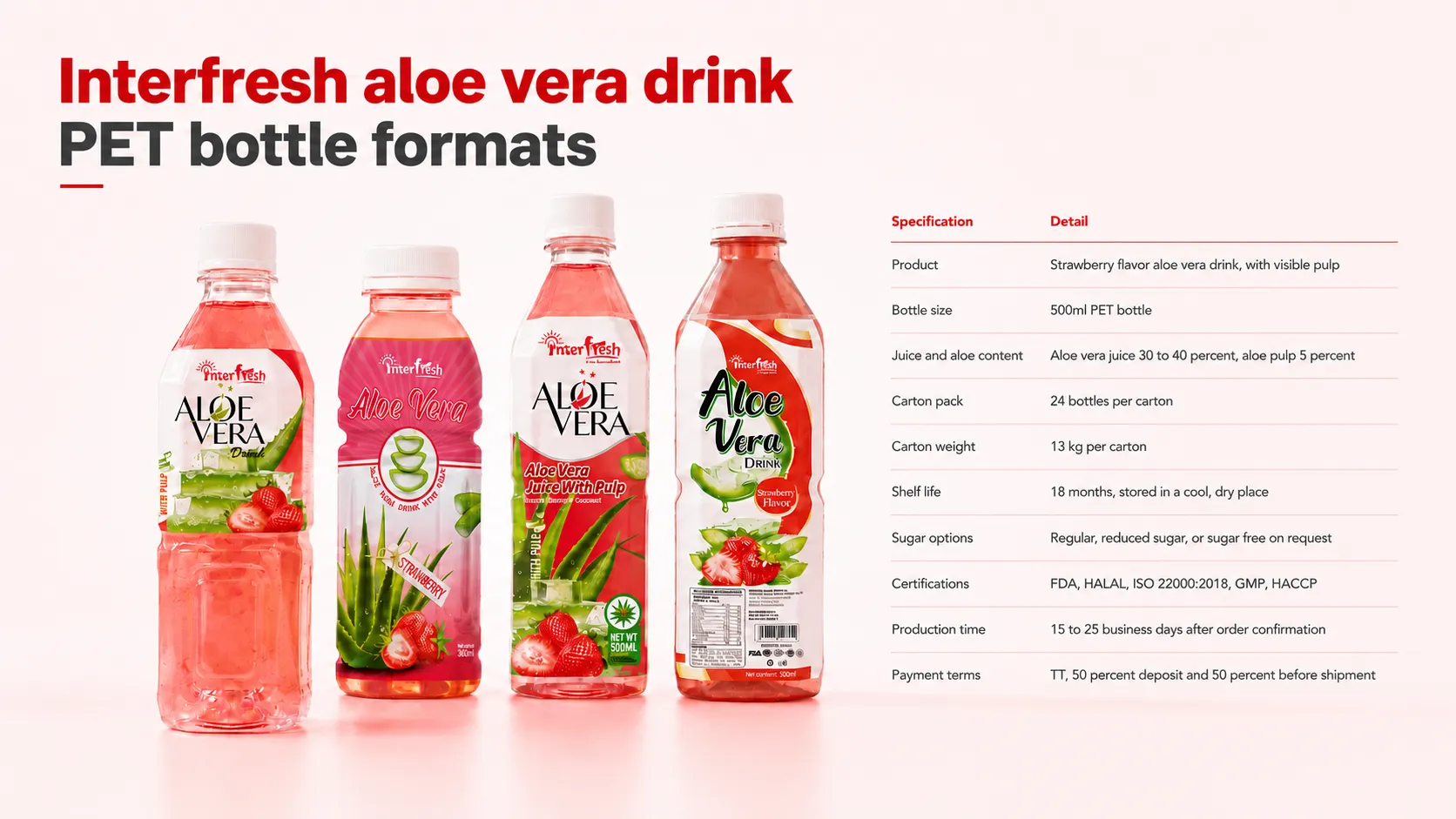
For distributors ready to move past research and into an actual RFQ, specification and minimum order detail matter more than market commentary.
| Format | Juice and Pulp Content | Shelf Life | Carton Configuration | MOQ |
|---|---|---|---|---|
| 360ml PET bottle | Aloe juice 30 to 40 percent, pulp 5 percent | 18 months | 24 bottles per carton | 400 trays per flavor |
| 500ml PET bottle | Aloe juice 30 to 40 percent, pulp 5 percent | 18 months | 24 bottles per carton | 400 trays per flavor |
| 320ml aluminum can | Aloe juice 30 to 40 percent, pulp 5 percent | 24 months | 24 cans per carton | 400 trays per flavor |
All three formats are produced under FDA, HALAL, ISO 22000:2018, GMP and HACCP certification, with flavor options including original, strawberry, pomegranate, pineapple, guava and mixed fruit. Buyers can request a private label version of any format through our aloe vera drink manufacturer hub, where full OEM process detail and lead times are outlined.
FAQs on the Aloe Vera Drink Market
What is the aloe vera drink market size in 2026? Yes, current data confirms the global market reached USD 190.51 million in 2026. This figure comes from Mordor Intelligence’s January 2026 update. It reflects growth from USD 172.07 million in 2025, at a 10.72 percent CAGR through 2031.
Is aloe vera drink good to drink every day? Yes, aloe vera drink is generally considered safe for daily consumption in moderate amounts. It is associated with digestive comfort and natural hydration support. Brands making specific health claims should confirm wording against local food regulations first.
What is the MOQ for aloe vera drink OEM from Vietnam? The standard minimum order is 400 trays per flavor, roughly one 20 foot container. Smaller trial or sample orders are available for first time buyers testing a new market. Private label programs typically scale from that first container.
Which certifications does an aloe vera drink manufacturer need for export? FDA registration, HALAL certification, ISO 22000:2018, GMP and HACCP are the core requirements for most import markets. Additional certificates, such as organic or Rainforest Alliance, apply depending on the destination country. Interfresh issues these per shipment as standard documentation.
How is aloe vera drink different from aloe vera juice? Aloe vera drink typically includes flavoring, sweetener and visible pulp for retail appeal. Aloe vera juice more often refers to a less processed, single ingredient format. Both use the same inner leaf gel as the functional base ingredient.
Which countries import the most aloe vera drinks? Asia Pacific leads in overall consumption, supported by proximity to raw material supply. The United States, United Kingdom and Australia show the fastest growing import demand outside that region. Middle East demand is expanding quickly as well, contingent on Halal certified supply.
References
- Mordor Intelligence. Aloe Vera Based Drinks Market Size and Share Analysis, Growth Trends and Forecasts 2026 to 2031. mordorintelligence.com, January 2026.
- Technavio. Aloe Vera Based Drinks Market Growth Analysis, Size and Forecast 2026 to 2030. technavio.com, December 2025.
- DataM Intelligence. Aloe Vera Drink Competitor Insights: Trends and Opportunities 2026 to 2034. datainsightsmarket.com, April 2026.
- Grand View Research. Aloe Vera Drinks Market Size, Share and Trends Report, 2030. grandviewresearch.com.
- Food Navigator Europe. Clean Label and Functional Beverage Trends in European Grocery, 2026. foodnavigator.com.
Distributors comparing categories often look at our full profile on the Interfresh aloe vera drink manufacturer hub before requesting a quote. Those focused on Australia specifically can review timing and compliance on the aloe vera drink import Australia page, while US focused buyers may prefer our Vietnam to USA importer guide. Flavor specific detail is available for grape, peach, mango and strawberry variants, and a full sourcing comparison sits on our Vietnam versus China OEM beverage page. For brand owners weighing a fully custom formula, our ODM development service and OEM private label guide outline the process end to end.
Last updated: July 2026 | Category: Market Trends, Global | Parent cluster: Aloe Vera Drink Manufacturer and OEM Vietnam