
Imagine standing in front of a supermarket juice aisle. One orange juice bottle says Not From Concentrate and costs more. It is also displayed in the refrigerated section. Another says From Concentrate, costs less, and sits on a regular shelf. Both labels state 100% juice.
So, what makes them different? Is Not From Concentrate juice actually better, or are you simply paying more for a different production method?
The answer comes down to processing, nutritional composition, flavor, and storage conditions. To understand the difference between from concentrate vs not from concentrate juice, let’s first look at what these terms actually mean.
Quick Answer: What Is the Difference Between From Concentrate and Not From Concentrate Juice?
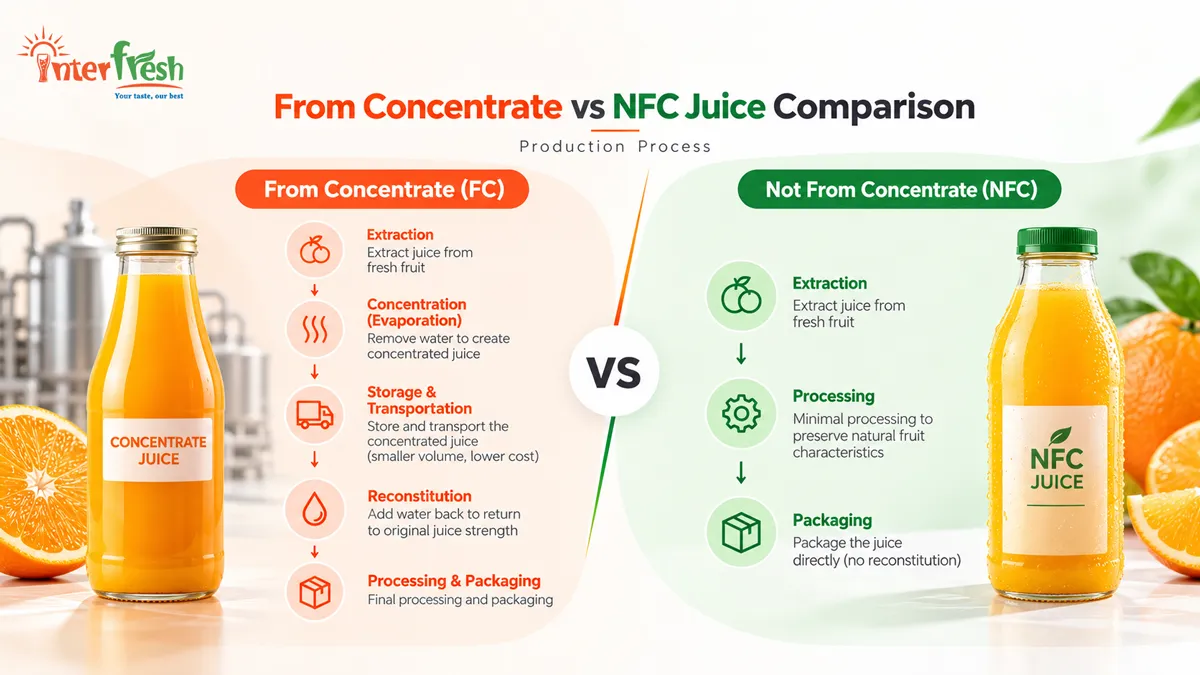
From Concentrate (FC) juice is made by removing most of the water from freshly extracted juice. Manufacturers store and transport the resulting concentrate, then add water back to restore the juice to its target Brix level before packaging.
Not From Concentrate (NFC) juice does not undergo concentration and reconstitution. Instead, manufacturers process and package the juice after extraction, usually with a pasteurization step to ensure food safety.
Both types can be 100% fruit juice. The main difference lies in their production processes, not whether they contain real fruit juice.
| Comparison Factor | From Concentrate (FC) | Not From Concentrate (NFC) |
|---|---|---|
| Production process | Extraction → concentration → storage/transportation → reconstitution → processing → packaging | Extraction → processing → packaging |
| Flavor | Can be consistent across batches through blending and formula control | Can retain distinct fruit characteristics, but may vary with harvest seasons |
| Nutrition | Depends on the raw ingredients and processing conditions | Depends on the raw ingredients and processing conditions |
| Sugar | Does not automatically contain added sugar | Does not automatically mean the product has no added sugar |
| Transportation | Offers logistical advantages because concentrated juice is transported | Requires transportation of juice with its natural water content |
| Storage | Can be stored at room temperature, depending on processing and packaging | Can require refrigeration or be shelf-stable, depending on processing and packaging |
| Price | Often benefits from lower transportation costs | May involve higher transportation costs |
Neither FC nor NFC is automatically lower or higher in quality. To evaluate a product, you need to consider its ingredients, processing technology, and storage conditions.
What Does “From Concentrate” Mean?
From Concentrate, also known as reconstituted juice, is juice made by adding water back to concentrated fruit juice.
During production, manufacturers remove most of the water from the original juice. This creates a concentrated product that is easier to store and transport.
At the packaging facility, water is added back to restore the juice to its target concentration. The finished product must meet the applicable composition and quality requirements in its target market.
What Role Does Brix Play in From Concentrate Juice?
°Brix measures the soluble solids content of a solution. In fruit juice, naturally occurring sugars usually account for most of these soluble solids.
Manufacturers use a refractometer to measure Brix and monitor product concentration. During reconstitution, this measurement helps technical teams determine how much water to add to bring the juice back to its target concentration.
The target Brix level depends on the fruit type and product specifications. Manufacturers therefore need to control this measurement to maintain consistency across production batches.
Can From Concentrate Juice Be 100% Fruit Juice?
Yes. 100% juice can still be From Concentrate.
These two terms describe different product characteristics:
- 100% juice indicates the proportion of fruit juice in the product.
- From Concentrate describes the production process, in which juice is concentrated and then reconstituted.
A product can therefore be both 100% fruit juice and juice from concentrate. The From Concentrate label does not automatically mean that the product contains added sugar or a lower proportion of fruit.
What Does “Not From Concentrate” (NFC) Mean?
Not From Concentrate (NFC) juice is produced without going through the concentration and reconstitution stages.
After extraction and processing, the juice moves to packaging. Depending on the technology used, manufacturers may also store the juice in aseptic tanks before filling.
However, NFC does not mean freshly squeezed juice that has never undergone industrial processing.
Are NFC, Pure Juice, and Freshly Squeezed the Same?
These three terms often appear on product labels and in marketing materials, but they are not necessarily interchangeable.
- NFC: Juice that has not undergone concentration. It can still be pasteurized and stored before packaging.
- Pure Juice / Direct Juice: Some brands use these terms to describe directly extracted juice. Their precise meaning depends on the definitions and labeling practices of each market.
- Freshly Squeezed: Usually describes juice that has recently been extracted and may be sold immediately or within a short period. The term does not automatically prove that the product has undergone no processing.
According to FAO materials on citrus processing, the juice industry can store NFC juice in large-scale aseptic tanks before packaging. Therefore, bottled NFC juice is not necessarily extracted immediately before it is packaged.
The key point is that NFC describes the absence of a concentration step. It does not describe the product’s entire processing history or the time between extraction and purchase.
How Are From Concentrate and Not From Concentrate Juices Made?
FC and NFC juice production share several initial stages. Both begin with fruit receiving, cleaning, and preparation.
The main difference appears in the subsequent processing stages. FC involves water removal and reconstitution, while NFC does not undergo either step.
How Is From Concentrate Juice Made?
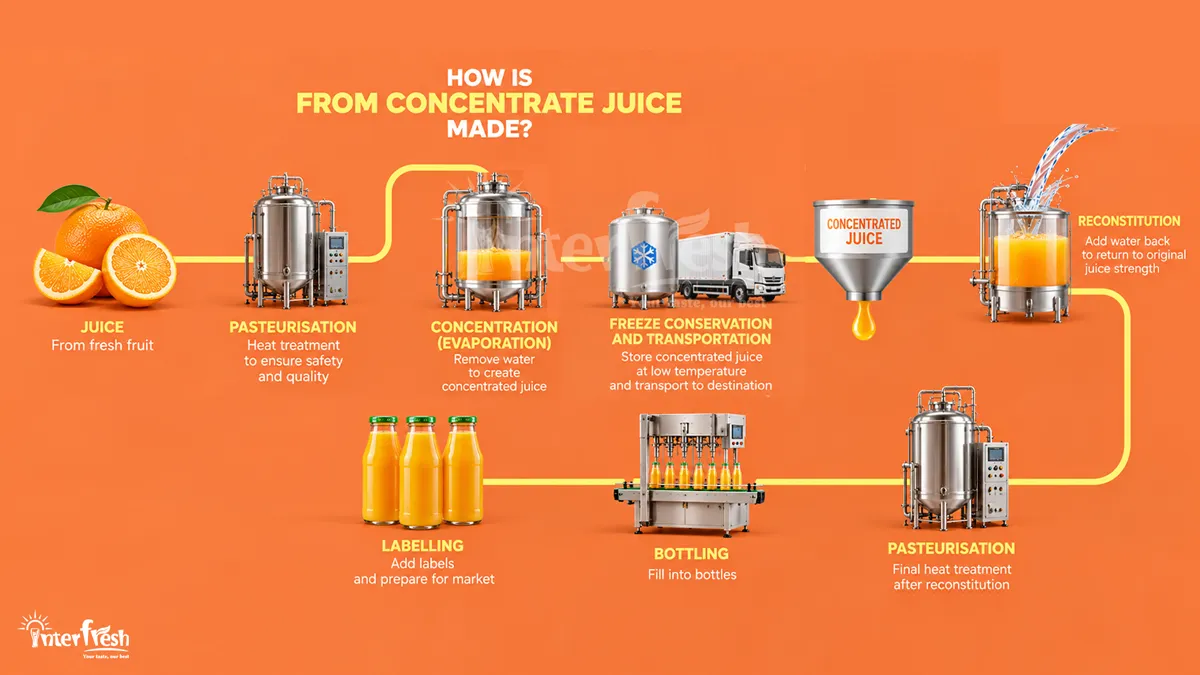
1. Fruit Receiving and Preparation
The factory receives, inspects, washes, and sorts the fruit. This stage removes raw materials that do not meet the required specifications before extraction.
2. Juice Extraction and Filtration
Extraction equipment separates the juice from the peel, seeds, and fruit tissues. A finisher or filtration system then removes unwanted particles and adjusts the pulp content according to product specifications.
3. Evaporation
The juice is fed into an evaporator to remove a large proportion of its water. This increases the concentration of soluble solids while reducing the juice’s volume.
For orange juice, the industry may use a TASTE (Thermally Accelerated Short Time Evaporator) system. This technology was developed to concentrate juice over a short processing period.
During evaporation, some volatile aroma compounds may also escape with the water vapor. Manufacturers can therefore use an essence recovery system to capture these compounds.
4. Concentrate Storage and Transportation
After concentration, the product may reach approximately 65 °Brix, depending on the juice type and processing method. Manufacturers store the concentrate under frozen or aseptic conditions, then transport it in specialized containers or packaging systems such as bag-in-drum.
5. Reconstitution
At the packaging facility, manufacturers add water back to the concentrate. Technical teams monitor Brix and other relevant parameters to bring the juice to its target specifications.
Depending on the formula, manufacturers may also restore recovered essence or adjust the pulp content to achieve the desired product characteristics.
6. Processing and Packaging
After reconstitution and quality checks, the juice undergoes appropriate heat treatment before filling and packaging.
How Is Not From Concentrate Juice Made?
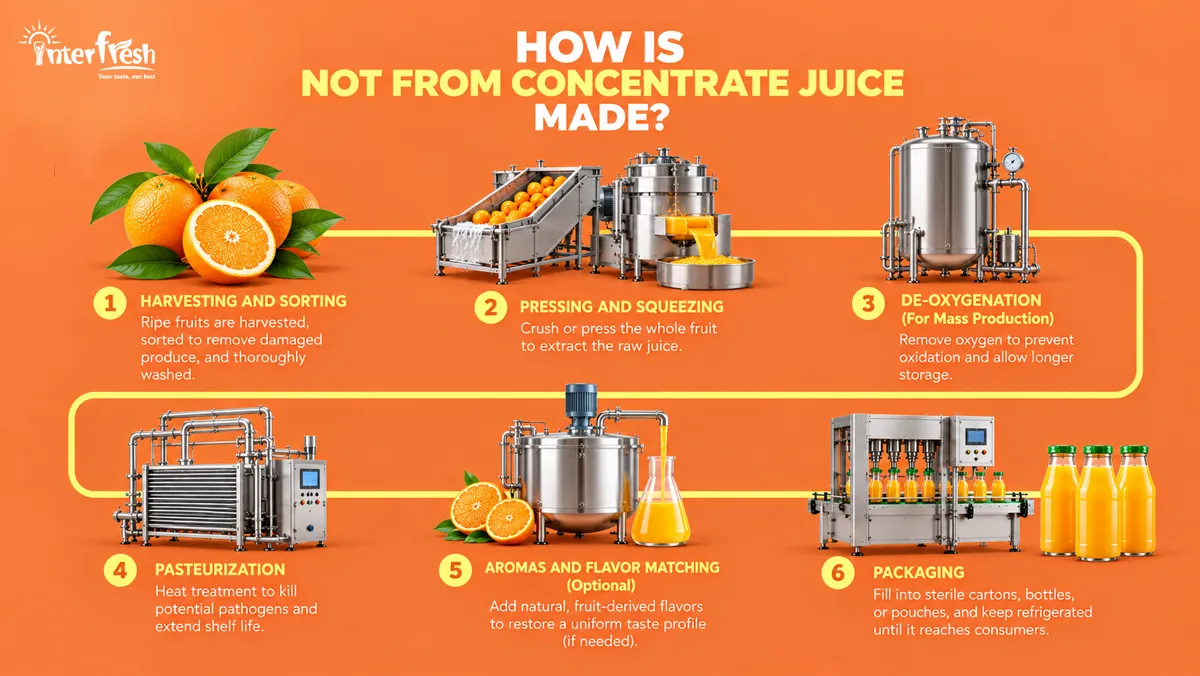
1. Fruit Receiving and Preparation
The factory receives, inspects, washes, and sorts the fruit. Approved raw materials are then transferred to the extraction stage.
2. Juice Extraction and Filtration
Extraction equipment separates the juice from the fruit. A filtration system or finisher removes unwanted particles and adjusts the pulp content.
3. Deaeration
Manufacturers may use deaeration to reduce dissolved oxygen in the juice. This helps limit oxidation reactions that could affect the product’s color and flavor.
4. Heat Treatment
The juice undergoes heat treatment, such as pasteurization, to control microorganisms and ensure food safety.
5. Storage and Packaging
Manufacturers can package the juice after processing or store it in aseptic tanks before transferring it to the filling line.
The Key Difference Between the Two Production Processes
FC involves two additional stages: evaporation and reconstitution.
NFC does not undergo the process of removing water and adding it back. However, both types may still require filtration, heat treatment, microbiological control, and packaging.
The additional concentration stage does not automatically make FC lower in quality. The final result also depends on processing conditions, flavor management, and the manufacturer’s quality standards.
Why Does the Juice Industry Use Concentrate?
Juice concentration is primarily a logistics solution.
Water accounts for most of the weight and volume of fruit juice. Removing a portion of this water significantly reduces the amount of product that needs to be stored and transported.
According to J. Peter Clark’s article in Food Technology (IFT), orange juice can be concentrated to approximately 65 °Brix. By comparison, regular orange juice typically has a Brix level of around 11–12.
Based on these two concentration levels, one part of 65 °Brix concentrate can be estimated to correspond to approximately five to six parts of single-strength orange juice with the same soluble solids content. This is an approximate calculation, not a fixed reconstitution ratio for every product.
Using concentrate offers several important advantages:
1. Reduced Transportation Costs
Manufacturers and distributors transport concentrated juice instead of the full volume of the original juice. This helps optimize storage space and transportation costs.
2. Improved Storage Efficiency
Depending on the technology, concentrate can be stored in frozen or aseptic form. This gives manufacturers more flexibility when managing inventory and production schedules.
3. Year-Round Supply
Fruit is often harvested during specific seasons. Producing concentrate allows manufacturers to store juice ingredients for use when fresh fruit supplies become less consistent.
4. Product Consistency
Manufacturers can blend different batches of raw materials to adjust Brix, acidity, and flavor. This helps maintain more consistent product characteristics across batches.
Concentrate is therefore more than a cost-saving method. It also helps the juice industry manage raw materials, storage, and large-scale product distribution.
Is Juice From Concentrate Less Healthy?
There is no sufficient basis for concluding that juice from concentrate is always less healthy than NFC juice. When both products are 100% fruit juice with no added sugar, their nutritional values can be relatively similar.
However, processing can affect certain nutrients. The extent of these changes depends on the fruit type, processing technology, temperature, and storage conditions.
Does From Concentrate vs Not From Concentrate Juice Have Different Nutritional Values?
Several studies have compared the nutritional composition of directly extracted juice and juice made from concentrate. Their findings do not show that NFC consistently contains more nutrients.
The results also vary depending on the fruit type and the compounds being analyzed.
Soural et al. (2022) analyzed 49 apple, orange, and grapefruit juice products in the Czech Republic. The researchers compared directly extracted juice with juice made from concentrate.
Most differences in the analyzed composition were not statistically significant. However, total polyphenols in directly extracted apple juice reached approximately 798 mg GAE/L, compared with around 473 mg GAE/L in apple juice from concentrate.
This finding suggests that some compounds can change depending on the processing method. However, the polyphenol results for apple juice alone cannot establish that all NFC products are better than FC products.
Vanamala et al. (2006) analyzed flavonoids in 12 made-from-concentrate orange juice brands and 14 NFC brands in the United States.
The study found that the concentrate group had a higher average total flavonoid content, at approximately 53 mg/100 mL compared with 36.5 mg/100 mL for the NFC group. However, individual compounds such as didymin showed different results.
This demonstrates that nutritional findings do not necessarily favor one production method.
Researchers from Cámara’s group at CEBAS-CSIC also investigated vitamins and plant compounds in orange juice. A 2024 study published in Nutrients continued the comparison of folate and minerals in chilled NFC and ambient-stored FC orange juice samples.
These findings should be interpreted in the context of the sample types, analytical methods, and processing conditions. A single study should not be generalized to the entire juice market.
How Can Processing Affect Vitamins and Antioxidants?
Some vitamins and plant compounds are sensitive to heat, oxygen, and storage time.
For example, vitamin C can decrease during processing and storage. Certain carotenoids and polyphenols can also change depending on processing conditions.
Research by Schweiggert et al. (2015) on orange juice found that pasteurization could cause slight reductions in carotenoids and vitamin C. However, the study also discussed changes in the bioaccessibility of certain compounds.
One important point is that both FC and NFC juice can undergo heat treatment. Pasteurization is therefore not exclusive to FC and cannot be used to conclude that NFC always retains more nutrients.
An accurate assessment requires considering the entire production process and the analytical results for each product.
Is Sugar Content Different Between FC and NFC Juice?
No. Whether juice is concentrated or not does not automatically determine its sugar content.
Juice from concentrate can be 100% juice with no added sugar. NFC juice can also contain similar levels of naturally occurring sugars when made from the same fruit type and formula.
According to the WHO’s 2015 guideline, free sugars include sugars naturally present in fruit juices and fruit juice concentrates. WHO recommends keeping free sugars below 10% of total daily energy intake, with a further reduction to below 5% where possible.
Another point to remember is that both FC and NFC juice generally contain less fiber than whole fruit. During extraction, most fiber remains in the fruit pulp or tissues that are removed.
When comparing nutritional value, check the following:
- Total sugar per serving.
- Whether the product contains added sugar.
- The juice percentage.
- Serving size.
- Specific nutrient information on the label.
Nutrition takeaway: FC is not automatically less healthy than NFC. Fruit type, actual ingredients, sugar content, and serving size matter more than whether the juice has undergone concentration.
Taste and Quality: Why Can FC and NFC Juice Taste Different?
Flavor differences mainly come from how juice is processed and how well its aroma compounds are retained.
During concentration, water vapor can carry away volatile aroma compounds. If these compounds are not recovered, reconstituted juice may lose some of its original flavor characteristics.
This is why the juice industry uses essence recovery systems. These systems capture some of the aroma compounds released during evaporation so manufacturers can add them back when reconstituting the concentrate.
When essence recovery works effectively and the formula is well controlled, FC juice can retain a flavor profile close to the original juice. In contrast, unsuitable processing conditions may result in a less fresh taste, reduced aroma, or cooked notes.
Does NFC Juice Always Taste Better Than FC?
Not necessarily.
NFC does not undergo concentration, but its flavor is still influenced by fruit variety, ripeness, harvest season, and storage conditions.
For example, oranges harvested in different seasons may have different sugar-to-acid ratios. This can cause NFC juice flavor to vary between production batches.
Concentrate, meanwhile, allows manufacturers to blend different batches of raw materials to adjust Brix, acidity, and flavor. This can be an advantage when consistent product characteristics are required.
Consumer perception also plays an important role. A 2024 UF/IFAS study found that participants tended to prefer the Not From Concentrate label over the From Concentrate label when evaluating orange juice.
However, a preference for a particular label does not mean that the product always has better sensory quality.
For a more objective comparison, choose two products made from the same fruit type and with the same juice percentage. Then taste them under similar conditions without looking at the labels.
Shelf Life, Storage, and Price: How Do FC and NFC Compare?
From Concentrate often has a logistical advantage because manufacturers transport and store juice after removing a large proportion of its water.
NFC requires transportation of juice with its natural water content. This can increase shipment weight and logistics costs.
However, the final retail price does not depend on the production method alone. Raw materials, processing technology, packaging, branding, supply chains, and distribution channels can all affect the price.
Does NFC Juice Need Refrigeration?
Not all NFC products require refrigeration.
Some NFC products are sold in refrigerated sections and must remain within a cold chain. However, others undergo heat treatment and aseptic packaging, allowing them to be stored at room temperature before opening.
Similarly, FC juice can be packaged for ambient storage or require refrigeration, depending on the processing technology.
Actual shelf life depends on several factors:
- Heat treatment methods, such as pasteurization or UHT.
- Filling technology and aseptic conditions.
- Packaging type and its protective properties.
- Storage and transportation conditions.
- Storage instructions after opening.
Therefore, the rule that “NFC must be refrigerated while FC can be stored on a regular shelf” does not apply to every product. Always follow the storage instructions on the packaging rather than relying only on the FC or NFC label.
How to Read Juice Labels: Identifying FC and NFC Products
When buying juice, you can check the label in three steps to identify whether the product has undergone concentration and reconstitution.
1. Check the Product Name
Look for terms such as:
- From Concentrate: Juice made by reconstituting concentrated juice with water.
- Made From Concentrate: Another common expression used to describe reconstituted juice.
- Not From Concentrate (NFC): Juice that has not undergone concentration followed by water reconstitution.
2. Read the Ingredient List
Terms such as “concentrated fruit juice,” “juice concentrate,” or “reconstituted juice” may indicate that the product uses concentrated juice ingredients.
However, ingredient declarations can vary depending on the product type and market. Review the full ingredient list rather than relying on a single term.
3. Do Not Confuse FC with Juice Percentage
Both From Concentrate and Not From Concentrate products can be 100% fruit juice when they meet the applicable product requirements.
The “100% juice” label indicates the proportion of juice in the product. It does not mean the product is NFC, nor does it tell you whether the juice has undergone concentration.
If you want to learn more about product names, juice percentages, and labeling requirements in the EU, US, and Australia, read Interfresh’s separate guide: Nectar vs Juice vs Juice Drink: Key Differences and New Labeling Rules for the EU, US and Australia (2026).
From Concentrate or Not From Concentrate: Which Is Better?
There is no single option that is better in every situation. FC and NFC suit different needs. Your choice should depend on flavor, price, storage, and product characteristics rather than the label alone.
| Consumer Need | Potentially Suitable Option | Why |
|---|---|---|
| Prefer juice that has not undergone concentration | NFC | The juice does not go through evaporation and reconstitution |
| Want an affordable and widely available product | FC | It may offer logistical and storage advantages |
| Concerned about sugar content | Both | Check added sugar, total sugar, and serving size |
| Prefer consistent flavor between purchases | FC may be suitable | Manufacturers can blend different raw material batches to adjust flavor |
| Want to experience seasonal flavor characteristics | NFC may be suitable | Flavor may reflect changes in the raw materials |
| Use juice for smoothies, cooking, or mixing | Both | Choose based on the recipe, flavor, and cost |
| Concerned about shelf life | Both | Check processing methods, packaging, and storage instructions |
If you are still unsure which is better, choose two products made from the same fruit type and with the same juice percentage. Then compare their ingredients, sugar content, price, and flavor.
NFC juice does not automatically contain more nutrients. FC juice is not automatically lower in quality. What matters most is the quality of the raw materials and how well the manufacturer controls the production process.
FAQs
Is Juice From Concentrate Real Juice?
Yes. Juice from concentrate is made from fruit juice. Manufacturers remove part of the water to make storage and transportation more efficient, then add water back during reconstitution.
Is Not From Concentrate Juice Healthier?
There is insufficient evidence to conclude that NFC is always healthier than FC. Nutritional value depends on the fruit type, processing conditions, and the actual composition of the product.
Does Juice From Concentrate Have Added Sugar?
Not necessarily. From Concentrate describes the concentration and reconstitution process. It does not mean that manufacturers have added sugar. Check the ingredient list and product description.
Why Is Not From Concentrate Juice More Expensive?
NFC may involve higher logistics costs because manufacturers need to transport and store the full volume of juice. However, retail prices also depend on raw materials, processing technology, packaging, and branding.
Which Lasts Longer: From Concentrate or Not From Concentrate?
Shelf life cannot be determined by the FC or NFC label alone. Heat treatment, filling technology, packaging, and storage conditions all affect product shelf life.
Can Juice From Concentrate Be Labeled 100% Juice?
Yes. FC products can still carry a 100% juice label when they meet the applicable definitions and composition requirements in their target markets. 100% juice does not mean NFC.
References
-
FAO Agricultural Services Bulletin No. 146. Rome: Food and Agriculture Organization of the United Nations. https://www.fao.org/4/y2515e/y2515e00.htm
-
Soural, I., Šnurkovič, P. and Bieniasz, M. (2022) ‘Chemical comparison of 100% apple, orange and grapefruit juices directly pressed and made from concentrate’ https://doi.org/10.17221/194/2021-CJFS
-
World Health Organization (2015) Guideline: Sugars Intake for Adults and Children. Geneva: World Health Organization. https://www.who.int/publications/i/item/9789241549028
-
Russo, H. (2024) ‘Squeezing out the facts: Consumer preferences in Not From Concentrate versus From Concentrate orange juice’