
Nectar vs juice looks like a small wording choice on a label. It isn’t. That one word decides your recipe, your cost per liter and the legal name of your product.
Consumers and trade buyers mix up juice and nectar all the time. For a brand, the mistake gets expensive: relabeling, border holds, lost retail listings. So this guide walks through the difference between nectar and juice, covers juice drink as well, and compares labeling rules in the EU, US and Australia. It’s written for importers, distributors and brand owners who have to name every product correctly on pack.
Key takeaway: 100% juice is nothing but fruit. Nectar is juice or purée thinned with water, often sweetened, and it must meet a legal minimum fruit content. Juice drink usually has less fruit than nectar and is built for everyday refreshment.
Nectar vs Juice vs Juice Drink at a Glance
Here’s a quick comparison. The sections after it go through each row in detail.
| 100% Juice | Fruit Nectar | Juice Drink | |
|---|---|---|---|
| Fruit content | 100% fruit, fresh or from concentrate | EU minimum of 25% to 50% by volume, set by fruit | No EU legal definition. Australia sets 50 mL/L for fruit drink |
| Added water | Only to reconstitute concentrate | Yes | Yes, in larger amounts |
| Added sugar | Not permitted in the EU | Capped at 20%, 15% or 10% of weight by fruit group | Common. Rules depend on market and ingredient list |
| Texture | Light, clear or cloudy | Thicker and smoother | Thin and light |
| Typical positioning | Premium and health focused | Pulpy or tart fruits for the mass market | Value and everyday refreshment |
| Main labeling risk | Calling a product 100% juice when anything extra is added | Missing the fruit content statement | Implying more fruit than the pack contains |
What Is 100% Fruit Juice?
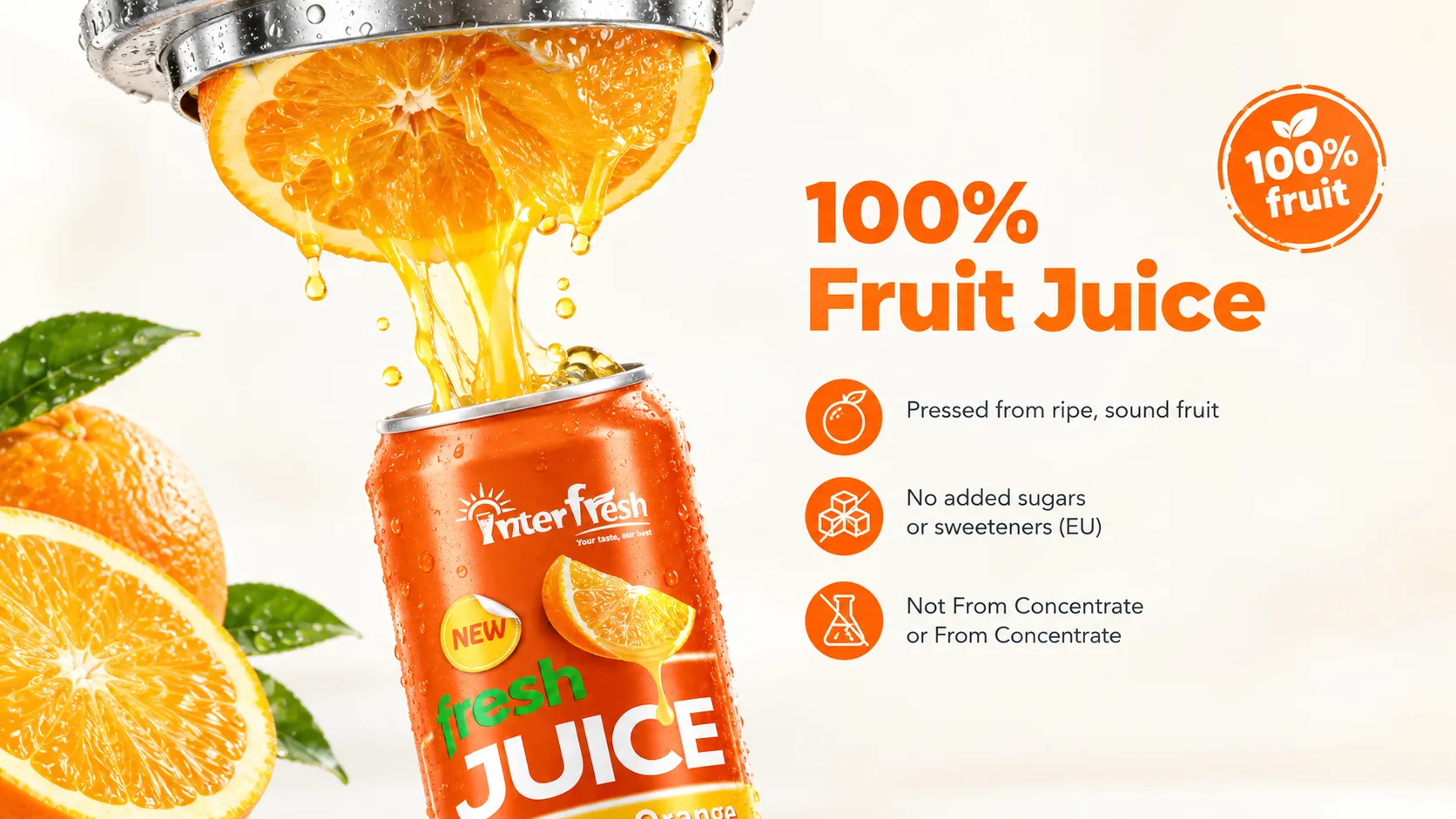
Fruit juice is the liquid you get by pressing or squeezing the edible part of ripe, sound fruit. Under EU rules it has to be 100% fruit. Added sugars and sweeteners aren’t allowed, and only a short list of authorised additives can be used.
The only things that can go back into the juice are flavor, pulp and cells from the same fruit. Water shows up in one case only: when concentrate is reconstituted to its original strength.
The EU banned added sugars in fruit juice through Directive 2012/12/EU. The rule applied from 28 October 2013, with a transition period until 28 April 2015.
Not From Concentrate vs From Concentrate
Not from concentrate (NFC) juice is pressed, heat treated, then stored or filled. From concentrate juice is different. Most of the water is taken out under vacuum, often close to where the fruit grows.
Concentrate ships in bulk, which saves on freight and storage space. At the bottling plant, the water goes back in until the juice is at its original strength.
Both routes can be sold as 100% juice.
For buyers, NFC usually costs more to store and ship, but it can support a premium shelf story. From concentrate suits larger volumes and steadier pricing through the year.
Brix and Natural Sugar
Brix measures the dissolved solids in a liquid, which are mostly natural sugars. One degree Brix is roughly one gram of solids in 100 grams of solution.
Codex and the EU both set minimum Brix values for reconstituted juice. If a reconstituted juice falls below the minimum for its fruit, it can’t be sold under the juice name. The minimum leaves out soluble solids from any added optional ingredients.
| Fruit | EU minimum °Bx |
|---|---|
| Apple | 11.2 |
| Orange | 11.2 |
| Pear | 11.9 |
| Pineapple | 12.8 |
| Passion fruit | 12.0 |
| Mango | 13.5 |
| Banana | 21.0 |
Source: Directive 2001/112/EC, Annex V. Mango and banana values apply to purée.
Codex STAN 247 uses slightly different values for some fruits. Apple is 11.5 there, against 11.2 in the EU. So always check the table for the market you’re selling into.
What Is Fruit Nectar?
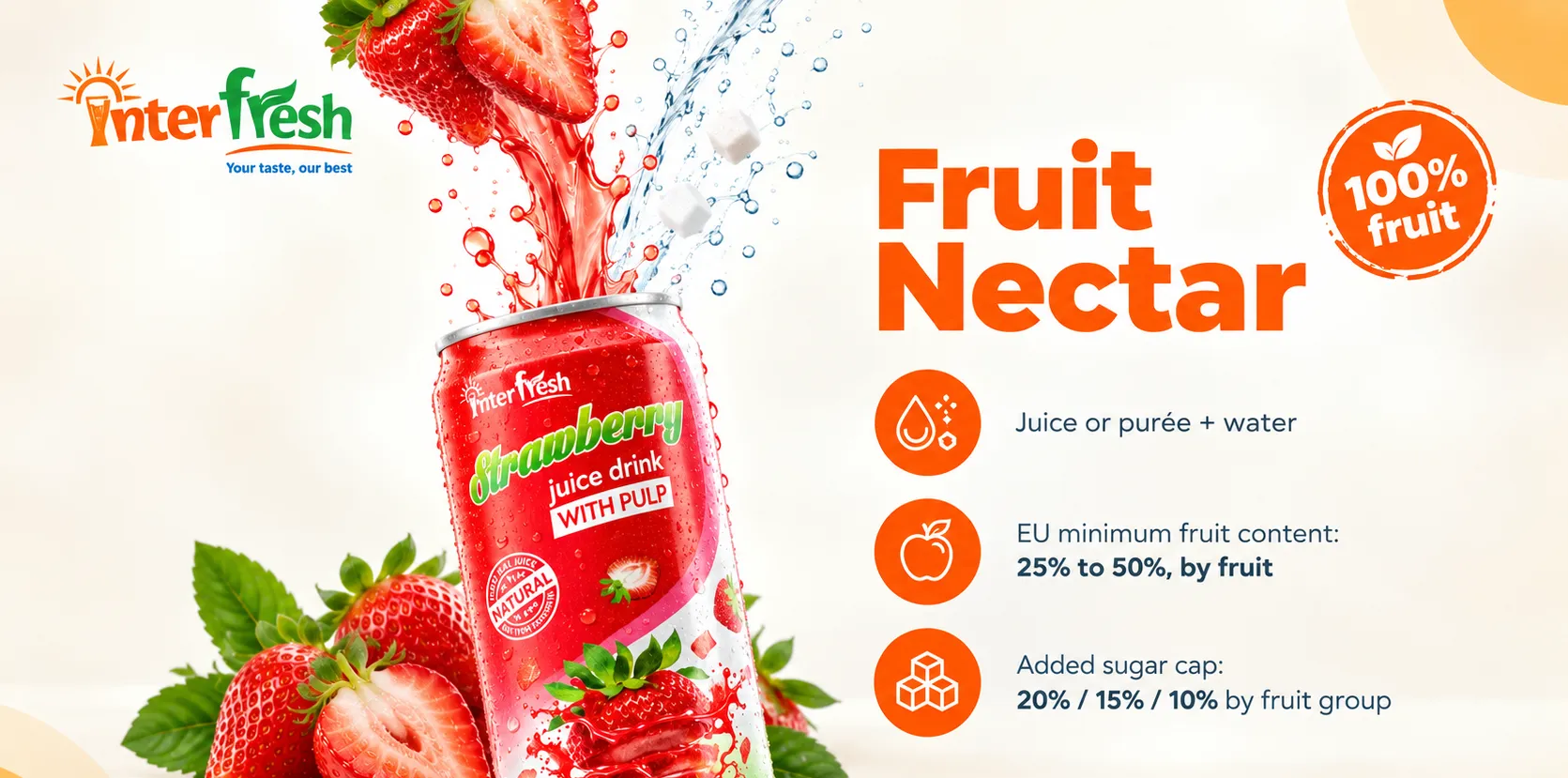
Nectar juice is simply another name for fruit nectar. On the pack, the legal name is fruit nectar.
Fruit nectar is a drink made from fruit juice, concentrate or purée. Water is added, often along with sugar, honey or sweeteners. Food acids are sometimes used to balance the taste.
In the EU, fruit nectar is a legally defined category, not a marketing term. The Directive sets a minimum amount of juice, purée or both. That minimum differs by fruit and is measured by volume of the finished product.
Some fruits can’t be sold as 100% juice. Their flesh is too thick, or their juice is too sour or astringent to drink straight. A bit of dilution and light sweetening makes them drinkable while the fruit keeps its character.
Codex STAN 247 takes a similar fruit by fruit approach to minimum content.
EU Sugar Caps for Nectar After the 2024 Update
Directive (EU) 2024/1438 tightened the sugar limit for nectar. The old rule allowed up to 20% added sugar or honey for every fruit. The new rule splits fruit into three tiers, and each tier’s cap is a share of the finished product’s weight.
The goal is to cut added sugar in everyday drinks. Member States had to transpose the Directive by 14 December 2025, and the rules have applied since 14 June 2026.
| Fruit group (Annex IV) | Examples | Max added sugar or honey | Min fruit content (by volume) |
|---|---|---|---|
| Part I: acidic juice, unpalatable in its natural state | Passion fruit, blackcurrant, lemon, sour cherry, raspberry | 20% | 25% to 50%, by fruit |
| Part II: low acid, pulpy or strongly flavored | Mango, banana, guava, papaya, lychee, soursop | 15% | 25% |
| Part III: juice palatable in its natural state | Apple, pear, peach, pineapple, citrus except lemon and lime, tomato | 10% | 50% |
Source: Directive 2001/112/EC, Annex IV, as amended by Directive (EU) 2024/1438. Confirm the current consolidated text before final formulation.
Common Fruit Nectars and Why They Exist
Fruit nectar usually starts with fruits that don’t work well as 100% juice. The table below shows common examples with their EU group, minimum fruit content and sugar cap.
| Fruit | Challenge as 100% juice | Typical nectar result | EU group | Min fruit |
|---|---|---|---|---|
| Mango | Very thick, fibrous flesh | Smooth, golden and sweet | Part II | 25% |
| Banana | Close to a thick purée | Creamy and mellow | Part II | 25% |
| Guava | Pulpy, strong aroma, hard seeds | Fragrant and rich | Part II | 25% |
| Passion fruit | Very sour and intense | Mildly tart and aromatic | Part I | 25% |
| Blackcurrant | Sharp and astringent | Rounded, sweet and tart | Part I | 25% |
| Sour cherry | Very tart | Balanced and fruity | Part I | 35% |
Source: Directive 2001/112/EC, Annex IV, as amended by Directive (EU) 2024/1438.
Nectar also gives brands more control over cost per liter. A formula with 25% to 50% fruit uses far less raw material than 100% juice, and that matters on long contracts, since raw material prices move with every harvest.
Interfresh develops these formulas across its fruit juice and nectar range, tuning flavor, sugar and composition to each client’s brief.
What Is a Juice Drink?
Juice drink has less fruit than nectar. It’s a sweet beverage made from a small share of juice or purée plus water, and it usually has sugar or sweeteners, flavors and other additives for taste.
The EU has no single legal definition for juice drink. Directive 2001/112/EC covers juice and nectar only, so national rules and the ingredient list decide what a juice drink can be called.
When a fruit is highlighted by name or image, Regulation (EU) No 1169/2011 requires the fruit percentage on the pack. For a juice drink, that declared percentage is the most important fact on the label.
Blend a juice drink with carbonated water and you get a spritzer, a format that belongs to the wider sparkling drinks category.
The Difference Between Juice and Nectar: 5 Key Points
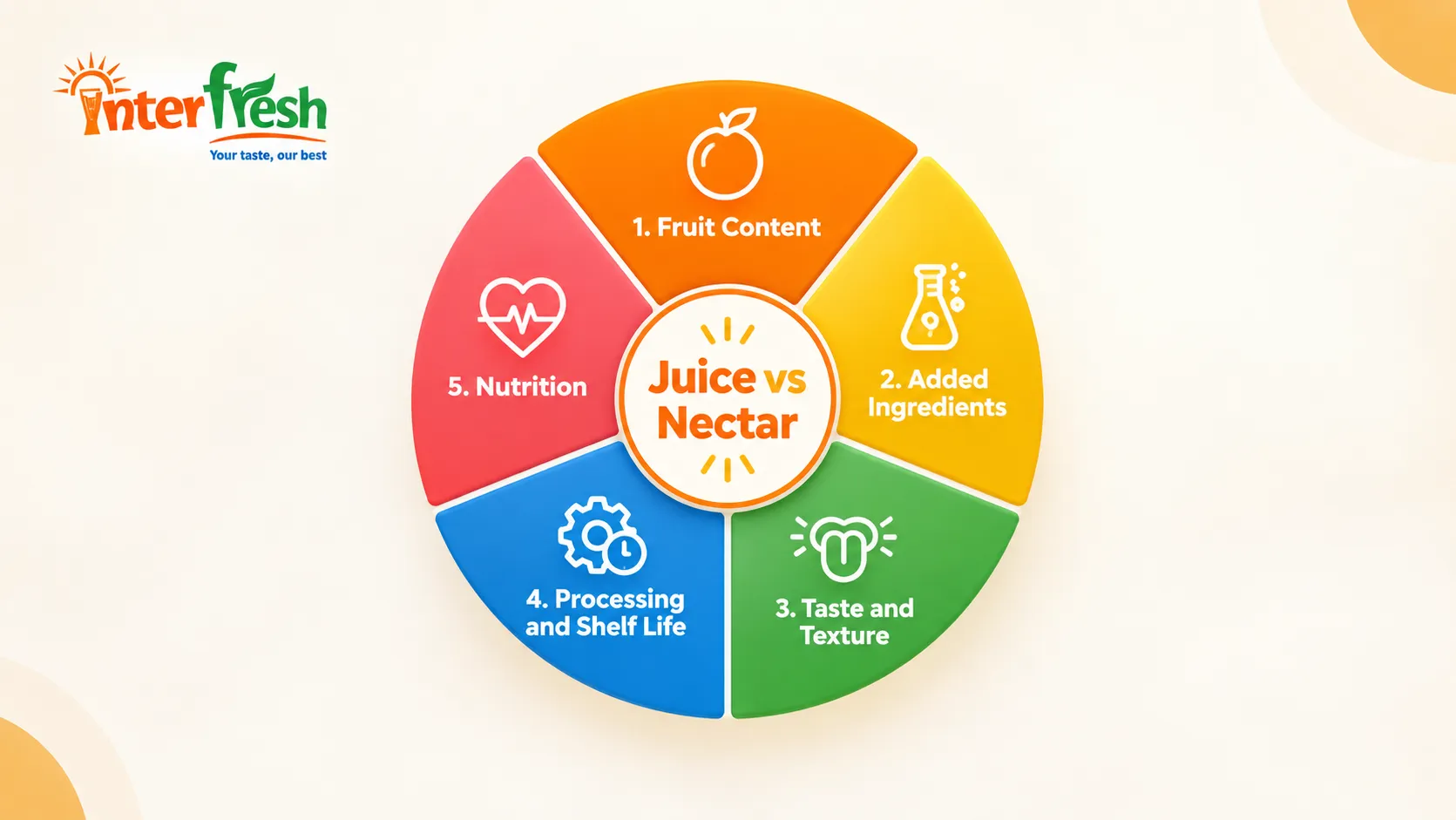
Nectar vs juice comes down to five points. Each one affects cost, positioning and compliance.
1. Fruit Content
Juice is 100% fruit. Fruit nectar has to reach a legal minimum, and that minimum depends on the fruit.
Juice drink can contain far less, and many markets set a low minimum or none at all. Fruit content also drives cost, so for buyers the declared fruit percentage is the first thing to check.
2. Added Ingredients
Nectar can contain water, sugar or honey within the tier caps. Sweeteners can replace sugar in reduced energy or no added sugar nectar, under Regulation (EC) No 1333/2008. Citric acid may be used to regulate acidity.
Claims come with strict conditions. A no added sugars claim on nectar requires no added sugars, no honey and no sweeteners. If the product contains natural sugars, the label must say “contains naturally occurring sugars”.
Juice drink can carry flavors, colors and vitamins. What’s actually permitted depends on the additive rules of each market.
3. Taste and Texture
Juice gives you the fruit’s taste straight, and that can be sharp, tart or acidic. Nectar tastes softer and sweeter.
Purée gives nectar a thicker, smoother body. A mango or banana nectar can feel closer to a smoothie than to a clear juice. Brands tune the body through purée level and particle size.
Juice drink is lighter and thinner. Its sweetness is set for easy drinking rather than fruit intensity.
4. Processing and Shelf Life
Juice is pressed or extracted, then pasteurized. It’s filled hot or treated with high pressure processing.
Nectar blends juice or purée with water and sugar, then gets homogenized so the pulp stays evenly spread through the drink.
Most shelf stable nectar is pasteurized and sealed in cans, glass bottles, PET bottles or aseptic packs. The packaging you pick affects shelf life as much as the formula does.
5. Nutrition
Juice supplies natural sugars, vitamins and a little fiber. Nectar usually has less fruit per serving and may have added sugar. When purée is used, nectar can keep more fiber than clear juice.
WHO counts sugars in fruit juice as free sugars in its guideline, and advises keeping free sugars below 10% of total energy intake. So compare total sugars per 100 mL, not product names.
The new EU reduced sugar juice category is a response to growing demand for lower sugar options.
Labeling Rules by Market: EU, US and Australia
This is where product naming meets the law. Each market defines these categories differently, so always confirm current rules before you print packaging.
European Union
- Reserved names. Directive 2001/112/EC reserves the names fruit juice, fruit juice from concentrate, concentrated fruit juice and fruit nectar. Only compliant products can use them.
- Fruit content on nectar. The label must state “fruit content: X% minimum”, in the same field of vision as the product name.
- From concentrate. Products reconstituted from concentrate must say “from concentrate”, close to the product name. Mixed products say “partially from concentrate”.
- Sugar statements. Juice may carry the voluntary statement “fruit juices contain only naturally occurring sugars”, placed beside the product name. Nectar may claim “no added sugars” only under the Directive’s conditions.
- Reduced sugar juice. Juice with at least 30% less sugar than the average juice must use a reduced sugar name. It can’t use the plain name fruit juice, and sweeteners aren’t permitted in this category.
- General food labeling. Regulation (EU) No 1169/2011 adds the ingredient list, nutrition declaration, allergens, date marking and operator details.
- Coconut update. The 2024 update also lets coconut juice be named coconut water. Our guide to coconut water versus coconut milk explains how the two products differ.
United States
The FDA requires beverages that purport to contain juice to declare the percentage of juice on the information panel. This rule sits in 21 CFR 101.30.
A drink with less than 100% juice needs a descriptive name. If the name uses the word juice, it has to add a qualifier such as drink, beverage or cocktail. These naming rules sit in 21 CFR 102.33.
The federal rules above don’t set a fixed minimum fruit level for the word nectar. That means the declared juice percentage carries the legal weight.
Added sugars must appear on the Nutrition Facts label of packaged foods, including nectar and juice drink. Juice processors also have to follow the FDA Juice HACCP rule in 21 CFR Part 120, and under that Part importers carry verification duties for imported juice.
Australia and New Zealand
FSANZ regulates beverages in Standards 2.6.1 and 2.6.2. Standard 2.6.1 covers fruit juice and vegetable juice. Standard 2.6.2 covers other non alcoholic beverages, including fruit drink.
Australia differs from the EU on added sugar. Standard 2.6.1 lets fruit juice contain up to 40 g/kg of added sugars. Check the current text before you formulate.
A product sold as fruit drink must contain at least 50 mL/L of fruit. For passionfruit drink, the minimum is 35 mL/L.
Standards 2.6.1 and 2.6.2 don’t create a separate nectar category, so confirm the correct name with FSANZ or a local adviser before printing labels. Standard 1.2.10 also requires the percentage of characterising ingredients, such as fruit, on the label.
Imported packaged food also needs country of origin labeling under Australian consumer law.
Market Summary
| EU | US | Australia and New Zealand | |
|---|---|---|---|
| Is nectar a defined category? | Yes, with minimums by fruit | No fixed minimum in these rules | No separate nectar category. Confirm the name |
| Fruit percentage on label | Minimum fruit content on nectar | Percent juice on the information panel | Characterising ingredient percentage on the label |
| Added sugar | None in juice. Nectar capped at 20%, 15% or 10% by fruit group | Declared as Added Sugars on Nutrition Facts | Fruit juice may contain up to 40 g/kg |
This section is general information. Confirm current rules with a regulatory specialist before printing labels.
Which Format Should Your Brand Choose?
The nectar vs juice decision depends on your shelf, your customer and your cost target.
- Choose 100% juice for premium or health focused shelves, where buyers accept a higher raw material cost.
- Choose nectar when your fruit is thick or tart, or when you need steady flavor all year at a competitive price.
- Choose juice drink when price per unit, large packs or sparkling formats drive your strategy.
Many successful ranges combine all three formats.
Before you place an order, check these points with every supplier:
- Fruit or purée percentage, and the Brix of the fruit ingredient
- Total sugars and added sugars per 100 mL
- Shelf life, filling method and pack format
- Food safety certifications relevant to your target market
- A label review for each target market
Interfresh has exported since 2012 and began official beverage production in 2023. It manufactures under OEM and ODM contracts, so you can set the formula, sugar level and pack format for your market.
Certifications include ISO 22000, HACCP, GMP, Halal and FDA registration. Trial samples are usually sent within 10 to 14 working days. Production takes place at the Interfresh factory in Củ Chi, Ho Chi Minh City.
Conclusion
The nectar vs juice choice shapes your cost, your compliance and your shelf position. Each format serves different buyers and follows different rules, and the right choice protects your margin while keeping your label compliant.
If you’re planning a new range for the EU, US or Australia, send your brief through the Interfresh contact page and our team will get back to you.
Regulations and Sources Referenced
- Directive 2001/112/EC on fruit juices and similar products (EUR-Lex)
- Directive 2012/12/EU amending the fruit juice Directive (EUR-Lex)
- Directive (EU) 2024/1438, the Breakfast Directive update (EUR-Lex)
- 21 CFR 101.30, percentage juice declaration (eCFR)
- 21 CFR 102.33, beverages containing fruit or vegetable juice (eCFR)
- 21 CFR Part 120, Juice HACCP (eCFR)
- FSANZ Australia New Zealand Food Standards Code
- WHO guideline on sugars intake for adults and children
Keep Exploring Beverage Development with Interfresh
- Fruit juice and nectar range for OEM and private label
- Sparkling drinks and soda formats
- How OEM beverage manufacturing works
- Custom formula development through ODM
- Inside the Interfresh beverage factory
- Overview of OEM and ODM services
- Coconut water versus coconut milk explained
- More beverage guides on the Interfresh blog
- Request a quote or sample