
Beverage packaging and label design brings together container structure, brand visuals, and product information. For private label drinks, effective design helps shoppers identify the product and distinguish flavors. It must also work with the selected packaging format, production specifications, and requirements of the destination market.
For distributors and retailers, packaging raises practical questions. Will shoppers understand the drink? Can they distinguish its flavors? Will they recognize the brand as the range grows? These decisions belong in the brief before artwork development begins.
This is Part 3 of the Interfresh Private Label Playbook. New to the business model? Start with our guide to private label beverage manufacturing before developing your packaging brief.
What Is Beverage Packaging and Label Design?
Beverage packaging design defines how a drink is contained and presented through materials, shape, size, and pack configuration. Beverage label design organizes the logo, colors, typography, imagery, and product information. Developing both together helps the physical package and its message work as one.
For example, a PET bottle label can incorporate the visible color of the drink into the design. Aluminum cans and beverage cartons rely more heavily on graphics and wording to communicate what is inside. Moving between formats therefore often requires changes to the artwork layout.
In private label beverage packaging, the brand defines its positioning and target market. The manufacturer helps select specifications, develop packaging, and review it before production. Interfresh supports this work through its OEM manufacturing services and ODM development services in Vietnam.
What Makes Beverage Packaging Design Effective?
Effective packaging makes the brand, beverage type, and flavor clear within the main viewing area. Format, typography, color, and imagery need a clear order of importance. The layout must also accommodate product information and provide a consistent structure for additional SKUs.
Visual Hierarchy: Decide What Shoppers Need to See First
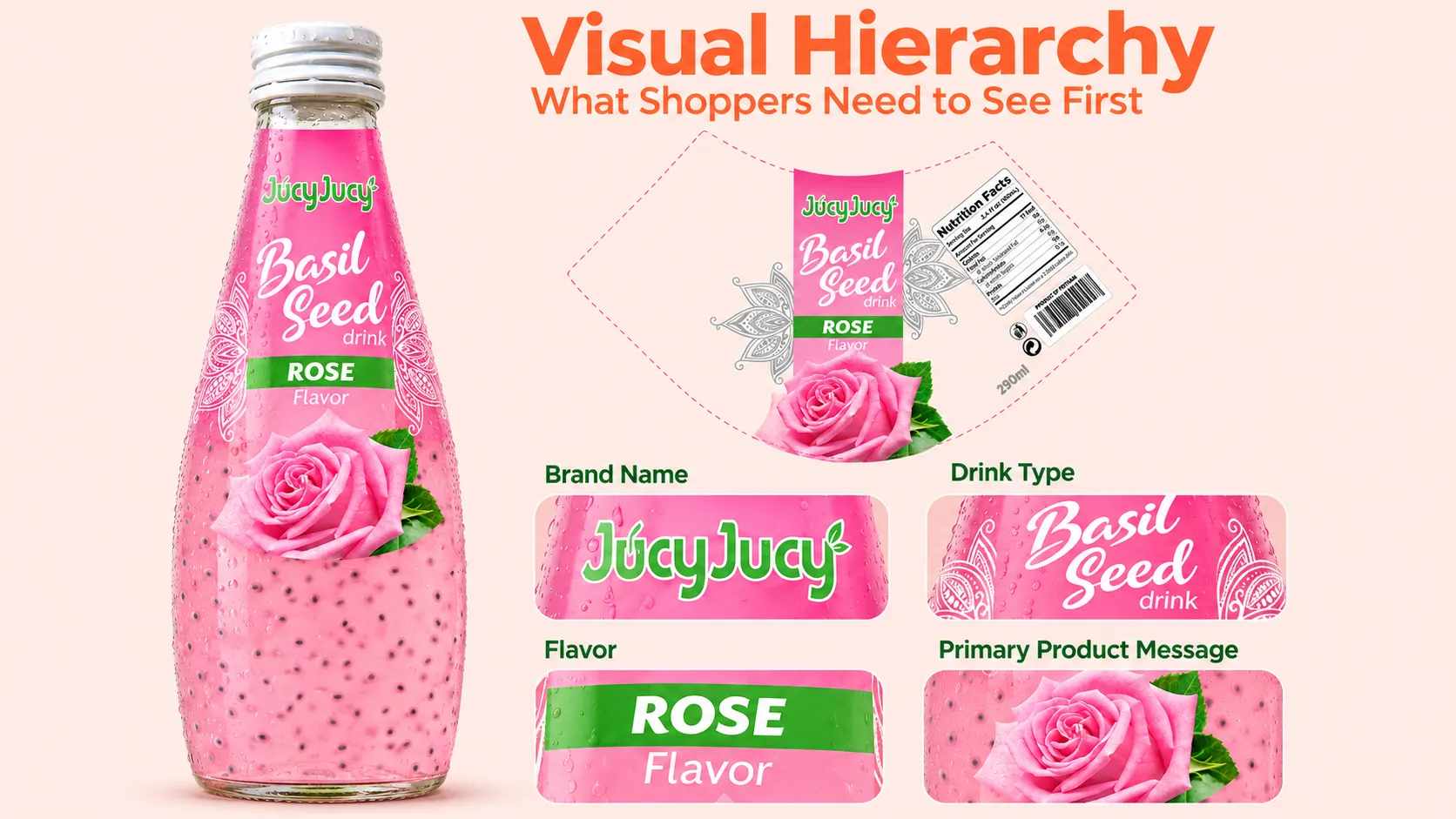
Before choosing colors or illustrations, decide which information deserves attention. New brands often need to make the beverage category especially clear. A label dominated by claims can leave shoppers unsure what the product actually is.
A useful starting point for visual hierarchy is:
- Brand name and logo.
- Beverage type: coconut water, fruit juice drink, energy drink, or coffee drink.
- Flavor or variant.
- One primary, substantiated point of difference.
The order can change with the positioning. However, giving every element the same size and contrast makes it harder to establish a reading sequence.
Packaging Typography: Check Readability at Actual Size
Artwork that looks clear when enlarged on a screen may be difficult to read on a can or bottle. Review the product name, flavor, and supporting information at actual size, particularly on multilingual labels.
Decorative fonts can support brand expression in selected areas. Product information needs clear letterforms, sufficient contrast, and appropriate spacing. Reducing every font size to fit more text usually weakens label readability.
Color and Imagery: Distinguish Flavors Without Losing the Brand
Choose colors within the context of the category, market, and beverage brand identity. Color can suggest a flavor, but it should not be the only way to identify a variant.
A mango, lychee, and guava juice range, for example, can retain the same logo position and layout. Flavor names, fruit imagery, and accent colors can change. This supports flavor differentiation while maintaining brand consistency across SKUs.
Ingredient imagery should also reflect the beverage accurately. The design needs to distinguish a juice drink, coconut water, or coconut milk, alongside creating shelf appeal.
Review the Design in Its Selling Context
Assess the artwork in the situations where customers will encounter the product.
| Viewing context | What to check |
|---|---|
| At actual package size | Are the beverage type and flavor easy to read? |
| Beside other SKUs in the range | Is the brand consistent, with clearly distinguishable variants? |
| Beside products in the same segment | Does the design stand out while communicating the category? |
| As a small online product image | Are the brand and beverage type still recognizable? |
| Inside a multipack | Does the outer packaging obscure information shoppers need? |
These checks help assess a design before approval. They do not replace research or testing with actual shoppers.
Design Direction by Beverage Category
Packaging should communicate the characteristics shoppers need to recognize in each category. Coconut water, energy drinks, and coffee require different product cues. Start with the beverage, its positioning, and its sales channel, then choose a visual direction that supports those decisions.
Coconut Water Packaging Design: Make the Product Type Clear
The words “coconut water” should be easy to identify, especially if the brand also sells coconut milk or coconut-flavored drinks. Coconut imagery should support the product name. Variants with pulp or added flavors also need clear differentiation.
An uncluttered layout can suit positioning that focuses on ingredients and simplicity. Claims such as “no added sugar” still need to match the formula and destination-market requirements. Green colors or nature imagery alone do not establish nutritional qualities.
Fruit Juice Packaging Design: Communicate Flavor Within a Consistent Range
Fruit imagery helps communicate flavor, while the product name must accurately describe the drink. If the product is a fruit juice drink, that description should remain easy to find.
For multiple flavors, keep the brand and range name in consistent positions. Adapt the fruit image, flavor name, and accent color. Designing every variant differently can weaken the connection between products when they appear together.
Energy Drink Packaging Design: Choose a Primary Message
Contrast and clear typography can give energy drinks a distinctive identity. The visual direction should reflect the intended audience. Sports, workplace, and lifestyle positioning can call for different approaches.
Choose a primary message rather than crowding the front with competing claims. Preserve space for the beverage name, flavor, and relevant information. Any caffeine declaration or nutrition claim must match the product data and applicable market requirements.
Ready-to-Drink Coffee Packaging: Set Clear Taste Expectations
Labels should distinguish black coffee, latte, and cappuccino, alongside relevant sugar and milk variations. These details help shoppers understand what they are choosing.
Coffee and milk imagery, supported by color, can communicate the intended taste profile. Decorative styling or creative names should not overwhelm the beverage type and force shoppers to read the back to identify it.
Seed, Aloe Vera, and Jelly Drinks: Communicate Texture
For basil seed, aloe vera, and nata de coco drinks, seeds or pieces are important product characteristics. Transparent bottles can reveal them directly. Cans rely more on imagery and descriptions to communicate texture.
Illustrations should reflect the actual ingredients. Keep the base beverage and flavor clear so shoppers can understand both taste and texture before purchase.
Choosing Beverage Packaging Formats at Interfresh
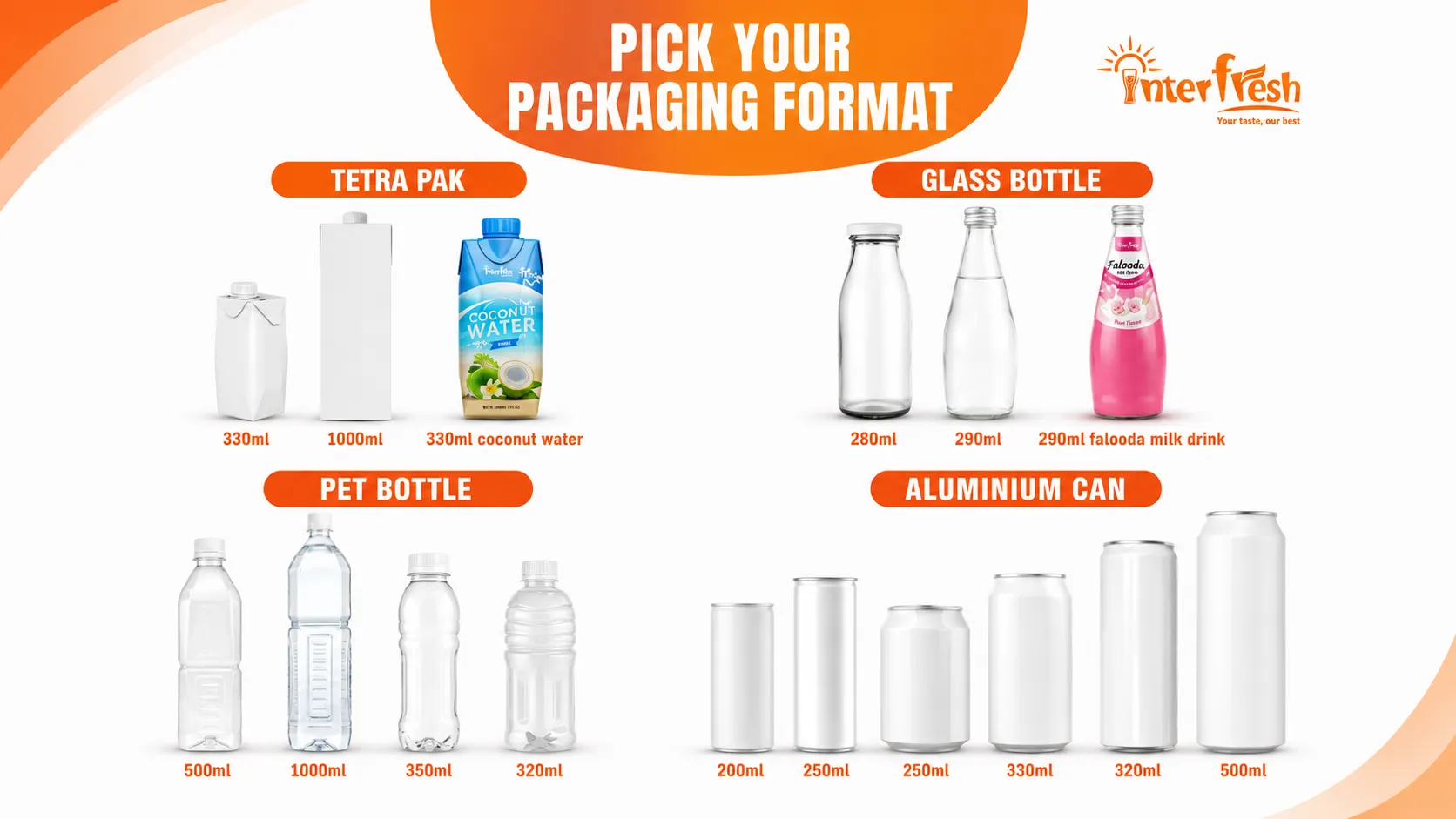
Interfresh offers four packaging groups for private label projects: aluminum cans, PET bottles, Tetra Pak cartons, and glass bottles. Each provides different design surfaces and presentation options. The selection needs to suit the formula, pack size, and production requirements.
| Format | Effect on design | Practical consideration |
|---|---|---|
| Aluminum can packaging | Artwork wraps around the body; shoppers see only part of the surface at once | Keep key information in a clear viewing area and rearrange it when changing sizes |
| PET bottles | Bottle shape and the visible drink color can become part of the design | Assess PET bottle label design on the selected bottle for layout and contrast |
| Tetra Pak cartons | Separate panels allow branding and product information to occupy different areas | Beverage carton design should account for folds and technical zones |
| Glass bottles | Bottle shape and labeling area determine the available design space | Review glass bottle label design at the correct size and on the curved surface |
Interfresh’s range includes can sizes such as 200 ml, 250 ml, 330 ml, and 500 ml. Buyers should share the beverage type and storage requirements when selecting a format. Availability depends on the product; not every format suits every drink.
If you are still evaluating suppliers, our guide to choosing the right OEM manufacturer in Vietnam explains how to assess packaging capability alongside R&D, capacity, and export experience.
Beverage Multipack Packaging, Trays, and Shipping Cartons
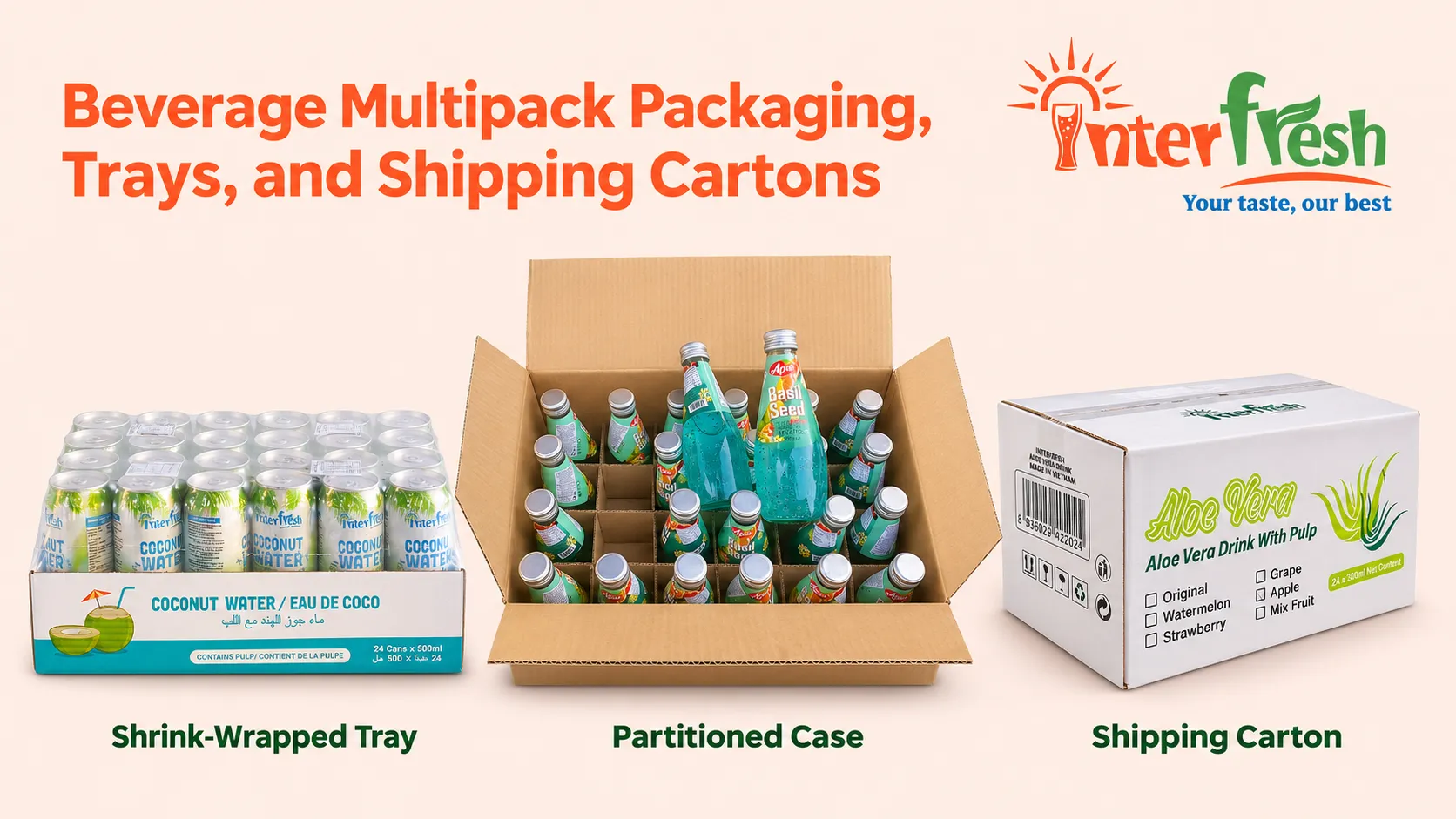
For applicable can SKUs, six cans form one shrink-wrapped pack, and 24 cans are packed in one tray. The six-can pack supports bundle sales. The 24-can tray provides a handling unit for storage and distribution.
When outer packaging covers individual labels, the multipack must communicate the brand, beverage type, flavor, and quantity. Shipping cartons should help receiving teams identify the correct SKU and pack configuration.
Interfresh designs shipping cartons, trays, and multipacks to customer requirements, consistent with the product’s identity. Include the number of units and intended use in the initial brief.
Preparing Artwork for Production and Export Markets
Artwork needs to match the packaging specifications and product data before printing. At Interfresh, customers approve labels through a digital proof. Our team reviews content, packaging specifications, and print proofs while preparing for mass production.
Plan Multilingual Beverage Labels Early
Adding languages increases the amount of text on the same surface. Shrinking type at the end can make the label crowded and difficult to read. Identify the destination market, languages, and importer or retailer requirements before finalizing the layout.
Depending on the product and market, review:
- Product name, description, and flavor.
- Ingredients, applicable allergen information, and nutrition labeling.
- Net quantity, measurement units, and relevant responsible-business details.
- Applicable storage, usage, and date information.
- Claims, barcodes, and proposed symbols.
Beverage labeling requirements and retailer specifications need to be checked for each market. A label used in one country is not automatically suitable for another. For EU projects, the European Commission’s food information guidance provides a starting point for reviewing labeling responsibilities, allergen presentation, and nutrition information. Label claims review should also consider any changes to the formula or intended market.
From Packaging Dieline to Digital Proof Approval
A packaging dieline shows the dimensions and technical areas of a package or label. Artwork should follow it to keep important information away from folds, seams, and unsuitable printing areas. This provides a basis for preparing print-ready artwork.
| What buyers need to know | How Interfresh handles it |
|---|---|
| Design review and approval | Customers receive a digital label proof to review, comment on, and approve |
| Artwork revisions | The design team adjusts the artwork according to customer feedback |
| Content checks | Commercial, R&D, and quality management teams review label content before mass production |
| New packaging specifications | Technical assessment and appropriate sample testing take place before specification approval |
| Print preparation | Files and print proofs are checked for discrepancies |
Screen approval helps confirm layout and content. It cannot show every difference caused by materials or printing. Preproduction checks therefore also consider packaging specifications and physical print proofs.
ISO, HACCP, FDA Registration, and Halal
Interfresh provides information on ISO, HACCP, FDA registration, and Halal in its factory capability information. Buyers should review the documentation applicable to the facility and product involved.
These records support manufacturer assessment. Certification marks on packaging must still follow their permitted scope and conditions of use. FDA registration does not mean FDA approval of a product label. The FDA explains that it does not pre-approve individual food labels, including Nutrition Facts labels.
How Interfresh Supports Private Label Beverage Brands
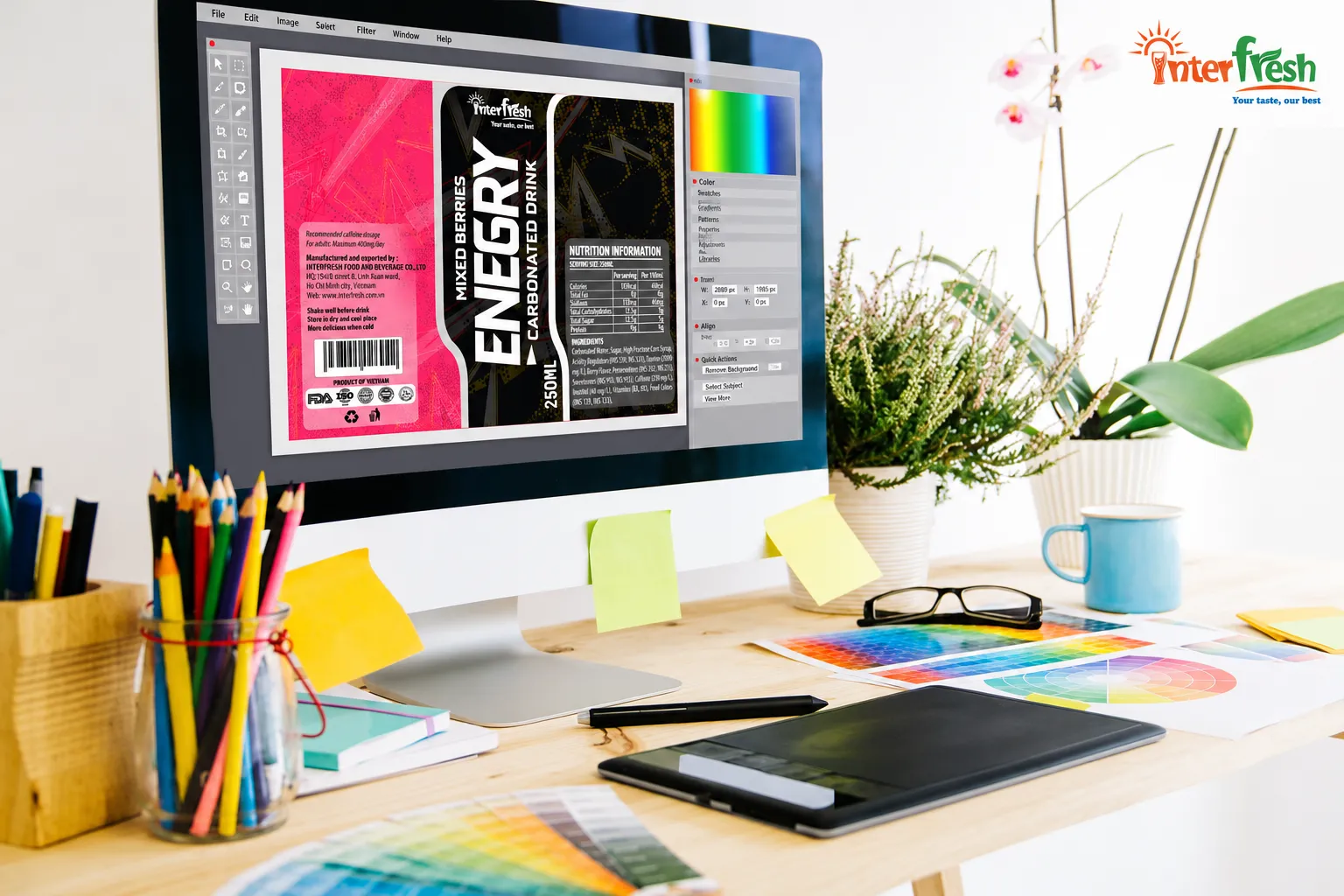 As a private label beverage manufacturer in Vietnam, Interfresh supports concept development, new designs, artwork revisions, and label adaptation across SKUs. Our design team has experience with markets including MEA, the United States, the EU, Russia, and Singapore. Design support is free, with unlimited revisions.
| Your starting point | Our support |
|---|---|
| An initial idea | Develop a design direction around the product and positioning |
| A logo or brand guidelines | Build the label around the existing brand identity |
| Existing artwork | Adjust imagery, content, and layout |
| An expanding product range | Adapt designs for different sizes, flavors, or formats |
| A coordinated packaging range | Design product labels, shipping cartons, trays, and multipacks |
Share your preferred style and reference images to help our team understand the direction. For a multi-flavor launch, provide the planned range early. This helps establish a custom beverage packaging system that can accommodate future additions.
Send Your Beverage Packaging Design Brief
A clear beverage packaging design brief helps Interfresh discuss formats, design direction, and production terms. Finished artwork is not required to start. The key information is the beverage type, destination market, packaging format, SKU count, and estimated order quantity.
- Product: beverage category, flavors, and desired characteristics.
- Market: destination country, sales channel, and label languages.
- Packaging: format, size, and multipack, tray, or shipping-carton requirements.
- Brand: available logo, artwork, or reference images.
- Order: SKU count, quantity per SKU, and preferred delivery date.
Interfresh provides free design and revisions. Material, printing, and printing-tooling costs are identified separately in the quotation. MOQ and timing depend on the order configuration, digital proof approval, and packaging preparation requirements.
Send your brief to info@interfresh.com.vn to discuss beverage packaging and label design for your private label project in Vietnam.
Explore the Interfresh Private Label Playbook
Follow the series from understanding the business model to choosing a manufacturing partner and developing your packaging:
- Part 1: Private Label Beverage Manufacturers — A Beginner’s Guide — Understand the private label model and the manufacturer’s role.
- Part 2: Choosing the Right OEM Manufacturer in Vietnam — Evaluate manufacturing capability, packaging options, and export readiness.
- Part 3: Beverage Packaging and Label Design for Private Label Brands — Develop a packaging direction and prepare artwork for production. You are reading this part.