
Who this guide is for
- Brand owners and product developers evaluating coconut water before briefing a sourcing team.
- Distributors deciding whether to add coconut water to an existing beverage portfolio.
- Buyers who already know the category works and want a sharper business case for internal approval.
If you are still asking whether this category deserves shelf space or investment, this guide answers that question first. The benefits of coconut water for beverage brands go well beyond taste. They sit inside a measurable shift in what buyers and retailers now demand.
The Core Benefits Driving Brand Interest
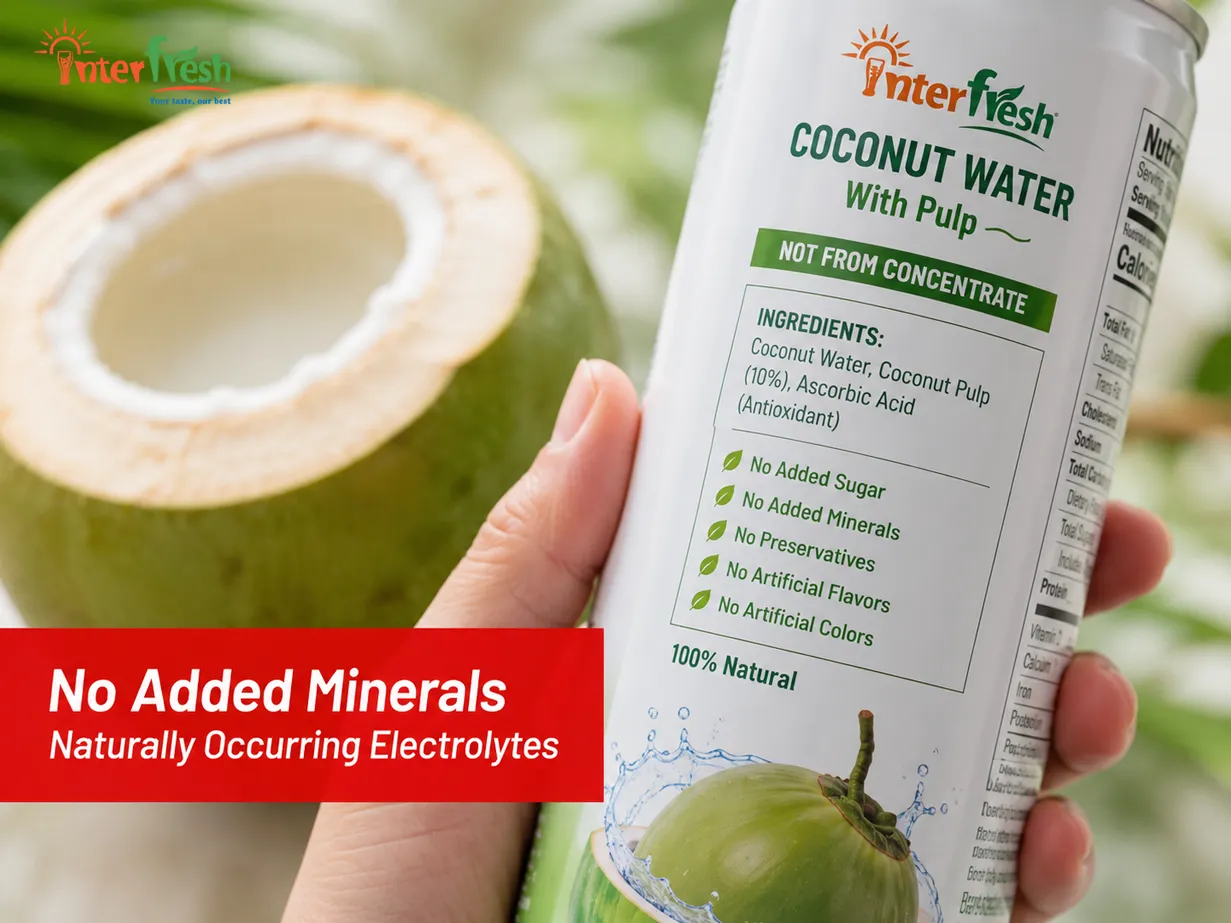
Coconut water carries a naturally occurring electrolyte profile, including potassium, magnesium and sodium. This composition needs no added minerals or synthetic blends to support a hydration claim. Buyers researching our coconut water manufacturer program often start from this single fact alone.
It also arrives low in calories and sugar relative to many sports and juice drinks on the same shelf. That single trait now carries direct regulatory weight, not just marketing value.
The United States FDA introduced an updated definition of a Healthy claim, effective in 2025. It sets stricter limits on added sugars and sodium across food and beverage categories. A beverage brand chasing this claim finds coconut water a natural fit, since it typically requires no reformulation to qualify.
Clean label expectations compound this advantage further. Buyers increasingly read ingredient panels before checking flavor. A short, recognizable ingredient list is now a competitive requirement, not a premium extra.
The Market Data Behind the Demand
Most category overviews describe consumer demand in vague terms. The numbers behind that demand are specific, and they are moving fast in 2026.
Mordor Intelligence values the global functional beverage market at roughly 151.8 billion US dollars in 2026. That figure is projected to reach close to 240 billion dollars by 2031, a compound growth rate near 7.9 percent. Sports and hydration drinks post the fastest growth within that category, expanding at close to 8.4 percent annually.
Packaging preference is shifting in a direction that favors coconut water specifically. Aluminum can formats are gaining share within functional beverages, growing at close to 8.9 percent annually. Cans offer lighter freight weight and stronger recyclability positioning than glass or heavier plastic formats.
Grand View Research also tracks strong regional momentum across Europe. Sugar reduction and natural ingredient sourcing shape category growth there directly. Distributors weighing a UK launch can cross reference this trend against our UK supplier page for market specific detail.
For a distributor comparing categories to add next, these are not abstract statistics. They describe exactly where retail buyers are already increasing shelf space and reorder frequency. This is the market context behind the benefits of coconut water for beverage brands weighing where to expand next.
Coconut Water as a Base Ingredient Across Categories
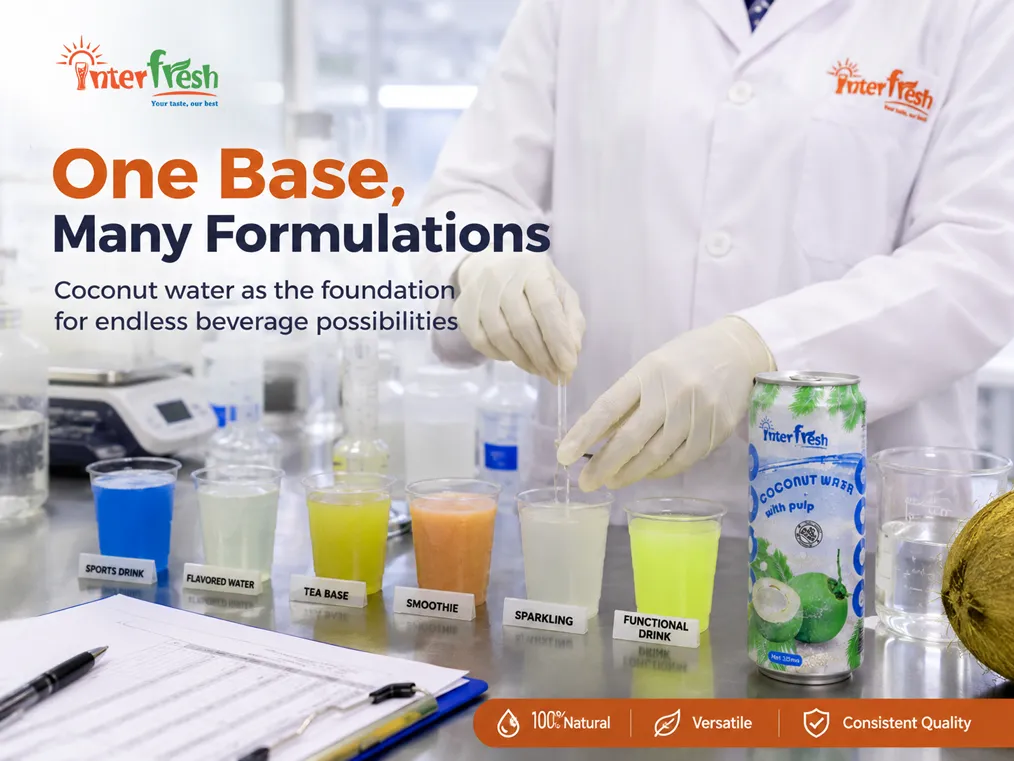
Most competitor content treats coconut water as a finished drink only. Its real commercial strength runs deeper, as a functional base ingredient across several categories at once.
Sports and hydration drinks benefit from its natural electrolyte content. A formulation can reduce or remove added mineral blends entirely. This supports a cleaner ingredient panel without sacrificing the hydration claim buyers expect. Our flavored coconut water OEM program covers this exact approach.
Ready to drink tea and kombucha style beverages use coconut water to soften acidity and add natural sweetness. This reduces the added sugar needed to balance a tart or fermented base. Distributors testing this format in Southeast Asia often review our Singapore distribution guide for regional sourcing detail.
Sparkling and mocktail formats use it as a low calorie carbonation base. It replaces plain carbonated water while still delivering a lighter mouthfeel than a fruit juice heavy blend.
Smoothie and juice blends use coconut water to extend a fruit heavy recipe without diluting flavor. It lowers sugar density per serving while keeping the drink genuinely 100 percent juice compliant in some formulations.
This range of use cases is exactly why product developers keep returning to coconut water across unrelated beverage categories. Few functional ingredients offer this level of cross category flexibility from one source.
The Private Label Business Case
Private label coconut water solves a margin problem that branded resale cannot. Buying finished branded stock caps your margin at whatever the brand owner allows.
Manufacturing under your own label removes that ceiling entirely. A distributor working directly with an OEM partner controls pricing and packaging. No third party brand sits between the factory and the shelf.
Differentiation follows the same logic. A generic resale product competes purely on price against every other reseller stocking the same branded item. A private label line, developed through a program like our flavored coconut water OEM service, competes on formulation instead.
Texture is one underused differentiator here. Buyers targeting ethnic or premium retail channels often request a coconut water with pulp line. Pulp content signals authenticity that a filtered, pure format cannot replicate alone.
What to Look For in a Coconut Water OEM Partner
Competitor guides typically list certification and MOQ as separate bullet points, without explaining how they interact. The two actually determine each other in practice.
Confirm ISO 22000, HACCP and FDA registration first. These certifications gate entry into most retail programs, regardless of your target market. Halal certification matters even outside Muslim majority markets, since some retailers request it as a general due diligence standard.
MOQ then determines how a certification stack becomes a workable order. Our own coconut water manufacturer hub runs a standard minimum of 400 trays per flavor, close to one 20 foot container. This threshold shapes how many flavors you can realistically test in a first order.
Production capacity and sample turnaround matter just as much as paperwork. Ask directly how many container equivalents a factory can run per month. This confirms your peak season order will not compete with someone else’s.
Ask a supplier to walk you through a documentation package from a recent shipment, not just a certificate list. Our beverage import guide for USA buyers shows the documentation depth a serious OEM partner should already have ready.
Matching the Format to Your Market
Format choice affects shelf life, freight cost and retail positioning all at once. Getting this wrong after committing to a specification is expensive to reverse.
Aluminum cans suit convenience retail and gym channels, where a single serve format drives reorder frequency. Our 320ml can OEM line and broader canned coconut water specification cover this format in full detail.
Tetra Pak suits supermarket multipacks and longer distribution chains, since its ambient shelf life supports slower moving retail. Our Tetra Pak coconut water page covers shelf life specifications for buyers planning wider distribution.
Glass bottles suit hospitality and premium grocery, where presentation matters more than freight efficiency. Buyers wanting a simple, additive free starting point can review our pure coconut water wholesale specification before adding flavor.
Market specific rules also shape format choice in ways easy to miss early. Distributors focused on Australia can check our bulk order planning guide for seasonal container sizing.
Why Interfresh for Your Next Beverage Line
Interfresh maintains ISO 22000:2018, HACCP, GMP, FDA registration and Halal certification across every production line. This is the same certification stack we apply for buyers across the United States and the Gulf region.
Our team supports everything from a first sample run to full container private label production. Buyers wanting the complete process overview can start from our coconut water manufacturer hub. From there, narrow down to a specific format or market.
Ready to test the category. Contact our export team for a sample or a documentation summary before you brief your sourcing team.
FAQs
Is coconut water a good product to add to a beverage portfolio? Yes, particularly for brands targeting sugar reduction or clean label positioning. Its natural electrolyte content also supports hydration and sports drink claims without reformulation.
What is the difference between coconut water and coconut milk for brand development? Coconut water is the clear liquid inside young coconuts, low in fat and calories. Coconut milk is pressed from the flesh, higher in fat, and used differently across categories.
Can coconut water be used as an ingredient rather than a standalone drink? Yes, it is widely used as a base in sports drinks, ready to drink tea, sparkling beverages and smoothie blends. Its natural sweetness reduces the need for added sugar.
What certifications should a coconut water OEM partner hold? Look for ISO 22000, HACCP and FDA registration as a baseline. Halal certification is increasingly requested even outside Muslim majority retail markets.
What is a typical minimum order quantity for private label coconut water? Many manufacturers set MOQ around 400 trays per flavor, close to one 20 foot container. Confirm this figure directly, since it varies by packaging format.
Why do some brands prefer coconut water over other functional beverage bases? It offers natural electrolytes without added minerals, a clean ingredient label and flexibility across multiple beverage categories. Few single ingredients support this much formulation range.
References
Mordor Intelligence (2026) Functional Beverage Market Size and Share Analysis. Available at: https://www.mordorintelligence.com/industry-reports/functional-beverage-market (Accessed: 17 July 2026).
Grand View Research (2026) Functional Drinks Market Size, Share and Growth Report. Available at: https://www.grandviewresearch.com/industry-analysis/functional-drinks-market (Accessed: 17 July 2026).
U.S. Food and Drug Administration (2025) Food Labeling, Nutrient Content Claims, Definition of Term Healthy. Available at: https://www.fda.gov/food/food-labeling-nutrition/use-term-healthy-food-labeling (Accessed: 17 July 2026).
Related Interfresh resources
- Coconut Water Manufacturer and OEM Vietnam, the complete production and certification overview
- Flavored Coconut Water OEM Custom Flavor Development, formulation options for private label
- Coconut Water with Pulp Supplier, texture led specification
- Pure Coconut Water Wholesale, additive free bulk sourcing
- 320ml Can OEM Coconut Water, single serve convenience format
- Canned Coconut Water OEM Vietnam, full canning specification
- Tetra Pak Coconut Water Manufacturer Vietnam, ambient shelf life packaging
- Coconut Water Supplier UK, UK and EU compliance detail
- Coconut Water Bulk Order Australia, container sizing and freight planning
- Coconut Water Supplier for USA Importers, FDA certified bulk export
- Coconut Water Supplier Singapore, ASEAN distribution hub guidance
- Coconut Water Supplier UAE and Middle East, Halal certified GCC export
- How to Import Beverages from Vietnam to USA, documentation and compliance depth
- Contact Interfresh Export Team, request a sample or documentation summary