
You already know the December to February window matters. You already know orders should land with your supplier around July to September. The harder question is different. How much should you actually order, and how do you protect that order from freight delays. This guide answers both, building on the full production overview inside our coconut water OEM manufacturer page.
Who this guide is for
  • Distributors who already plan a coconut water bulk order Australia wide, now sizing the actual volume.
  • Buyers worried about freight capacity and rate risk during the Australian peak shipping window.
  • Repeat importers deciding between a single flavor container and a mixed SKU load.


Why 2026 Freight Risk Raises the Stakes Beyond Production Lead Time

Production lead time is only half the planning problem this year. Ocean freight into Australia tightens sharply once the northern hemisphere holiday season begins. Carriers on the Asia to Australia lane are already reporting firmer capacity and rising rates through the third quarter of 2026.
Freight analysts tracking this lane report rate increases of 20 to 40 percent during peak season months. Port delays at Melbourne, Sydney and Brisbane commonly run one to two days longer than normal. Without buffer time built in, berth waiting periods can stretch beyond five days.

This changes how a coconut water bulk order Australia buyer should plan. Production lead time and freight booking now need separate buffers, not one combined estimate. Our coconut water supplier Australia page covers the biosecurity and BICON side of this timeline in full detail.


A Simple Method to Size Your Peak Season Order

Most distributors size their order using last year’s sell through as the only input. That method ignores growth, promotions and shelf life risk.
Start with last year’s total volume sold during December through February. Add a growth buffer based on your confirmed retail listings for this year. Then check that volume against a 24 month shelf life window, since overordering ties up cash in stock that ages before it sells.

A useful check point sits at the SKU level, not just the total order. Review sell through for each pack size before committing tray counts, especially for 320ml can formats that move faster through convenience channels than larger sizes.

A worked example makes this easier to apply. Say last year you sold 4,800 cans of one 330ml flavor across December through February. Add a 15 percent growth buffer for confirmed new listings this year. That gives a target of about 5,520 cans for the coming peak.
At 24 cans per tray, 5,520 cans works out to roughly 230 trays. Our MOQ runs at 400 trays per flavor, and this minimum applies to each flavor on its own. It cannot be combined with a different flavor to reach that number. This means your real demand for this flavor sits below the volume needed to justify its own production run at standard MOQ.
That leaves two honest options. Order the full 400 tray minimum and carry the extra 170 trays into next season, since shelf life runs 24 months. Or hold this flavor back this round and put your container behind flavors where demand already clears 400 trays alone.

One Flavor Container vs Multi SKU Peak Mix
coconut water bulk order australia3

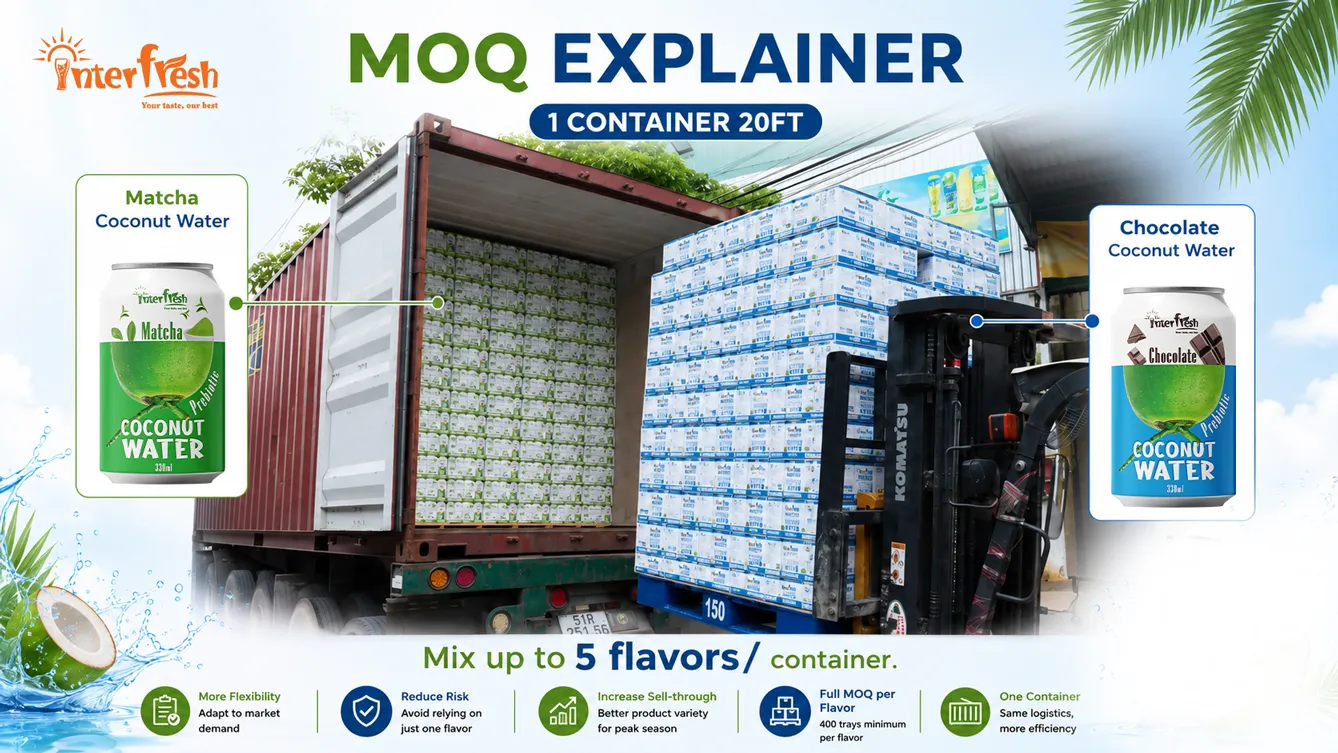
A single flavor container commits your full container to one flavor’s performance. A multi flavor order spreads that risk, but each flavor still has to clear its own minimum.
Our standard MOQ runs at 400 trays per flavor, and this minimum applies independently to every flavor in your order. It is not a shared pool split across SKUs. A coconut water bulk order Australia buyer with two flavors that each reach 400 trays in real demand can run both as separate full batches inside one shipment. This suits buyers with two proven flavors strong enough to stand alone, rather than a way to combine smaller, unproven volumes into one minimum. Buyers with two established sellers often pair a standard SKU with our coconut water with pulp line, each ordered at full MOQ, inside the same shipment.

If your retail buyer needs a longer ambient shelf life for regional distribution, a Tetra Pak format runs as a separate order line rather than mixed inside a canned container. Planning it as its own shipment keeps loading and labeling simple for both formats. Full specifications for the canned side of your mix sit inside our canned coconut water OEM guide.


Booking Your Production Slot Before Capacity Fills

Placing your order inside the July to September window is only the first step. Factories filling peak season capacity book their busiest slots early within that same window.
Buyers who submit specifications in early July typically secure earlier production slots than those confirming in September. This matters because production, quality checks and freight booking now run on tighter timing due to the freight pressure covered above. Our coconut water manufacturing hub outlines the full production and certification process behind each slot.

Confirming artwork and packaging specification early removes the most common cause of slot delay. Late artwork approval is a bigger risk to your timeline than freight congestion itself.


Payment Structure and Cash Flow for a Bulk Peak Season Order

Standard terms for a bulk order run at 50 percent deposit, with the balance due before shipment. For a large peak season order, this deposit ties up working capital months before any stock reaches your warehouse.

Distributors managing several SKUs at once should plan deposit timing against their own retail payment terms. If your retail buyer pays on 60 or 90 day terms after delivery, your deposit sits as a cash outlay well before that revenue returns. Planning this gap early avoids a cash flow surprise during your busiest quarter.


What to Do If You Are Already Ordering Late This Season

If your brief is not confirmed by early September, standard timelines are already under pressure. A few adjustments can still protect your peak season stock position.

Consider a smaller first container to secure early shelf presence, followed by a reorder once initial sales confirm demand. Our pure coconut water wholesale line runs on the fastest standard specification, which suits a compressed timeline better than a fully custom flavor brief. Reorders typically run four to six weeks against six to eight weeks for a new specification, so a proven SKU moves faster through a late booking window.


Documentation Checklist Before You Confirm the PO

Confirm your product classification is checked against BICON before signing off on volume. Confirm your label meets the Country of Origin Food Labelling Information Standard, a requirement covered in depth on our clean label beverage manufacturer page. Confirm certification documents, packing declaration and commercial invoice are ready before your container books a vessel slot.

Full production specifications across our coconut water range are available before you submit a final purchase order.


FAQs

How much coconut water should I order for the Australian summer peak? Start from last year’s December to February sell through, then add a confirmed growth buffer. Check the total against a 24 month shelf life before finalizing tray counts.
Can I combine several SKUs in one peak season container? Yes, but each flavor still needs to reach its own 400 tray minimum. You cannot split the minimum across two smaller flavor volumes.
What happens if I book ocean freight too late for peak season? Rates typically rise and vessel space tightens, with berth delays sometimes exceeding five days. Booking earlier within the July to September window reduces this exposure.
How much do freight rates rise during Asia to Australia peak season? Industry reporting on this lane shows rate increases in the range of 20 to 40 percent during peak months. Port delays at Melbourne, Sydney and Brisbane also tend to extend during this period.

What is the difference between a new order lead time and a reorder lead time? A new specification typically runs six to eight weeks from confirmation to shipment. A reorder on an existing specification usually runs four to six weeks.


References

  1. Couriers and Freight. What to Expect During Peak Season Sea Freight from China to Australia, 2026. https://www.couriersandfreight.com.au/blog/peak-season-sea-freight-from-china-to-australia
  2. AGC Global. Ocean Freight Transportation Australia 2026: Cost Efficient Import and Export.  https://agcglobal.com.au/ocean-freight-transportation-australia-2026-cost-efficient-import-export/
  3. Nexus Logix. Asia Australia Ocean Freight Rates: Q3 to Q4 Outlook.  https://nexuslogix.com.au/insights/ocean-freight-rates-from-asia-to-australia
  4. IMARC Group. Australia Coconut Water Market Size, Share and Forecast, 2026.  https://www.imarcgroup.com/australia-coconut-water-market


Also in this hub

  1. Coconut Water Manufacturer Vietnam — Hub page, anchor: coconut water OEM manufacturer (intro)
  2. Coconut Water Supplier Australia — anchor: coconut water supplier Australia page, BICON and timeline detail
  3. Coconut Water with Pulp Supplier Australia — anchor: coconut water with pulp line
  4. Canned Coconut Water OEM Vietnam — anchor: canned coconut water OEM guide
  5. Coconut Water Manufacturer Vietnam — Hub page, anchor: coconut water manufacturing hub (production slot section)
  6. Pure Coconut Water Wholesale — anchor: pure coconut water wholesale line
  7. Clean Label Beverage Manufacturer Vietnam for AU — anchor: clean label beverage manufacturer page
  8. Coconut Water OEM Manufacturer — anchor: coconut water range, full specifications