
Coconut water market trends 2026 point to a category growing faster than most beverage segments worldwide. For distributors and brand owners, the real question sits deeper than headline growth. Where is demand actually accelerating, and what should a sourcing strategy account for right now.
Who this guide is for
- Distributors and wholesalers researching category growth before committing to a new supplier relationship.
- Brand owners evaluating whether coconut water fits their next product launch.
- Procurement teams tracking raw material cost pressure ahead of contract negotiations.
How Big Is the Coconut Water Market in 2026
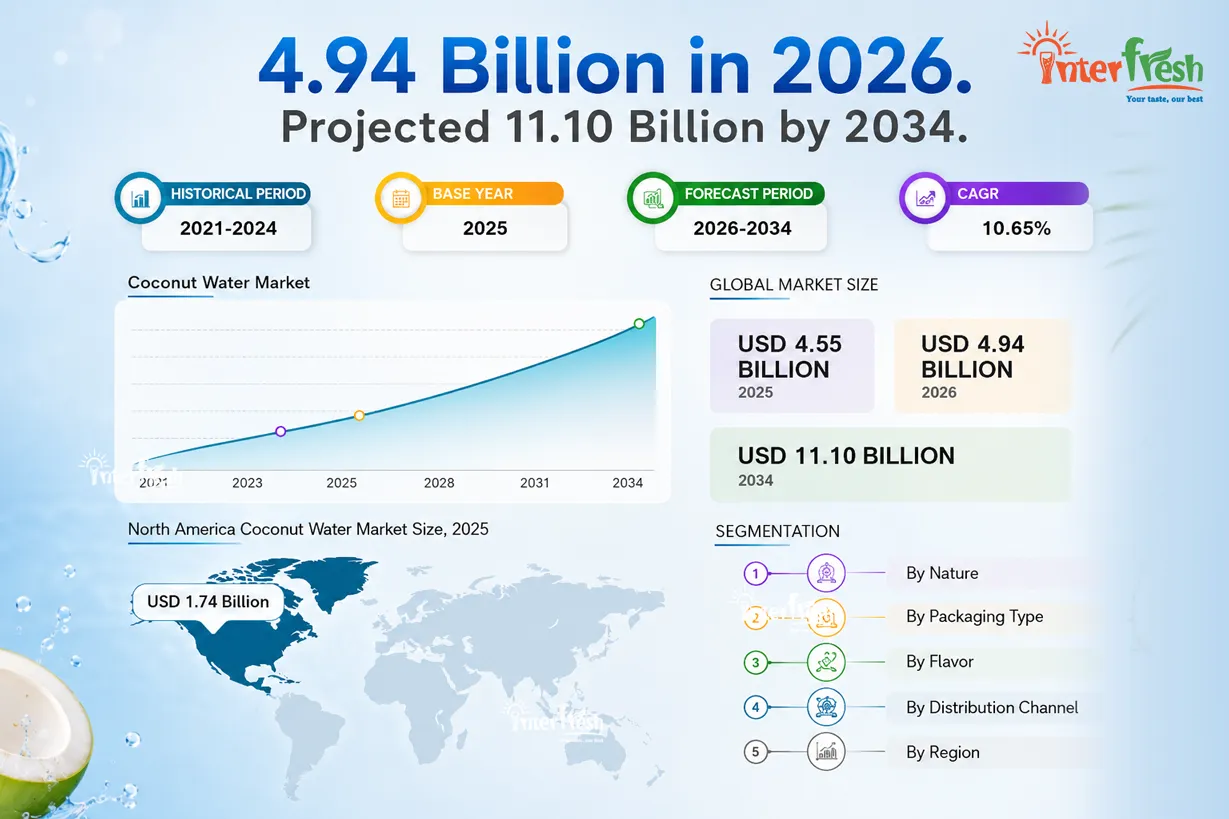
Fortune Business Insights values the global coconut water market at 4.94 billion US dollars in 2026. The firm projects growth to 11.10 billion dollars by 2034, a compound annual growth rate of 10.65 percent. That pace outstrips most packaged beverage categories tracked over the same period.
North America remains the largest single region, holding 38.24 percent of global market share in 2025. This dominance reflects deep retail penetration and strong brand recognition built over the past decade. Growth elsewhere is accelerating faster than this mature region, though, which changes where new supply relationships matter most.
Clean label demand sits behind much of this expansion. Buyers increasingly treat coconut water as a plant based alternative to sports drinks and soda. Sugar reduction goals across retail categories are reinforcing this shift further still. Our pure coconut water wholesale specification reflects exactly this positioning, built around a short, recognizable ingredient list.
Regional Demand: Where Growth Is Fastest
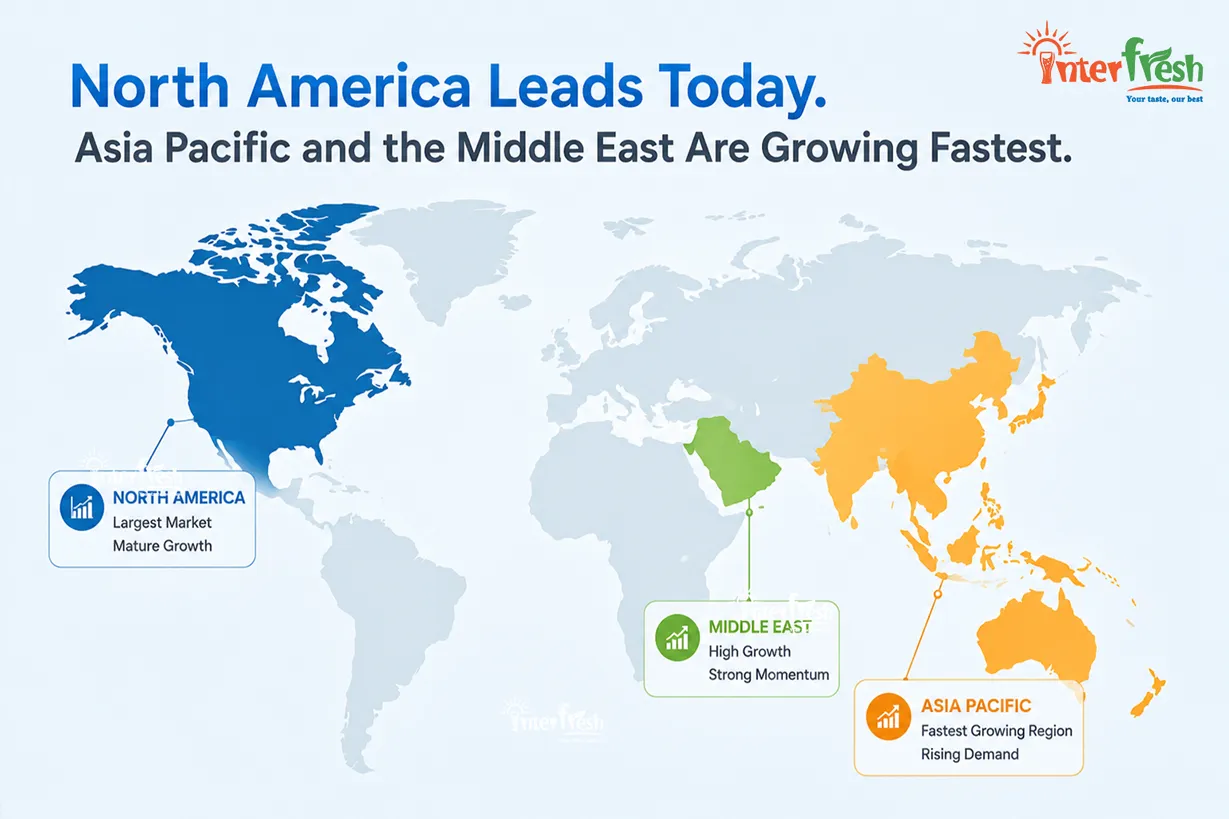
Growth is not distributed evenly across regions this year. Asia Pacific already leads on raw consumption, supported by local coconut availability and cultural familiarity with the product. Europe is accelerating from a smaller base, particularly across the UK, Germany and France.
The Middle East and parts of Africa are expanding quickly as well, driven by expatriate populations and rising urban health awareness. This mirrors the growth pattern we cover in detail on our Middle East supplier page, where demand growth already outpaces the global average. Distributors entering any of these regions should expect a different competitive landscape than the mature North American shelf.
Top Producing and Exporting Countries Buyers Should Know
Vietnam’s coconut export sector generated more than 533 million US dollars in 2025. That figure represents growth of over 36 percent compared to the previous year, according to Vietnam Customs Department data. The United States alone accounted for close to 26 percent of that total export value.
Trade data covering the twelve months through June 2025 shows a slightly different picture specifically for packaged coconut water shipments. Thailand led with 35 percent of global export share, followed by China at 24 percent and Vietnam at 19 percent. Vietnam’s strength shows up more clearly in total coconut product value and growth rate than in shipment count alone.
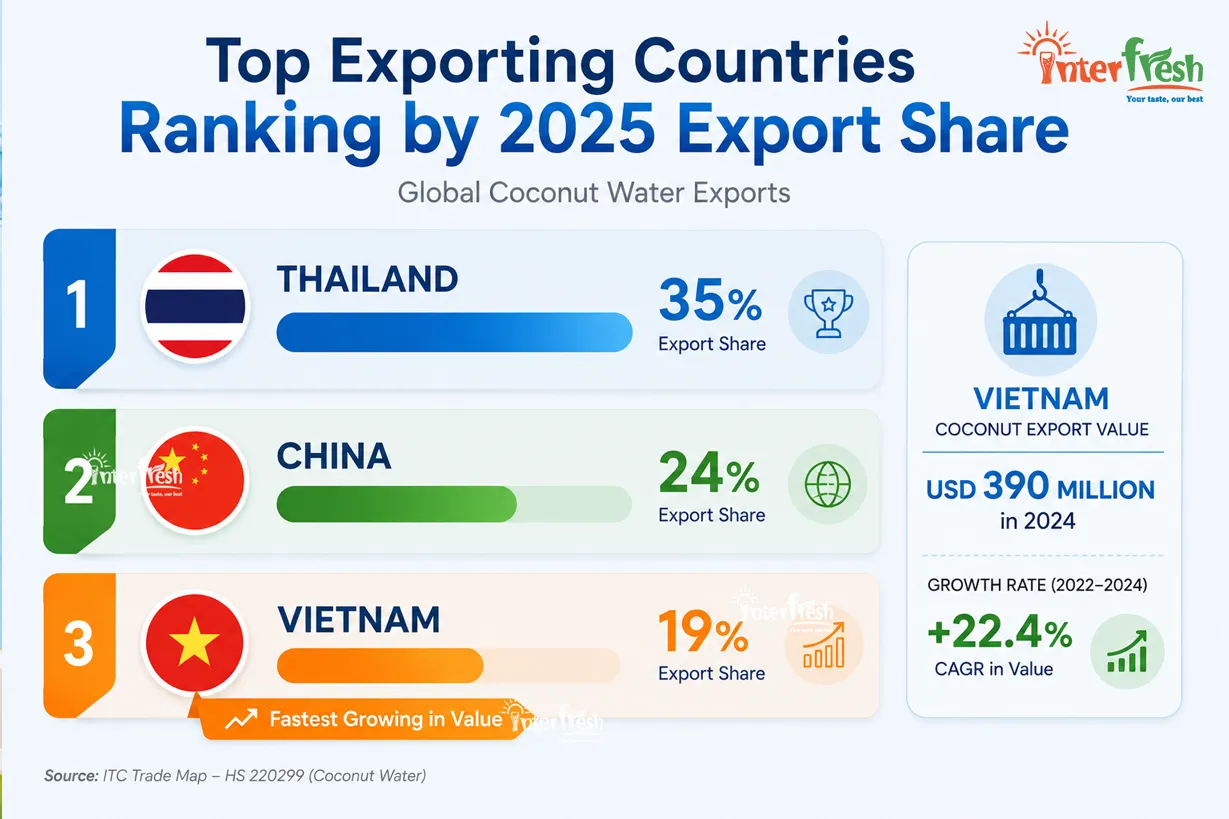
This growth trend has continued into 2026, with provincial coconut export centers in the Mekong Delta reporting further gains this year. Thailand and the Philippines remain strong competitors, particularly in premium and specialty segments. Vietnam’s advantage sits in scale, cost efficiency and an increasingly organized export infrastructure supporting bulk orders.
Our coconut water manufacturing hub operates from within this exact export ecosystem. Buyers sourcing from Vietnam benefit from established shipping lanes, mature customs processes and growing certification infrastructure. This matters increasingly as more markets add strict import documentation requirements each year.
Five Consumer and Retail Trends Shaping 2026
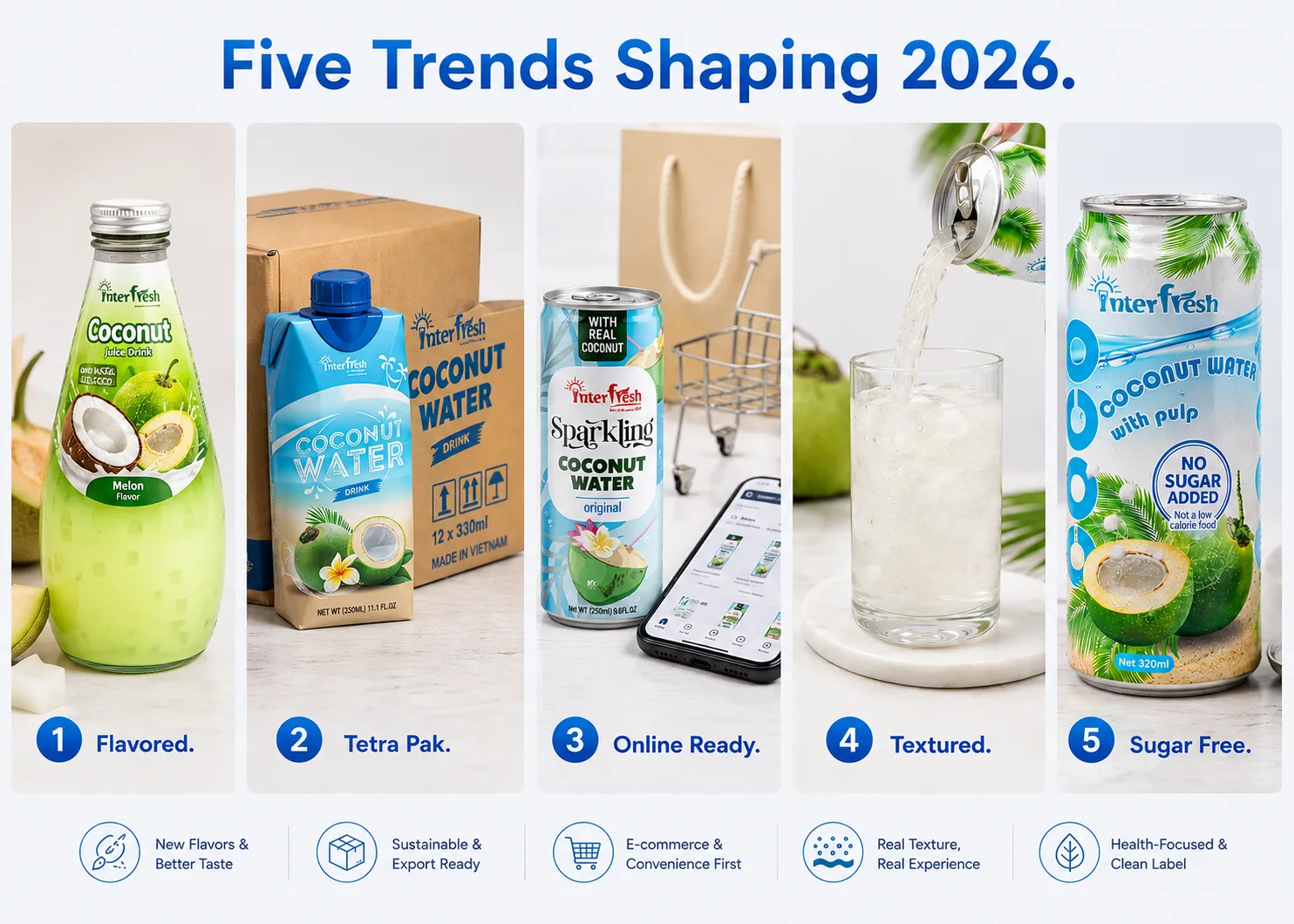
Coconut water market trends 2026 extend beyond simple volume growth into how the product reaches shelves. Five shifts stand out clearly this year, each backed by independent market research.
Flavored and Functional Variants Are the Fastest Growing Segment
Data Bridge Market Research identifies mixed and flavored coconut water as the category’s fastest growing segment through 2033. Buyers are pairing coconut water with fruit, functional ingredients and even matcha or chocolate profiles. Our custom flavor development program reflects this exact demand shift, moving beyond a fixed flavor menu entirely.
Grand View Research reports Tetra Pak packaging held the largest revenue share of any format in 2025, at 52.65 percent. This reflects its shelf stability and lighter freight weight compared to cans or bottles. Our Tetra Pak coconut water line suits buyers prioritizing exactly this combination of shelf life and logistics efficiency.
Online Retail Is Growing Faster Than Any Physical Channel
The same Grand View Research analysis projects online coconut water sales growing at 20.1 percent yearly through 2033. This channel favors smaller, single serve formats that travel well and photograph clearly. Buyers stocking convenience formats often start from our 320ml can specification for exactly this reason.
Texture Differentiation Is Gaining Genuine Traction
Beverage flavor developers including Flavorman and IFF Tastepoint have flagged texture as an emerging differentiator across functional drinks in 2026. Coconut water with real pulp is gaining ground in premium retail positioning specifically. Our coconut water with pulp line already runs as a proven specification in more than one export market.
Sugar Reduction Remains a Constant Baseline Expectation
Fortune Business Insights names sugar reduction initiatives as a core driver behind the category’s overall growth. No sugar added variants are increasingly the default expectation, not a premium add on. This pressure applies across every flavor and packaging format covered in this guide.
The Supplier Side Story: Raw Coconut Prices and Supply Constraints in 2026
Most coverage of this category focuses on consumer demand alone. Distributors negotiating supply contracts need the raw material picture too.
China’s fresh coconut demand has surged sharply over the past two years. Buyers there are sourcing raw coconuts directly from Indonesia, Thailand and Vietnam for local consumption. This pulls volume away from processing lines that would otherwise supply coconut water and oil production.
The Philippine government raised its mandatory biodiesel blend requirement in October 2024, and plans further increases through 2027. Each increase directs more coconut oil toward domestic fuel production instead of export. This structural shift is tightening coconut derivative supply well beyond oil alone.
Vietnam is currently facing tight raw nut supply, with desiccated coconut prices trending firm to slightly higher through the third quarter of 2026. Ocean freight rates have broadly stabilized after years of volatility, though they remain above pre pandemic levels industry wide. Distributors locking in annual contracts should factor this pricing environment into their planning now.
Packaging Formats Buyers Are Choosing and Why
Packaging choice increasingly reflects channel strategy rather than simple cost comparison. Each major format now serves a distinct buying occasion.
| Format | Best Suited Channel | Key Advantage |
|---|---|---|
| Aluminum can | Convenience, gym, retail | Fast chill time, strong shelf presence |
| Tetra Pak carton | Export, long distance retail | Lightweight, up to 12 month ambient shelf life |
| PET or PP bottle | Chilled retail, food service | Resealable, familiar consumer format |
| Glass bottle | Premium and hospitality retail | Premium perception, strong on shelf visibility |
Full specifications across every can size sit inside our canned coconut water OEM guide, useful when comparing formats side by side. Matching format to channel early avoids an expensive packaging mismatch further down the sourcing process.
From Bulk Wholesale to Private Label: How Distributors Are Responding
Private label growth is reshaping how distributors approach this category. Fewer buyers want a generic branded product alone. More are building their own recognizable range instead.
Buyers new to the category often begin with a standard specification before adding complexity. Our pure coconut water wholesale line works well as this first entry point. From there, many distributors expand into flavored or functional variants once initial demand is proven.
Timing bulk orders correctly matters just as much as flavor selection. Our Australia bulk order planning guide walks through container sizing and freight booking in detail, principles that apply well beyond one single market.
Regional Spotlight: Where Interfresh Already Supplies
Interfresh currently supports coconut water distribution across several strict, well documented markets. Each carries its own certification and labeling requirements worth understanding early.
Our United States program runs under FDA review, alongside broader guidance available on importing beverages from Vietnam. Our Australian supplier page covers BICON biosecurity requirements specific to that market. Our UK program addresses food safety documentation for post Brexit import.
Buyers in Southeast Asia can review our Singapore market page for regional distribution details. Each of these pages reflects real certification work already completed, not a generic capability claim.
What This Means for Your Sourcing Strategy
Coconut water market trends 2026 point toward faster growth, more format diversity and tighter raw material supply all at once. A distributor entering now needs a supplier who understands each of these forces together, not in isolation.
Matching product format to your actual retail channel matters more than chasing every trend at once. Locking in supply terms early protects against raw material price pressure building through this year. Request a sample or a production quote to see how this category fits your specific market.
FAQs
How big is the global coconut water market in 2026? Fortune Business Insights values the market at 4.94 billion US dollars in 2026. Growth is projected to reach 11.10 billion dollars by 2034.
Which country exports the most coconut water? Vietnam and Thailand lead global coconut water exports by volume. Vietnam’s broader coconut export sector generated more than 533 million US dollars in 2025 alone.
Why are coconut water prices rising in 2026? Raw coconut supply is tightening due to rising demand from China and Philippine biodiesel policy. Freight costs also remain above pre pandemic levels industry wide.
What packaging format is most popular for coconut water? Tetra Pak held the largest global revenue share in 2025, at 52.65 percent. Its shelf stability and lighter freight weight support this position.
Is private label coconut water growing faster than branded products? Private label demand is rising as distributors build their own recognizable range. Many buyers start with a standard specification before expanding into flavored variants.
References
- Fortune Business Insights. Coconut Water Market Report, 2026 to 2034. Available at: https://www.fortunebusinessinsights.com/coconut-water-market-112299
- Grand View Research. Coconut Water Market Size and Share Report, 2026 to 2033. Available at: https://www.grandviewresearch.com/industry-analysis/coconut-water-market
- Data Bridge Market Research. Coconut Water Market, Global Industry Overview and Forecast to 2033. Available at: https://www.databridgemarketresearch.com/reports/global-coconut-water-market
- Agrideco Vietnam. Vietnam’s Coconut Products Are Captivating Consumers Worldwide, 2026. Available at: https://agridecovietnam.com/vietnams-coconut-products-are-captivating-consumers-uorldwide/
- Expert Market Research. Coconut Price Trend 2026, Forecast and Index. Available at: https://www.expertmarketresearch.com/price-forecast/coconut-price-trends
- Commodity Board. Desiccated Coconut Prices Steady to Softer as Vietnam Faces Tight Raw Nut Supply, 2026. Available at: https://commodity-board.com/desiccated-coconut-prices-steady-to-softer-as-vietnam-faces-tight-raw-nut-supply/
- Volza. Coconut Water Import and Export Trade Data, Twelve Months Through June 2025. Available at:
Related Interfresh Resources
Pillar hub
- Coconut Water Manufacturer and OEM Vietnam, the full production standard behind every market and format covered above.
Market pages
- Coconut Water Supplier for USA Importers, FDA certified bulk export.
- How to Import Beverages from Vietnam to the USA, a broader import compliance guide.
- Coconut Water Supplier Australia, bulk wholesale for the summer season.
- Coconut Water Bulk Order Australia, container sizing and freight planning.
- Coconut Water Supplier UK, wholesale and private label for the UK market.
- Coconut Water Supplier UAE and Middle East, halal certified Vietnam OEM for GCC distributors.
- Coconut Water Supplier Singapore, regional distribution for Southeast Asia.
Product and packaging specifications
- Pure Coconut Water Wholesale, the standard entry level specification.
- Coconut Water with Pulp Supplier Australia, our texture led specification for premium retail.
- Flavored Coconut Water OEM, Custom Flavor Development Vietnam, for brands building a fully custom flavor brief.
- Tetra Pak Coconut Water Manufacturer Vietnam, aseptic carton for long distance distribution.
- Coconut Water 320ml Can OEM Manufacturer Vietnam, the single serve format for convenience and gym channels.
- Canned Coconut Water OEM Vietnam, full canning detail across every can size.