
A distributor in Rotterdam and a wholesaler in Hamburg are both asking the same question this quarter. Can a beverage exporter from Vietnam to Europe really deliver duty free pricing, or is that just a sales pitch? The honest answer depends on your product, your paperwork, and your HS code, not on a vague promise.
Vietnam and the EU have traded under the EU Vietnam Free Trade Agreement since August 2020. Under this agreement, the EU is removing import duties on Vietnamese goods in stages. Many food and beverage lines now clear at zero or near zero duty. This guide explains exactly how that works for a beverage exporter from Vietnam to Europe. It covers real tariff codes, real VAT figures, and the actual ports your shipment will use.
Why EU Distributors Are Sourcing Beverages from Vietnam in 2026
European retail buyers are actively diversifying their supplier base beyond traditional manufacturing hubs. A beverage exporter from Vietnam to Europe now competes directly with suppliers in Thailand and Turkey. Price and quality both matter in that comparison.
Vietnam’s Beverage Export Growth to the EU
Two way trade between Vietnam and the EU has grown steadily since EVFTA took effect. Total bilateral trade reached tens of billions of euros in recent years. Agricultural and processed food products now take a growing share of that total. For a distributor sourcing private label drinks, this trend signals a maturing supply chain rather than a short term trend.
Tropical Ingredients Not Available from European Suppliers
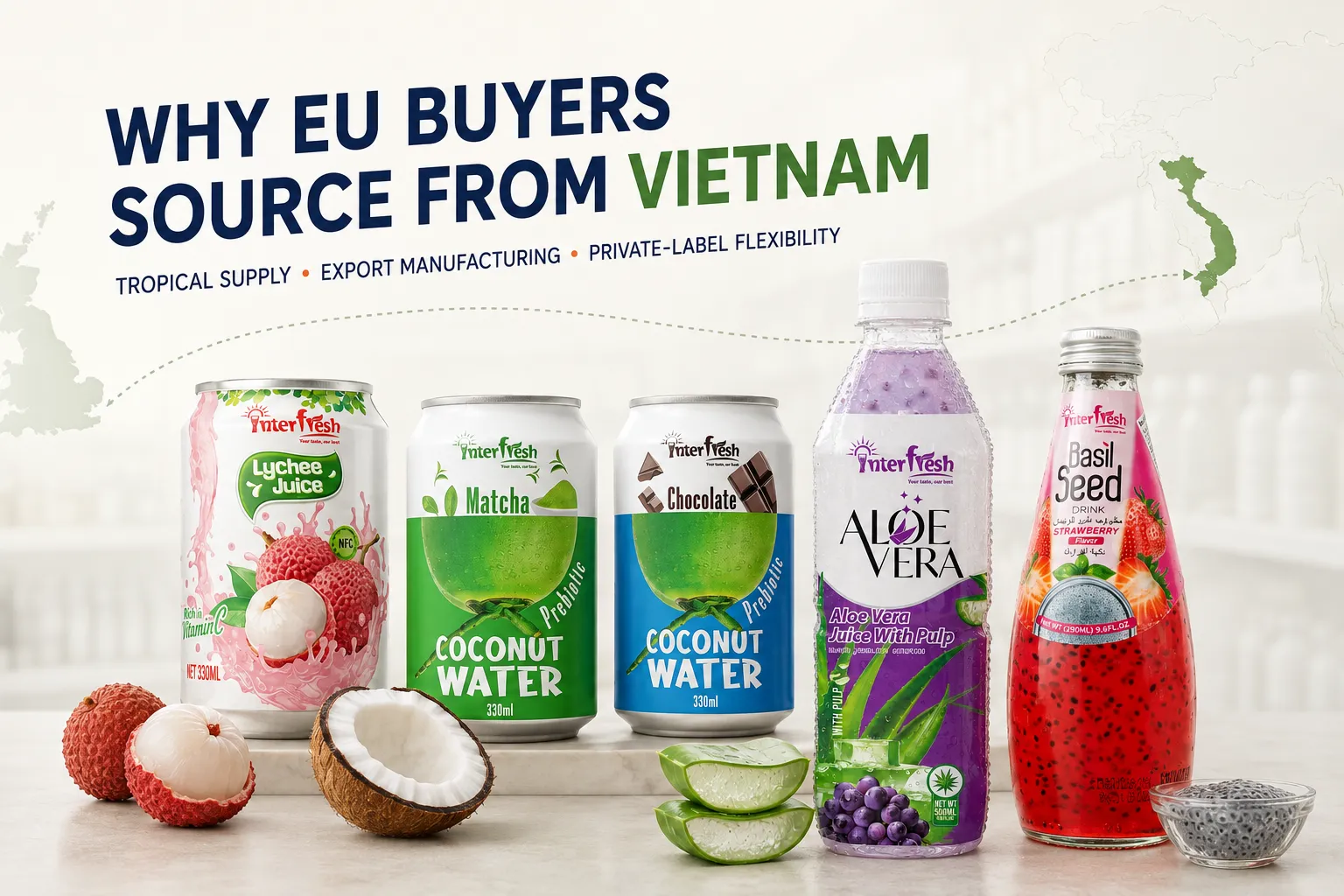
Coconut, passion fruit, aloe vera, and lychee cannot be grown at commercial scale inside the EU. A beverage exporter from Vietnam to Europe fills a gap that no domestic producer can close. This is one reason retailers such as Sainsbury’s, Carrefour, and Rewe continue expanding tropical drink ranges sourced from Southeast Asia.
What the EU Vietnam Free Trade Agreement Means for Beverage Exporters
EVFTA is not a single flat tariff cut. It is a schedule that phases different product categories to zero duty at different speeds. Understanding this schedule is the first real step for any buyer evaluating a beverage exporter from Vietnam to Europe.
Tariff Elimination Timeline for Vietnam Origin Goods
The EU began eliminating duties on Vietnamese goods when EVFTA entered into force in 2020. A large share of tariff lines became duty free immediately. Most remaining lines are being phased to zero over three to seven years from entry into force. This includes many processed food and beverage categories.
Which Beverage Categories Qualify for Zero Tariff
Most non alcoholic beverages, including fruit juice, coconut water, and flavored waters, fall well within the EVFTA tariff reduction schedule. Alcoholic beverages such as wine, spirits, and beer follow a separate and longer phase out timeline. A distributor should always confirm the exact rate for their specific product code before finalizing a quote.
EVFTA Tariff Rates for Vietnamese Beverage Exports by HS Code
Generic advice about zero tariffs is not useful without the actual product classification. A beverage exporter from Vietnam to Europe should always quote using the correct HS code. Duty rates are set at that level, not at the category level.
HS Code 2009, Fruit and Vegetable Juices
Fruit and vegetable juices fall under HS heading 2009. This includes mango juice, passion fruit juice, guava juice, and mixed tropical blends. Under EVFTA, most subheadings within 2009 carry reduced or zero duty when Vietnamese origin is properly documented.
HS Code 2202, Coconut Water and Non Alcoholic Beverages
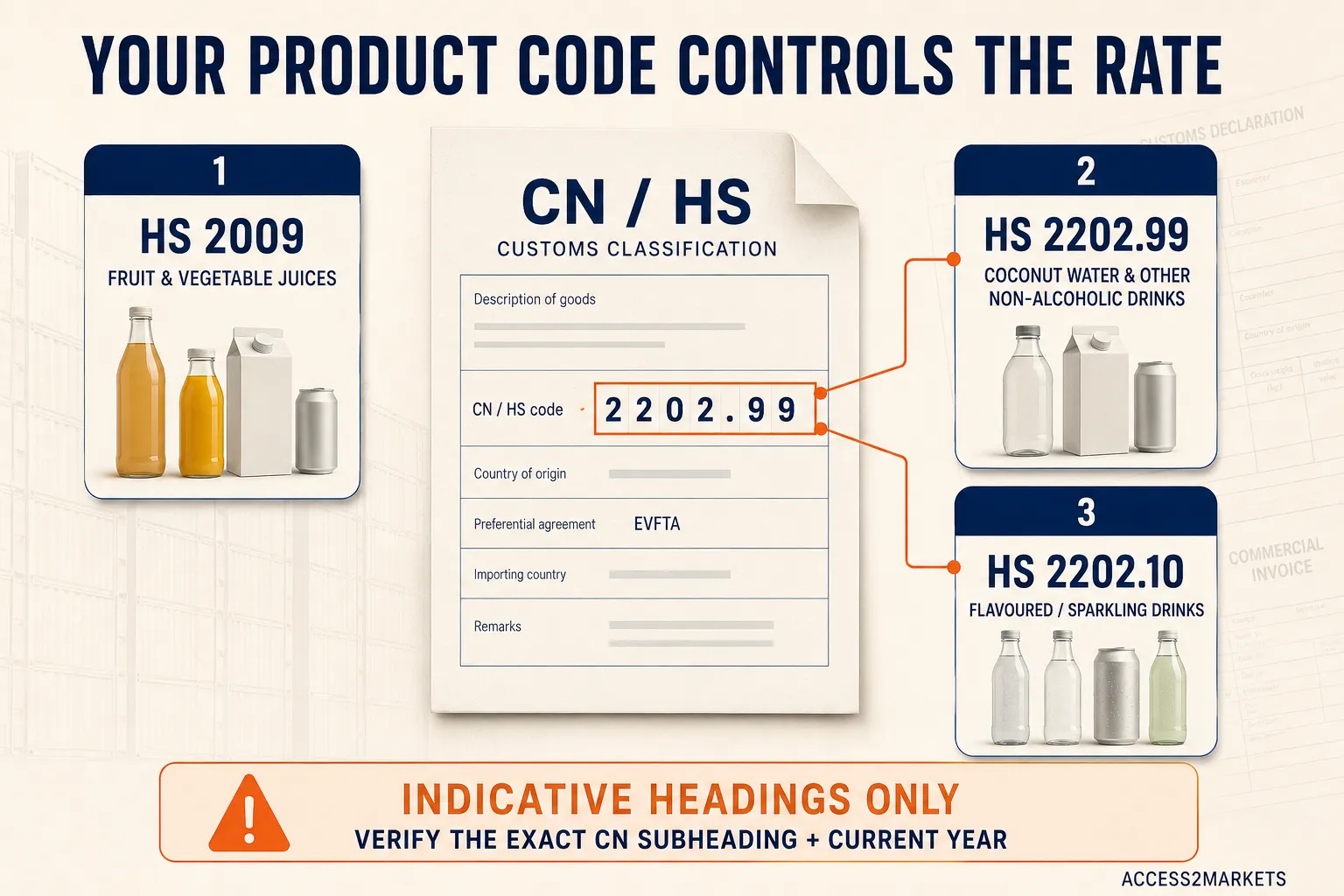
Coconut water, flavored waters, and most ready to drink non alcoholic beverages fall under HS heading 2202. This heading covers a wide range of Interfresh’s export categories, including sparkling drinks and functional beverages.
| Beverage category | HS heading | Standard MFN duty | Typical EVFTA treatment |
|---|---|---|---|
| Fruit and vegetable juice | 2009 | Varies by subheading, often 10 to 20 percent | Reduced or eliminated under the phase out schedule |
| Coconut water, flavored water | 2202.99 | Varies by subheading | Reduced or eliminated under the phase out schedule |
| Sparkling and functional drinks | 2202.10 | Varies by subheading | Reduced or eliminated under the phase out schedule |
Duty rates change by subheading and by year within the phase out schedule. Always verify the current rate for your exact product using the EU Access2Markets database before you finalize pricing.
How to Qualify for EVFTA Preferential Tariff Treatment
A zero tariff on paper means nothing without the correct origin documentation. This is the step most first time buyers underestimate when evaluating a beverage exporter from Vietnam to Europe.
EUR.1 Certificate of Origin for Shipments Over 6,000 Euro
For shipments valued above 6,000 euro, Vietnamese customs authorities issue a EUR.1 Certificate of Origin before export. This certificate must travel with the shipment and be presented to EU customs at the point of entry. Without it, your goods clear at the standard MFN duty rate instead of the EVFTA rate.
Invoice Declaration and the REX Self Certification System
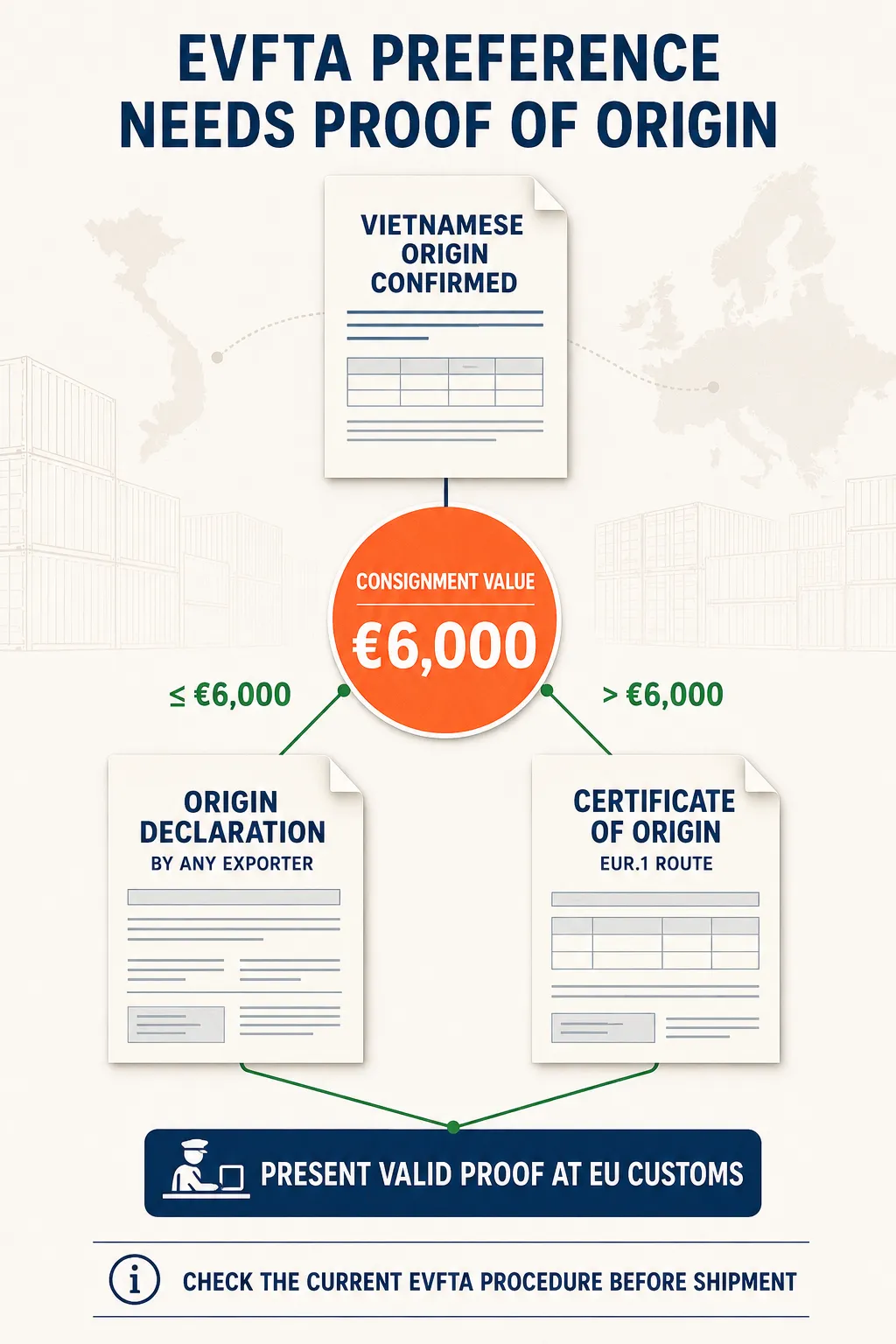
For shipments under 6,000 euro, the exporter can self certify origin directly on the commercial invoice. Larger and more frequent exporters can also register under the REX system, which allows self certification regardless of shipment value. Interfresh prepares this documentation as a standard part of every EU bound order.
Landed Cost Beyond the Tariff, VAT by EU Country
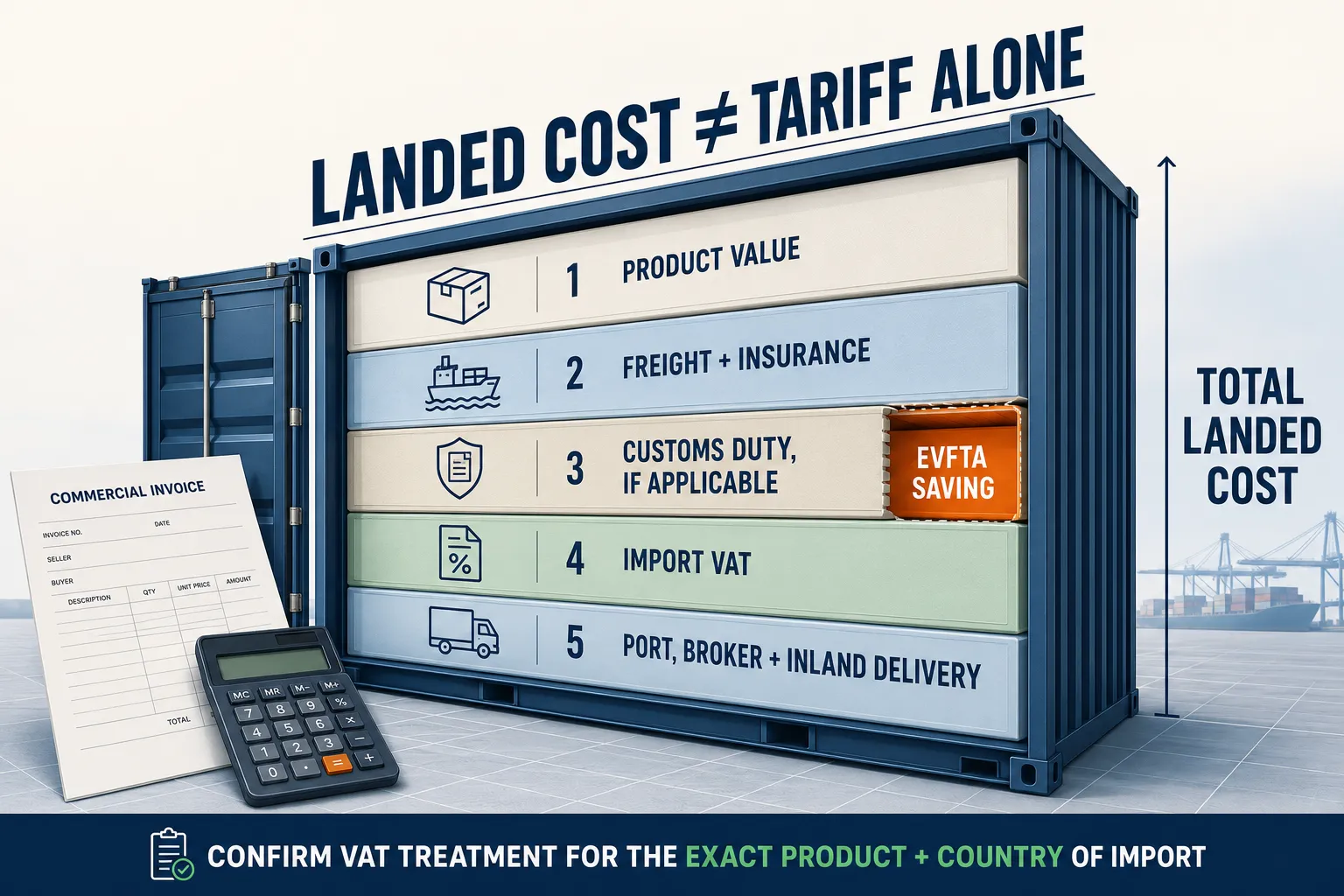
Tariff savings only tell part of the cost story. Every shipment still owes Value Added Tax in the EU member state where it clears customs. This is where many first orders get miscalculated.
Standard VAT Rates Across Key EU Import Markets
VAT is calculated on the customs value of the goods. That value includes the product cost, freight, and any duty owed. Germany applies 19 percent VAT, the Netherlands applies 21 percent, France applies 20 percent, and Belgium applies 21 percent. Rates vary across the other 23 EU member states, so always confirm the current rate for your destination country.
Worked Example, Calculating Landed Cost for One Container of Juice
Consider a container of fruit juice valued at 20,000 euro FOB, clearing in the Netherlands. Suppose the applicable EVFTA duty is zero for that HS subheading. You still owe 21 percent VAT on the customs value. That works out to roughly 4,200 euro in VAT, separate from freight and handling costs.
Shipping Routes and Ports, Rotterdam, Hamburg, and Beyond
Vietnam has well established shipping lanes to Northern Europe. A beverage exporter from Vietnam to Europe typically routes shipments through one of two major gateway ports.
Transit Time and Container Options from Ho Chi Minh City
Rotterdam in the Netherlands and Hamburg in Germany are the two largest entry points for Vietnamese beverage shipments. Ocean freight transit time from Ho Chi Minh City to either port typically runs 25 to 35 days. Interfresh can quote both 20 foot and 40 foot container options depending on your order volume.
Choosing a Port Based on Your Distribution Network
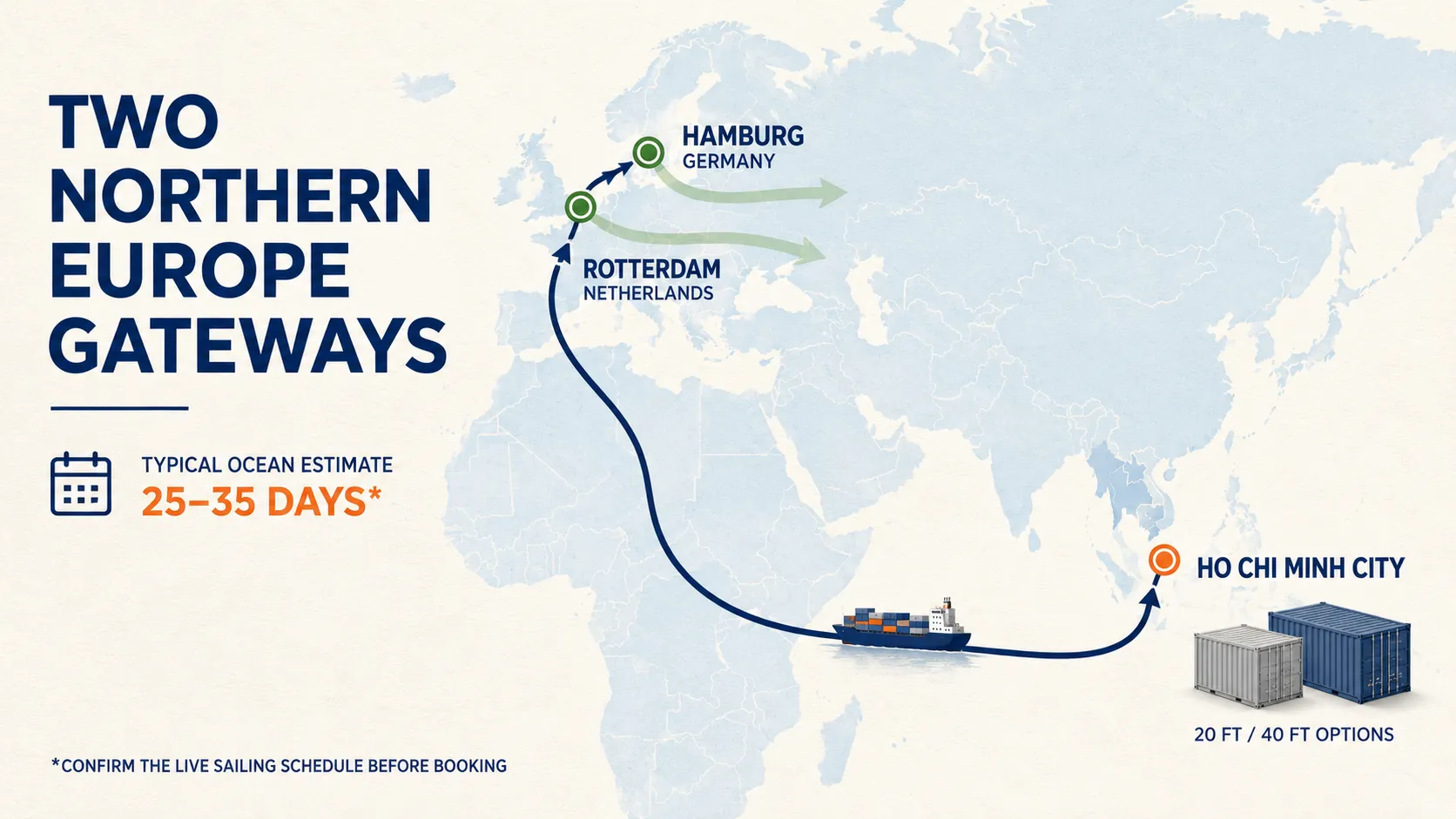
Once a shipment clears customs at one EU port, it can move freely to any other EU country. No further duty applies once that first clearance is complete. This means you can choose the port that best matches your own warehouse network.
Buyers in the United Kingdom should note one distinction. EVFTA does not apply there directly. The UK operates under a separate mirror agreement, the UK Vietnam Free Trade Agreement, with broadly similar zero tariff terms.
EU Certification and Labeling Requirements for Vietnamese Beverage Imports
Duty savings mean little if a shipment gets held at customs over missing paperwork. European buyers consistently rank certification and labeling among their top concerns when vetting a beverage exporter from Vietnam to Europe.
Food Safety Certifications EU Buyers Expect
ISO 22000 and HACCP certification are considered baseline requirements for any beverage supplier entering EU retail channels. Interfresh holds both, alongside FDA registration and GMP compliant production. Some buyers also require EU organic certification or BRC for a specific retail account. Confirm exact scope directly with the export team in those cases.
EU Labeling Rules, Allergens, Nutrition Declaration, and Packaging Standards
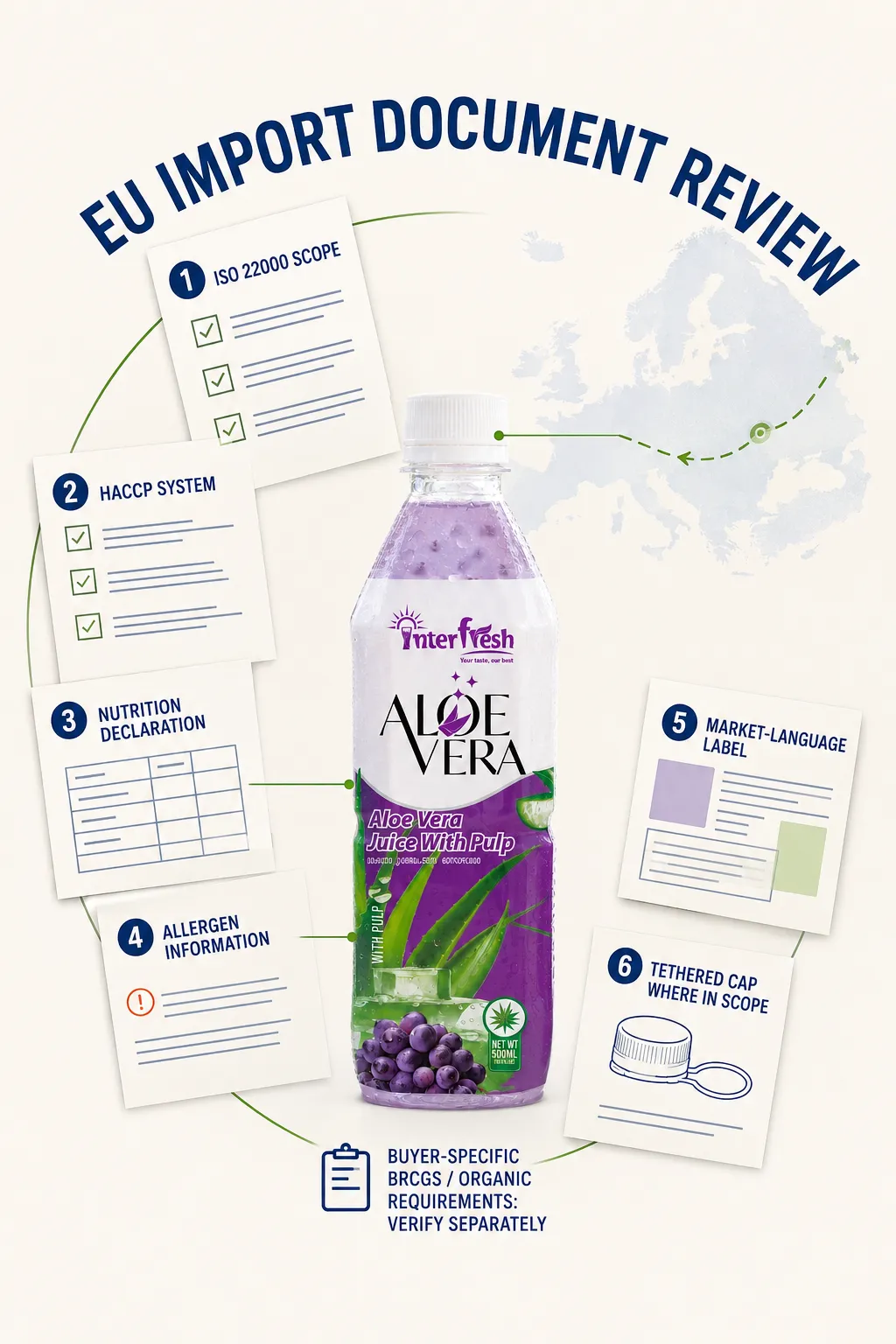
EU labeling law requires a full nutrition declaration and clear allergen statements on every product. Packaging must also meet current EU sustainability rules, including caps that stay attached to bottles. Our guide on new EU packaging standards covers this specific requirement in more depth.
Step by Step Process to Start Importing Beverages from Vietnam to the EU
The path from first inquiry to a cleared container follows a predictable sequence. Understanding each step in advance keeps a new relationship with a beverage exporter from Vietnam to Europe on schedule.
Steps Before Production
First, confirm your target HS code and request a sample under that classification. Second, review the supplier’s certifications, including ISO 22000 and HACCP. Third, agree on label artwork that meets EU nutrition and allergen rules. Our MOQ guide for beverage OEM Vietnam explains how order volume affects pricing at this stage.
Steps After Production
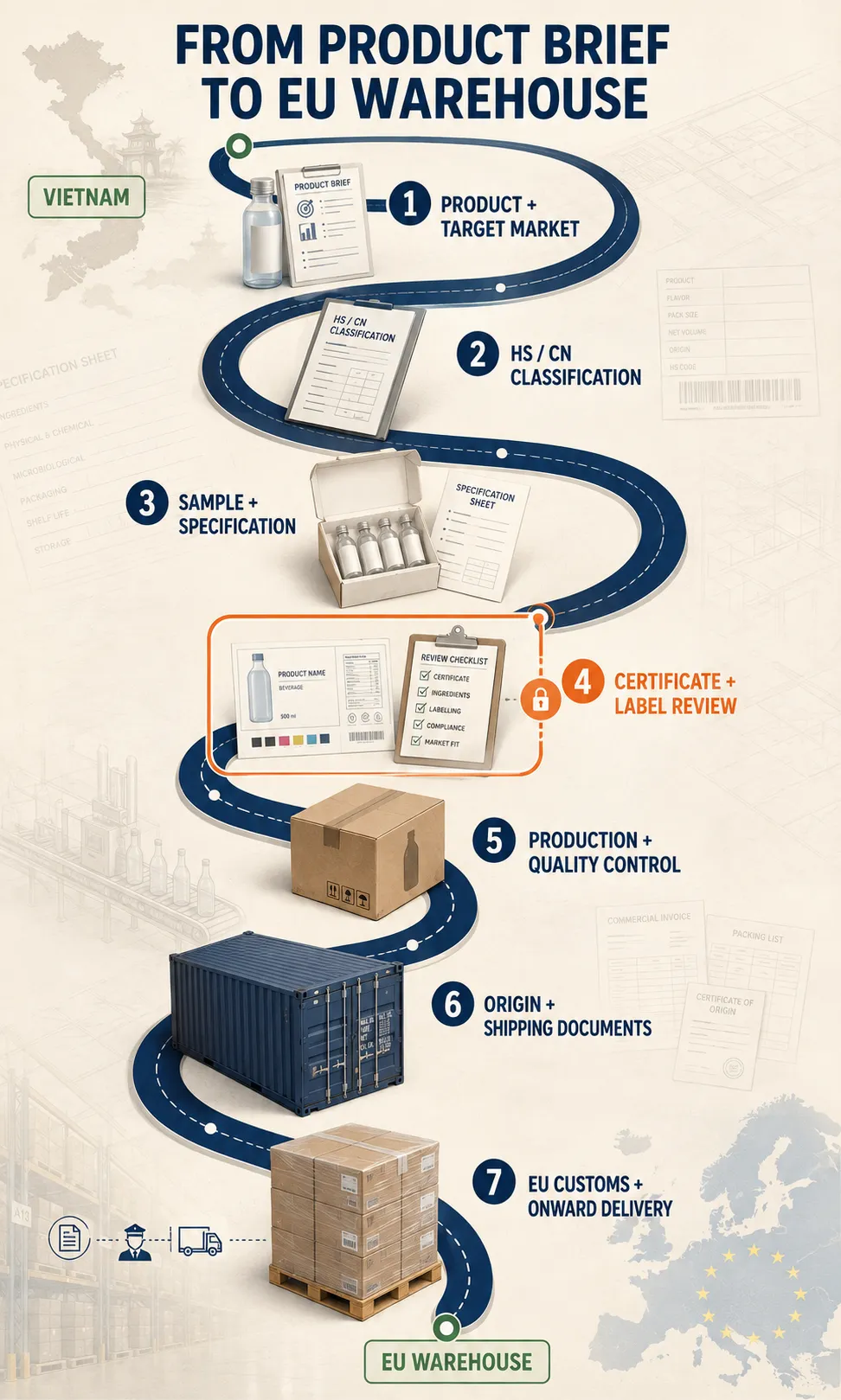
Once production is confirmed, your supplier prepares the commercial invoice, packing list, and EUR.1 Certificate of Origin. The shipment then moves by ocean freight to Rotterdam or Hamburg. Your customs broker files entry, pays any applicable VAT, and releases the goods to your warehouse.
Beverage Categories in Highest Demand Among EU Buyers
Not every product category performs the same way across European retail channels. Matching category to market helps a distributor prioritize which SKUs to launch first.
Fruit Juice and Clean Label Drinks for Western Europe
Western European buyers increasingly favor clean label formulations with no artificial additives. Our clean label beverage manufacturer guide for Vietnam and Australia covers this positioning in detail. Fruit juice remains the strongest single category for tropical flavor demand.
Coconut Water and Functional Drinks for Northern Europe
Northern European markets show strong growth in functional and hydration focused drinks. Coconut water and RTD tea both fit this trend well. Our tea and kombucha range is gaining traction with buyers looking for lower sugar alternatives.
Choosing a Reliable Beverage Exporter for the EU Market
Price and tariff savings matter less if the supplier cannot actually deliver compliant, on time shipments. A short verification process protects your first order.
Verification Points Before You Sign
Ask directly whether the supplier has prior EU export experience and can produce sample EUR.1 documentation. Confirm certification validity dates rather than trusting a logo on a brochure. Our private label beverage manufacturers guide outlines a fuller vetting checklist for private label buyers.
Red Flags That Signal Compliance Risk
Be cautious of any supplier unwilling to share their ISO 22000 or HACCP certificate directly. Our comparison of ISO 22000, HACCP, and BRC certifications explains what each one actually verifies. A supplier who cannot explain their own EUR.1 process is not ready for EU export.
Why EU Importers and Distributors Work with Interfresh
Interfresh has supported OEM and private label partners across multiple export markets. For a distributor comparing options, direct experience with EU documentation makes a measurable difference.
Certifications and Documentation Ready for EU Entry
Interfresh maintains ISO 22000, HACCP, FDA, GMP, and Halal certification across its production lines. Our export team prepares EUR.1 documentation, commercial invoices, and full shipping paperwork for every EU bound order. You can review our full OEM and private label beverage manufacturer guide for the complete production process.
Sample Turnaround and MOQ for a First EU Coder
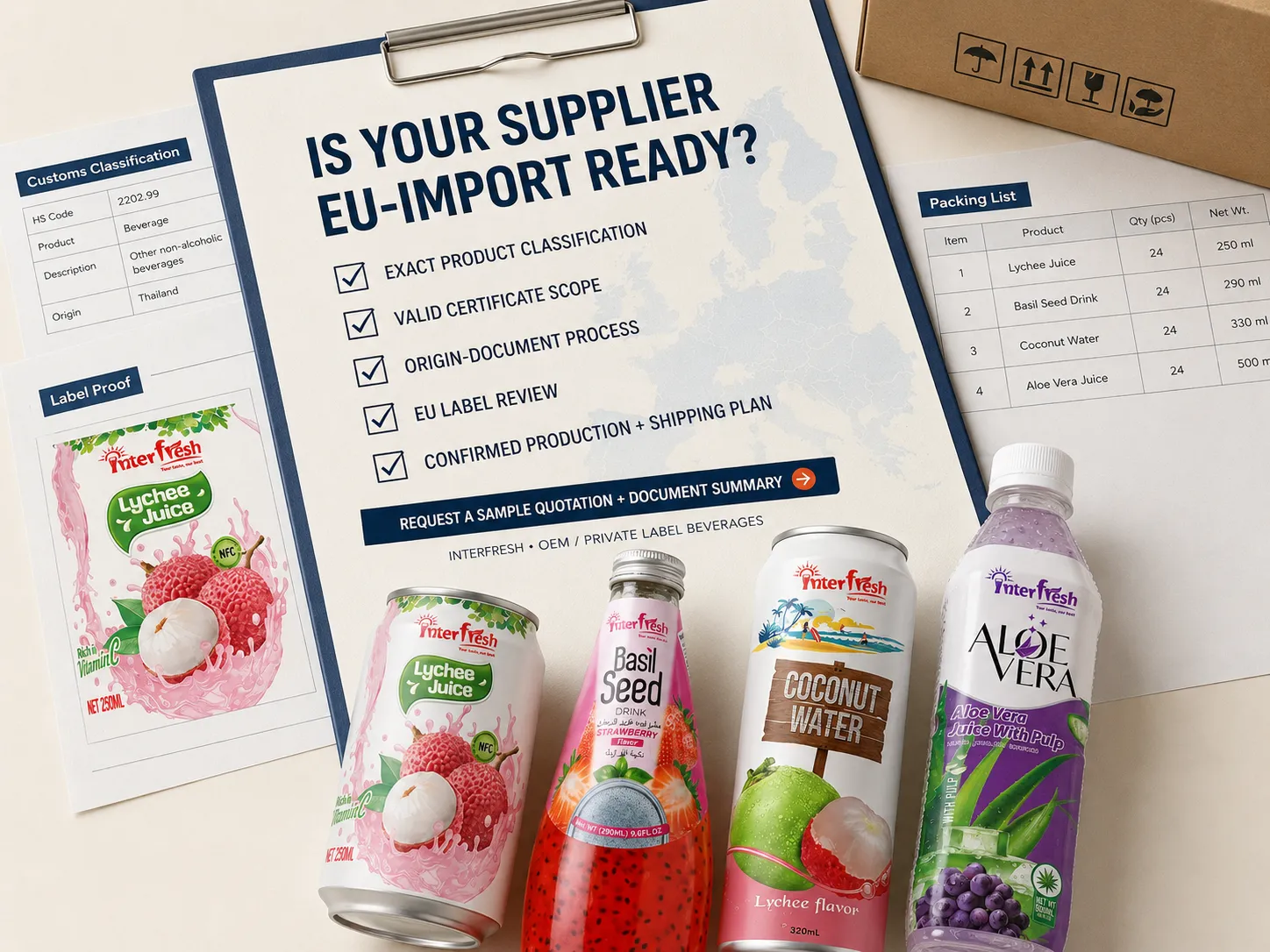
Standard minimum order quantity runs around 400 trays per flavor across most beverage categories. Samples typically ship within 5 to 7 business days of a confirmed product brief. Our cost to manufacture beverages in Vietnam guide breaks down how volume affects your landed price.
If you are also comparing sourcing origins, two guides may help. Our Vietnam versus China OEM beverage comparison covers that decision directly. Our seven step guide to starting a beverage brand covers the earlier planning stage many EU buyers pass through first.
US based teams evaluating a parallel market can also read our guide to importing beverages from Vietnam to the USA. Buyers tracking category trends may also find our healthy drink trends report useful for planning next year’s range. For technical production capability, see our OEM manufacturing service page.
Ready to move forward as a beverage exporter from Vietnam to Europe? Contact our export team for a sample quotation, EUR.1 documentation summary, and full landed cost estimate for your destination port.
FAQs: Beverage Exporter from Vietnam to Europe
Is the EVFTA zero tariff automatic, or do I need to apply for it? It is not automatic. Your supplier must provide a EUR.1 Certificate of Origin or a valid invoice declaration for the preferential rate to apply.
What happens if my supplier cannot provide a EUR.1 certificate? Your shipment will clear at the standard MFN duty rate instead of the EVFTA rate. Always confirm this document before placing a production order.
Which port should I use if I distribute across multiple EU countries? Rotterdam and Hamburg both offer strong onward distribution networks. Once cleared at either port, goods move freely across the EU without further duty.
Does EVFTA cover alcoholic beverages the same way as juice or coconut water? No. Alcoholic beverages follow a separate and generally longer tariff phase out schedule than non alcoholic drinks.
Is there a minimum order required to qualify for EVFTA tariff rates? No. The preferential rate applies based on origin documentation, not order size. Shipments under 6,000 euro simply use a simpler self certification process.
Do I need a customs broker in the EU to clear my shipment? Most distributors use a licensed customs broker to file entry and calculate VAT correctly. Interfresh can recommend partners experienced with beverage imports.
References
- European Commission, Access2Markets. EU Vietnam Free Trade Agreement Tariff Database. Retrieved from trade.ec.europa.eu.
- European Commission. EU Vietnam Free Trade Agreement, Full Text and Rules of Origin Annexes. Retrieved from ec.europa.eu.
- USDA Foreign Agricultural Service, GAIN Report. European Union Vietnam Free Trade Agreement Ratified. Hanoi, Vietnam.
- WTO Center Vietnam, VCCI. EVFTA to Benefit European Beverage Exporters. Retrieved from wtocenter.vn.
Continue Reading on Vietnam Beverage Export and OEM Sourcing
For related guidance on sourcing, cost, and compliance across other markets, these pages cover each stage in depth.
- OEM and Private Label Beverage Manufacturer Guide for Vietnam
- Private Label Beverage Manufacturers Guide
- MOQ Guide for Beverage OEM Vietnam
- Cost to Manufacture Beverages in Vietnam
- Vietnam vs China OEM Beverage Comparison
- How to Start a Beverage Brand, 7 Steps
- How to Import Beverages from Vietnam to the USA
- FDA Requirements for Importing Beverages from Vietnam
- ISO 22000 vs HACCP vs BRC Certifications
- Clean Label Beverage Manufacturer for Vietnam and Australia
- Top Healthy Drink Trends in the US Market
- New EU Packaging Standards
- Coconut Water OEM Manufacturer
- Aloe Vera Drinks
- Fruit Juice Drinks
- Tea and Kombucha
- OEM, Original Equipment Manufacturer Services
- Contact Interfresh for a Quote and Free Sample