
OEM vs ODM beverage manufacturing sounds like a small terminology question. It is not. The model you choose decides who owns your formula, how fast you launch, and what your first invoice actually includes.
This guide breaks the decision down using real production terms, not abstract definitions. For the full production model behind both approaches, see our OEM and private label beverage manufacturer guide for Vietnam. For a broader look at private label models overall, see our Private Label Beverage Manufacturers Playbook.
Key Takeaways
- OEM means the manufacturer builds your product to your own formula and specification.
- ODM means the manufacturer already owns a formula, which you then rebrand.
- OEM vs ODM beverage manufacturing also splits on IP ownership, pricing structure and speed to market.
- Recipe protection follows trade secret law, not patent law, in almost every case.
- Most growing beverage brands eventually use both models across different SKUs.
What OEM Means in Beverage Manufacturing
OEM stands for Original Equipment Manufacturer. In beverage production, this means the factory builds your drink to your own recipe and specification. The formula direction comes from you, not the factory.
This is the model buyers choose when a unique taste profile or functional claim is central to the brand. An OEM beverage manufacturer executes your vision. It does not set the direction. Our OEM manufacturing service page outlines exactly what this collaboration covers day to day.
What the Buyer Provides
A buyer entering an OEM beverage manufacturing agreement supplies a clear brief. This includes target taste, sugar or functional claims, packaging format, and label direction. The more specific this brief, the faster development moves.
Market research and positioning also stay with the buyer. The factory can advise on feasibility, but demand validation is not part of an OEM scope.
What the OEM Factory Handles
The factory turns that brief into a working formula through R&D and sampling. Interfresh typically returns first samples within 5 to 7 business days once a brief is confirmed. Production and quality control follow under the same ISO 22000, HACCP and BRC standards required across export markets.
What ODM Means in Beverage Manufacturing
ODM stands for Original Design Manufacturer. Here, the factory already owns a finished formula. You select from that catalog and apply your own branding on top of it.
ODM beverage manufacturing trades formula uniqueness for speed. A buyer can move from selection to purchase order in days, not weeks, since development work is already done. Our ODM manufacturing service page lists the formula catalog available today.
What the Buyer Provides
An ODM buyer mainly provides brand direction. This covers label design, packaging color, and market positioning around an existing formula. Minor tweaks, such as sweetness level or a flavor blend ratio, are often available.
What the ODM Factory Handles
The factory owns the formula, the shelf life data, and most of the technical development risk. This is why ODM orders typically move faster through sampling and into production than a full custom OEM build.
OEM vs ODM vs Contract Manufacturing: The Real Three Way Split
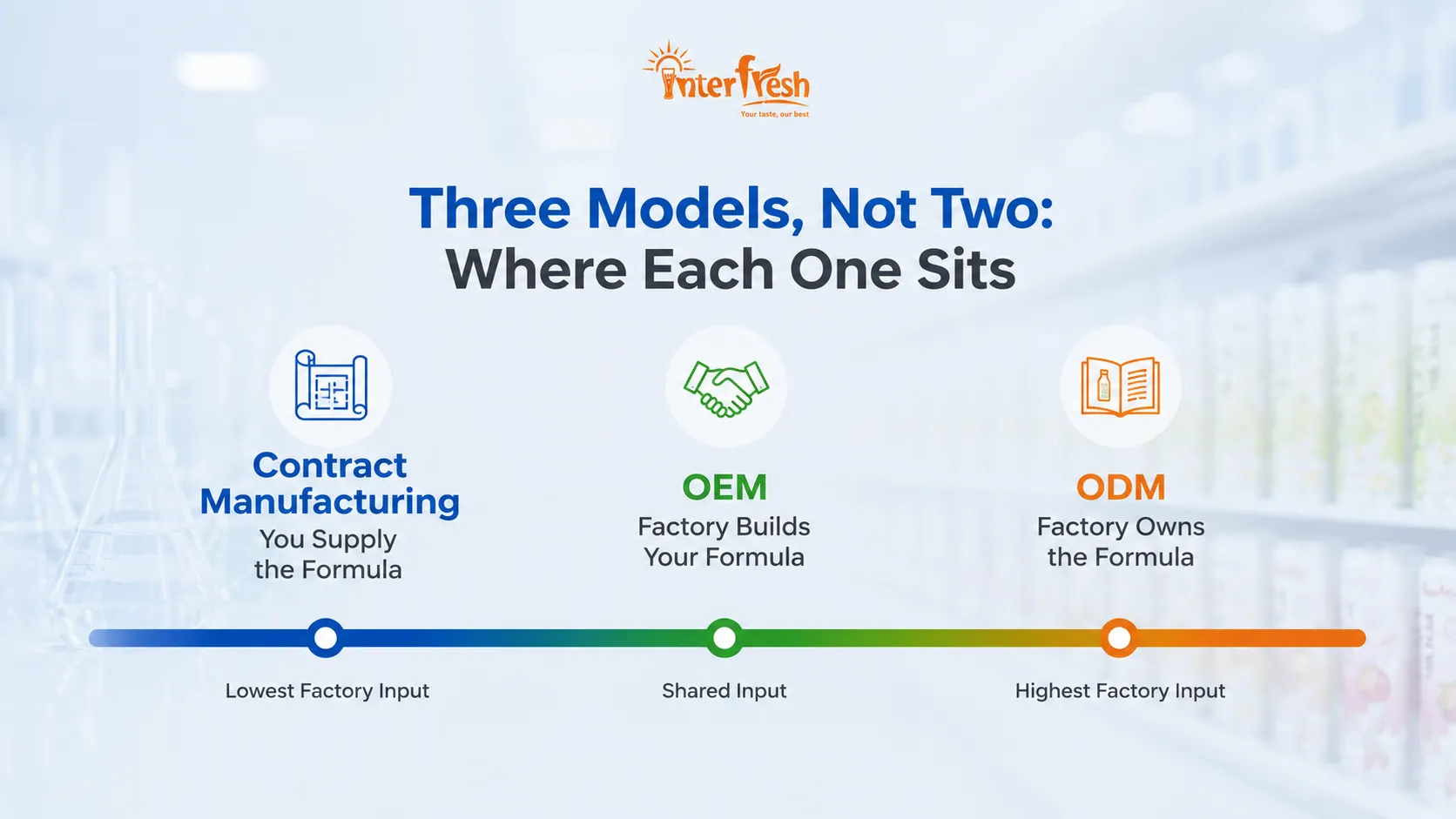
Most comparisons stop at two models. A third term, contract manufacturing, gets used loosely and causes real confusion for first time buyers.
Contract manufacturing means the factory produces strictly to your specification, with no design input at all. You supply the complete formula, and the factory supplies labor, equipment and utilities only. This differs from OEM, where the factory may still guide feasibility and packaging decisions.
Where Contract Manufacturing Fits
In practice, most Vietnamese beverage factories operate closer to the OEM model than pure contract manufacturing. Interfresh’s R&D team actively shapes formula direction during development, not just execution. Our 7 step guide to starting a beverage brand shows how this collaboration works from first consultation onward.
Key Differences at a Glance
The table below compares OEM and ODM specifically. For a fuller comparison including white label and private label, see our Playbook Part 1 guide.
| Factor | OEM | ODM |
|---|---|---|
| Who designs the formula | The buyer, with factory support | The factory |
| IP ownership | Buyer retains formula rights | Factory typically retains rights |
| Customization level | Full, built from your brief | Limited to existing formula base |
| Speed to market | Slower, requires development time | Faster, formula already exists |
| Typical pricing model | Full package, sometimes toll fee | Full package, formula fee included |
| Best fit | Unique, defensible product concept | Fast entry, proven formula base |
OEM vs ODM beverage manufacturing decisions rarely come down to one factor alone. IP ownership and pricing model deserve their own explanation, covered next.
Pricing Models Explained: Toll Fee vs Full Package
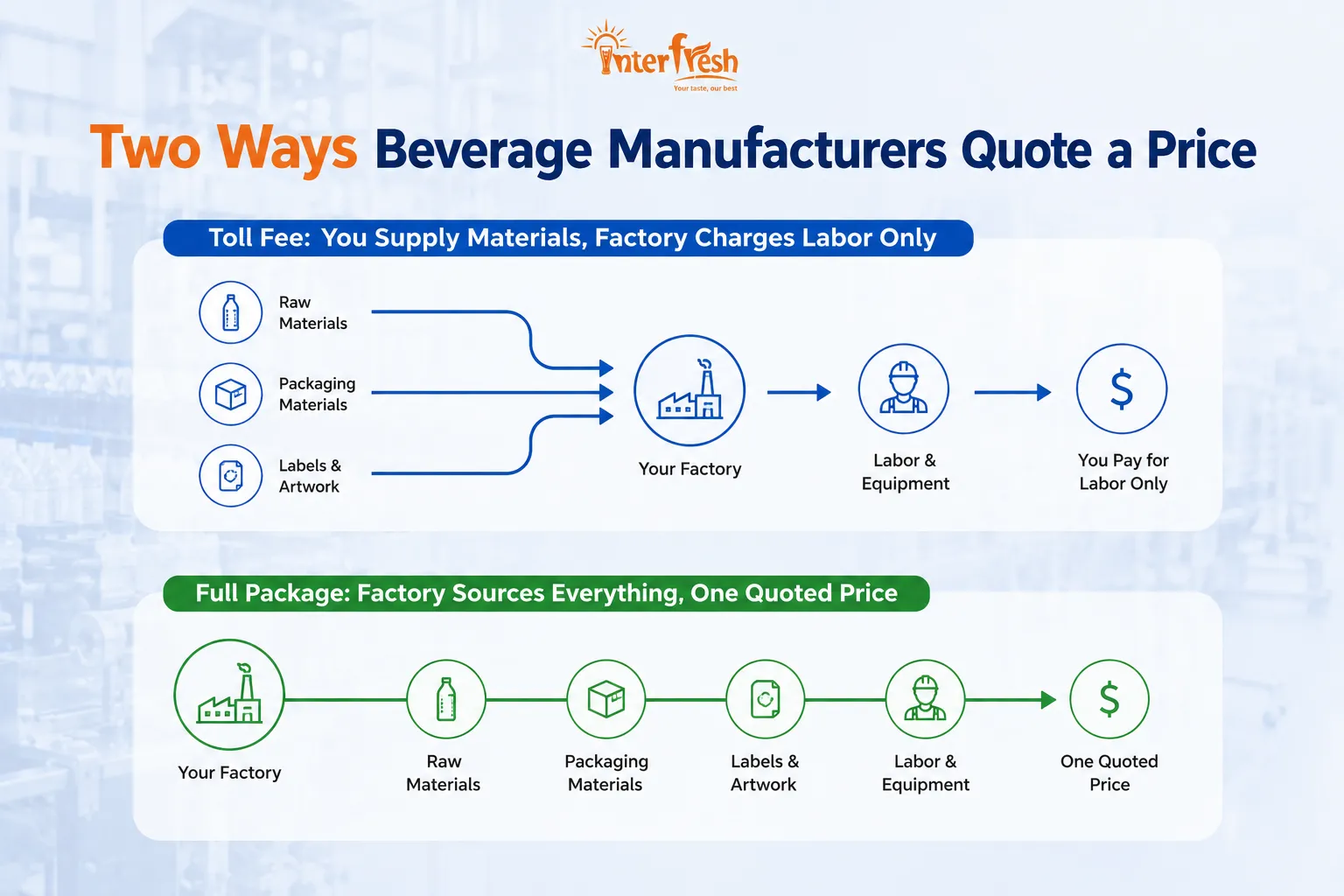
Most comparisons skip this entirely, yet it changes your actual cost structure. Beverage manufacturers generally quote one of two pricing models.
Toll Fee Model
Under a toll fee model, the buyer sources and supplies raw materials, cans and labels directly. The factory charges a fee purely for labor, equipment and utilities. This gives the buyer more control over ingredient cost, but adds real supply chain coordination work.
Full Package Model
Under a full package model, the factory sources everything. One quoted price covers ingredients, packaging, labor and production. Most OEM vs ODM beverage manufacturing buyers outside Vietnam prefer this model, since it removes sourcing complexity entirely.
When comparing quotes across factories, confirm which model is being quoted. Our cost to manufacture beverages in Vietnam guide breaks down what a full package quote typically includes by category.
Recipe IP and Formula Ownership: Why Food Differs From Electronics
Most OEM versus ODM comparisons come from electronics or hardware industries. Beverage formula protection works under a different legal framework entirely.
A beverage recipe almost never qualifies for patent protection. Patents require a novel, non obvious invention, and most drink formulas fail that bar. Coca Cola’s formula remains one of the most famous examples of trade secret protection instead of a patent (Chenoweth Law, 2025). The company chose secrecy over public disclosure, a decision most beverage brands still make today.
Trade Secret Protection for Beverage Formulas
Trade secret protection lasts indefinitely, as long as secrecy is maintained. Unlike a patent, it never expires after a fixed term. In the US, this protection runs through the Defend Trade Secrets Act, codified at 18 U.S.C. Section 1836 (Daeryun Law, 2026).
This matters directly for OEM vs ODM beverage manufacturing decisions. Under OEM, your formula stays your trade secret, protected by contract and confidentiality terms. Under ODM, the factory’s formula is their trade secret, not yours.
What to Put in Writing Before Production
Regardless of model, a signed non disclosure agreement should precede any formula sharing. Buyers should also confirm who owns any formula adjustments made during development. This single contract clause prevents most disputes that surface later.
Decision Framework: Choose OEM If, Choose ODM If
Use this framework to match your business stage to the right model. Do not default to whichever a factory pitches first. Our Vietnam versus China OEM beverage comparison shows how origin choice interacts with this same decision.
Choose OEM If
You have a specific functional claim, unique flavor combination, or clean label positioning central to your brand story. Our clean label beverage manufacturer guide covers exactly this kind of formulation work. Choose OEM when differentiation, not speed, drives your launch timeline.
Choose ODM If
Speed to shelf matters more than formula uniqueness for your first order. A proven base formula with strong branding can validate a market fast. Review our MOQ guide for beverage OEM Vietnam to confirm realistic volume expectations either way.
The Hybrid Model: When Beverage Brands Mix Both
A growing number of Southeast Asian factories now offer flexible arrangements. These blend OEM level customization with ODM level speed on select formulas. Buyers are no longer forced into one fixed model per order.
A distributor might launch with an ODM formula to test a new market quickly. Once demand is confirmed, the same brand can shift that SKU to full OEM development for a defensible, differentiated version. This staged approach reduces upfront risk while preserving room to build IP later.
Buyers targeting the Middle East often use this staged path. Our Halal beverage OEM manufacturer guide explains how certification timing fits into this hybrid approach.
FAQs: OEM vs ODM Beverage Manufacturing
What is the main difference between OEM and ODM in beverage manufacturing? OEM builds a drink to your own formula and specification. ODM offers an existing formula that you rebrand under your own label.
Which model protects my formula better, OEM or ODM? OEM protects your formula as your own trade secret. Under ODM, the factory retains ownership of the base formula.
Is ODM common in the beverage industry? Yes. Private label and ODM style beverage manufacturing has grown fast. Rising demand for store brand and functional drinks worldwide drives this shift. Our Halal beverage supplier guide for the Middle East shows the same pattern for that region.
Does OEM cost more than ODM for beverages? Usually yes, due to formula development time. Confirm whether a quote uses a toll fee or full package pricing model before comparing cost directly.
Can I switch from ODM to OEM later for the same product? Yes. Many brands start with an ODM formula to test demand. They move to a custom OEM version once sales justify the investment.
Do I need a patent to protect my beverage formula? Rarely. Most beverage formulas are protected through trade secret law and confidentiality agreements, not patents.
References
- Chenoweth Law Group (2025). When to Seek a Patent or Preserve a Trade Secret. Link: https://www.chenowethlaw.com/blog/2024/12/when-to-seek-a-patent-or-preserve-a-trade-secret/
- Daeryun Law (2026). Recipe Trade Secrets: What Trade Secret Law Does That Copyright Cannot. Link: https://www.daeryunlaw.com/us/practices/detail/recipe-trade-secrets
- Daeryun Law (2026). Food and Beverage Patents: Patent vs Trade Secret. Link: https://www.daeryunlaw.com/us/practices/detail/food-and-beverage-patents
- The Food Law Firm (2025). Protecting Food Product Formulas. Link: https://www.foodlawfirm.com/what-we-do/protecting-food-product-formulas/
Keep Exploring the Interfresh Sourcing Library
These guides carry the OEM and ODM decision forward, covering cost, MOQ and market specific execution.
- Private Label Beverage Manufacturers Playbook, Part 1
- OEM and Private Label Beverage Manufacturer Guide for Vietnam
- MOQ Guide for Beverage OEM Vietnam
- Cost to Manufacture Beverages in Vietnam 2026
- How to Start a Beverage Brand: 7 Steps
- Vietnam vs China OEM Beverage Comparison
- ISO 22000 vs HACCP vs BRC Certifications
- Clean Label Beverage Manufacturer for Vietnam and Australia
- Halal Beverage OEM Manufacturer for the Middle East
- Halal Beverage Supplier for the Middle East
- OEM, Original Equipment Manufacturer Services
- ODM, Original Design Manufacturer Services